
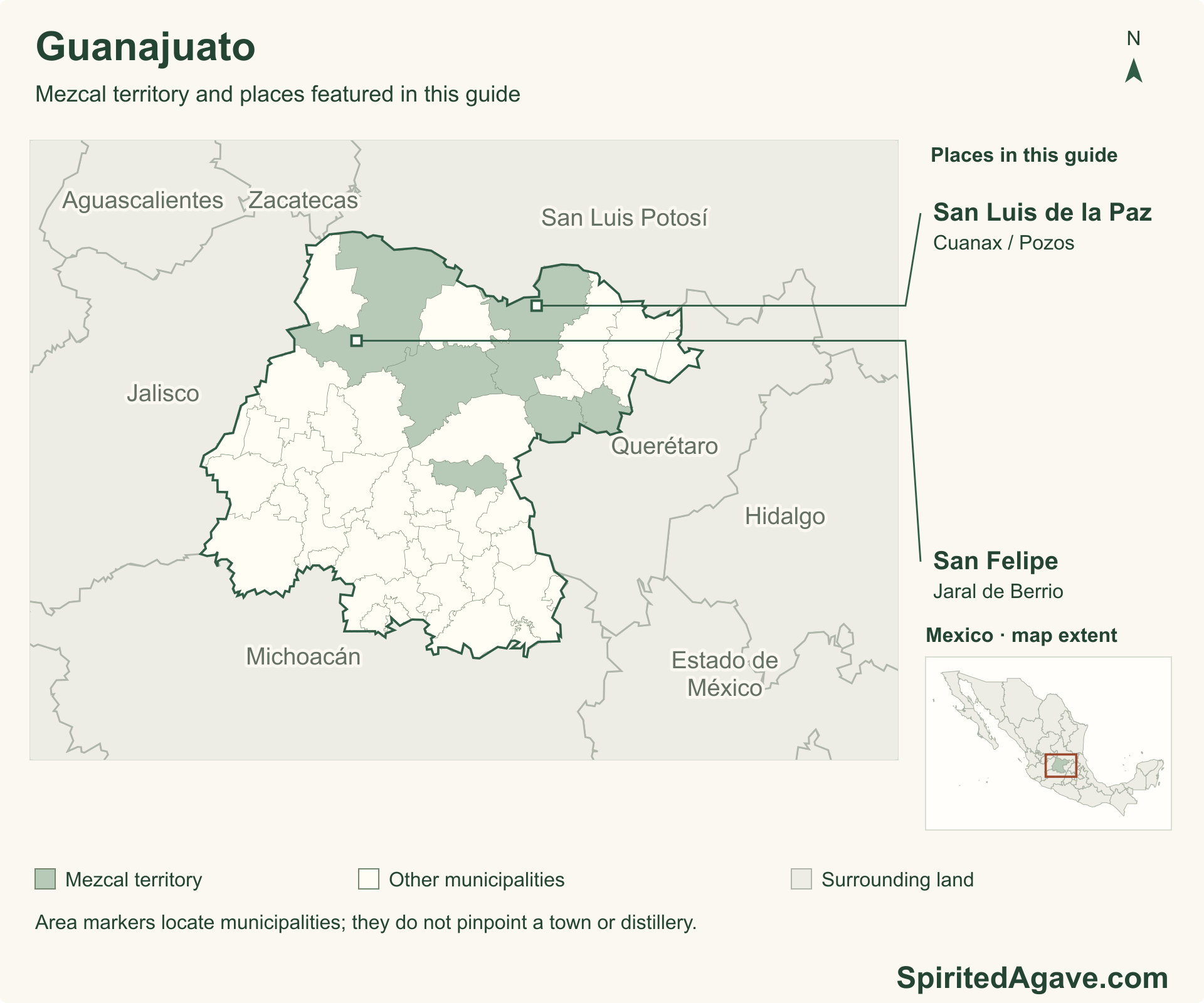
Northern Guanajuato has a long tradition of distilling salmiana at haciendas and outlying rural distilleries. Producers around San Felipe and Mineral de Pozos continue to work with the agave. Four more municipalities joined the protected Mezcal territory in May 2026.
The workers behind the hacienda industry
Northern Guanajuato’s haciendas belonged to a wider salmiana distilling region shared with the Potosí–Zacatecas plateau. Larger factories stood near the main estate compound; smaller ranchos de vino worked farther out on land with wild agaves and nearby water. Spirit from these outlying distilleries returned to the hacienda for recording, storage and sale. 6
Experienced workers called cortadores de vino monitored fermentation and judged when it was ready for distillation. Removable stills served outlying production sites.
San Felipe entered the denomination in 2001 and San Luis de la Paz in 2015, followed by four more municipalities in 2026. Mezcal production in the region predates those legal milestones.
Six municipalities now lie within the protected territory
Comonfort, Dolores Hidalgo, San José Iturbide and Tierra Blanca were added by a resolution published on 20 May 2026. They join San Felipe and San Luis de la Paz. The resolution extends the geographical area; it leaves the product and production requirements unchanged. 1
Guanajuato’s reported 2025 share is rounded to 0.00%
Guanajuato’s share of Mexico’s certified mezcal production reported by COMERCAM for 2025 rounds to 0.00%. A value rounded to two decimal places can include a small volume. The figures also precede the four municipality expansion in 2026. 7
Two salmiana producers: Jaral de Berrio and Cuanax
Steam ovens at Jaral de Berrio
Jaral de Berrio in San Felipe makes salmiana mezcal. The agave hearts are steamed in stone ovens, crushed with a stone tahona and distilled twice in copper. Its joven is fermented in open stainless steel containers and bottled at 40% ABV. 2
Steam cooking helps explain why mezcal can have little smoke. Jaral de Berrio describes its salmiana as unsmoked.
Cuanax’s salmiana range in Mineral de Pozos
Cuanax is based in Mineral de Pozos, within San Luis de la Paz. Its 2025 Cuanaxhuato salmiana range includes 42%, 46% and 50% ABV versions, with artesanal and ancestral variants. Production uses wooden fermentation vessels and two distillations, with several oven, milling and still options. 3
| Example | Place | Production |
|---|---|---|
| Jaral de Berrio joven | Jaral de Berrio, San Felipe | Steam cooking and copper pot distillation |
| Cuanaxhuato | Cuanax, Mineral de Pozos | Several strengths and production variants in the 2025 catalog |
The 2023 Cuanaxhuato artesanal blanco was bottled at 42% or 46% ABV after four months resting in glass. It used a mechanical mill, wooden fermentation vessels and a copper still. The broader 2025 range also includes clay still variants. 4
Cuanax’s Mineral de Pozos expression blends agaves it calls verde, cenizo and manso and is bottled at 46% ABV. 5
Questions about Guanajuato mezcal
Which Guanajuato municipalities can produce mezcal within the denomination?
The territory includes San Felipe, San Luis de la Paz, Comonfort, Dolores Hidalgo, San José Iturbide and Tierra Blanca following the May 2026 expansion. Producers must also meet the applicable product requirements.
Is Guanajuato mezcal always smoky?
No. Jaral de Berrio describes its steam cooked salmiana as unsmoked. Cooking methods vary among producers.
Follow salmiana across state borders
Explore San Luis Potosí’s salmiana mezcals, then compare it with the salmiana and Azul regions in Zacatecas.
Sources and notes
Maps adapted by Spirited Agave from INEGI’s Marco Geoestadístico, December 2025. Spirited Agave added the labels and geographic highlighting.
- IMPI’s May 2026 Guanajuato resolution
- Jaral de Berrio’s product and process descriptions
- Cuanax’s 2025 presentation, page 40
- Cuanaxhuato product page
- Cuanax’s 2025 presentation, page 41
- Juan Gallardo Valdez, Historia del mezcal guanajuatense (electronic edition 2020), pp. 49–65, historical factories, ranchos de vino and workers; regional connection in the prologue.
- COMERCAM 2026 report, page 4 Production figures are for 2025, normalized to 45% ABV; the report does not estimate uncertified state output.