
Tepeztate’s broad, twisting leaves spread outward in an open rosette, with wavy edges and stout teeth. Its botanical name is Agave marmorata. In Oaxaca, it supplies Tepeztate or Tepextate mezcal. Its native range also reaches southern Puebla, where people collect aguamiel—the sweet liquid tapped from a living agave—bake its stem and cook its flowers. 1 2 3 14
Tepeztate can take decades to reach harvest maturity. Around Miahuatlán, makers cut plants from rocky slopes and carry the piñas, or agave hearts, to the palenque—the mezcal distillery. There, they cook the hearts and make small batches of mezcal. In Puebla, the same species has a long history as pichomel or pitzomel, used for pulque—the drink made by fermenting aguamiel—food and living fences. 4 14
Tepeztate at a glance
- Plant
- A. marmorata Roezl. Tepeztate and tepextate are familiar Oaxaca names.
- Recognize it
- Broad, channeled leaves; wavy, toothed edges; a loose rosette with little visible stem.
- Leafy rosette
- Leafy rosettes about 1.5–2 m high and 1.5–2.5 m across.
- Native places
- Southern Puebla and Oaxaca.
- People’s uses
- Mezcal; aguamiel and pulque in Puebla; baked stem and leaf bases, flowers, fences and crafts.
Broad leaves, deep channels and wavy edges
An intact Tepeztate usually has no obvious trunk. Wide leaves spread in several directions, often twisting or folding near the tip. The blades are rough to the touch, with fleshy scallops beneath the dark teeth and a short, sturdy spine at the leaf’s tip. Some leaves carry pale, waxy cross-bands; others look more evenly gray-green. 2
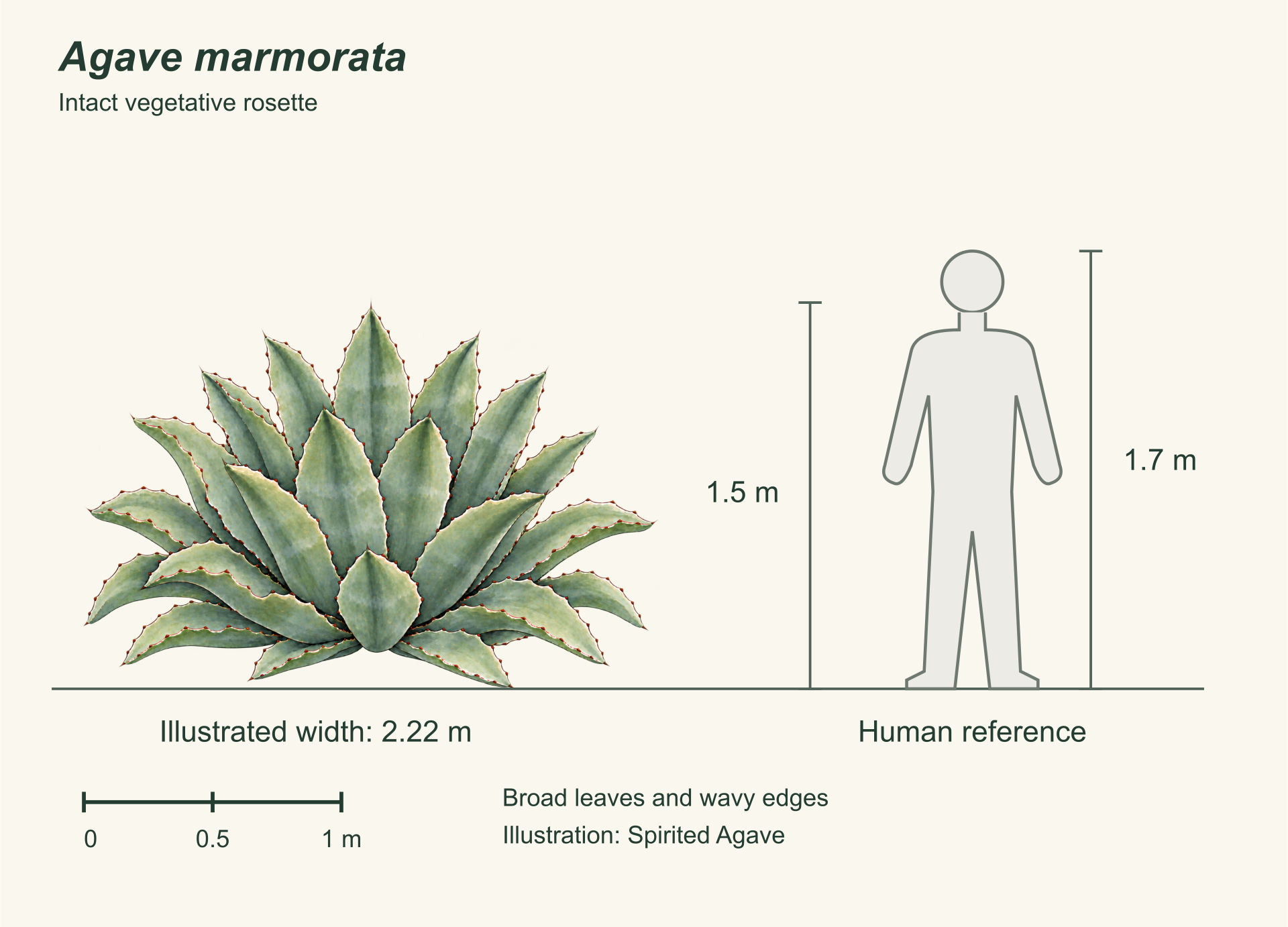
A. marmorata · leafy rosette
The illustrated plant is 1.5 m high and about 2.22 m across.
Person: 1.7 m. Bar: 1 m.
View the vegetative drawing larger
Scroll sideways in the enlarged panel, or open the full-size drawing.
Tepeztate’s leaves are commonly about 1–1.3 m long and 20–30 cm wide. Their breadth and waviness help distinguish the plant from espadín, whose leaves are much narrower and generally straighter. 2
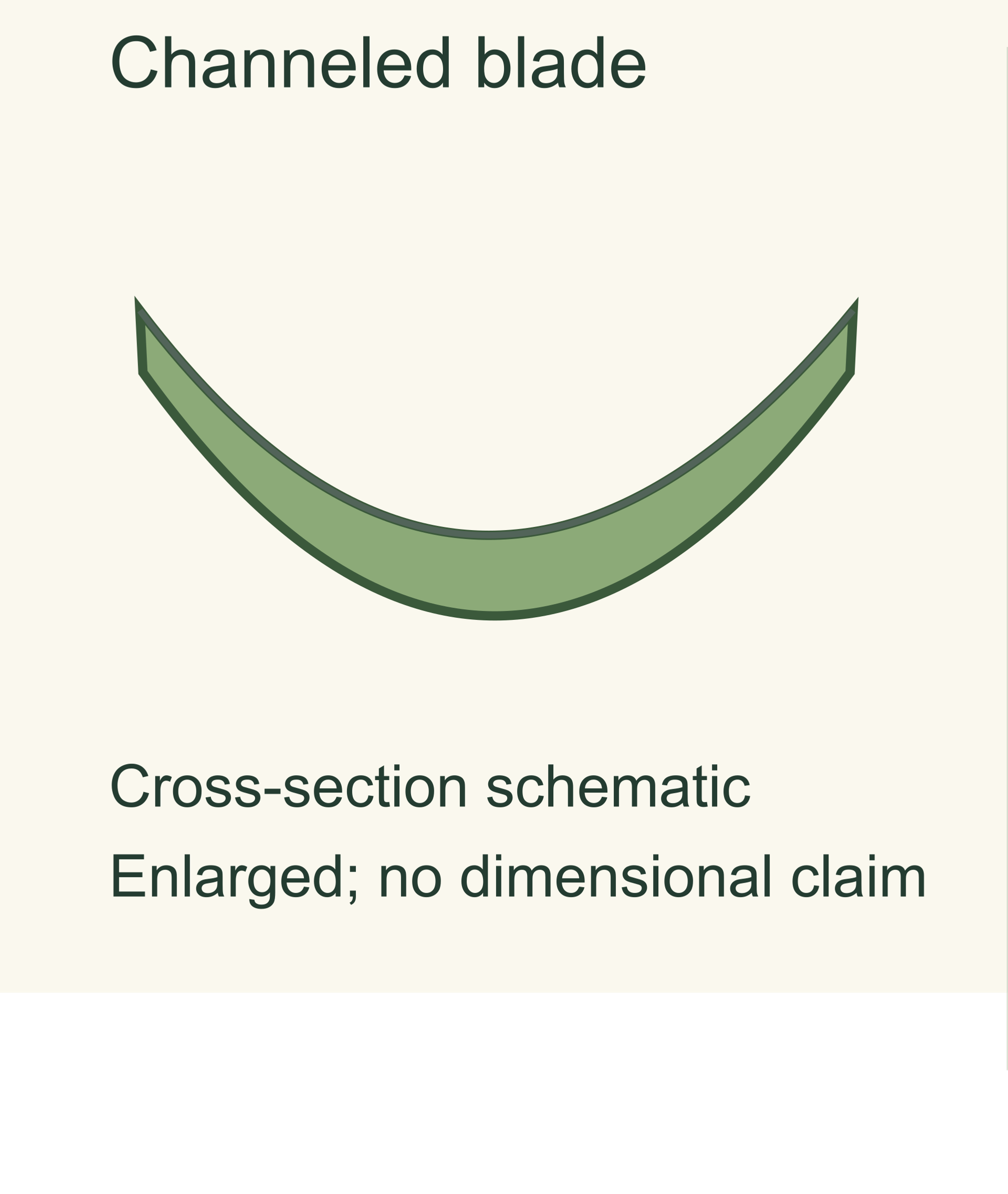
Channeled blade
An enlarged cross-section shows the trough along the leaf.
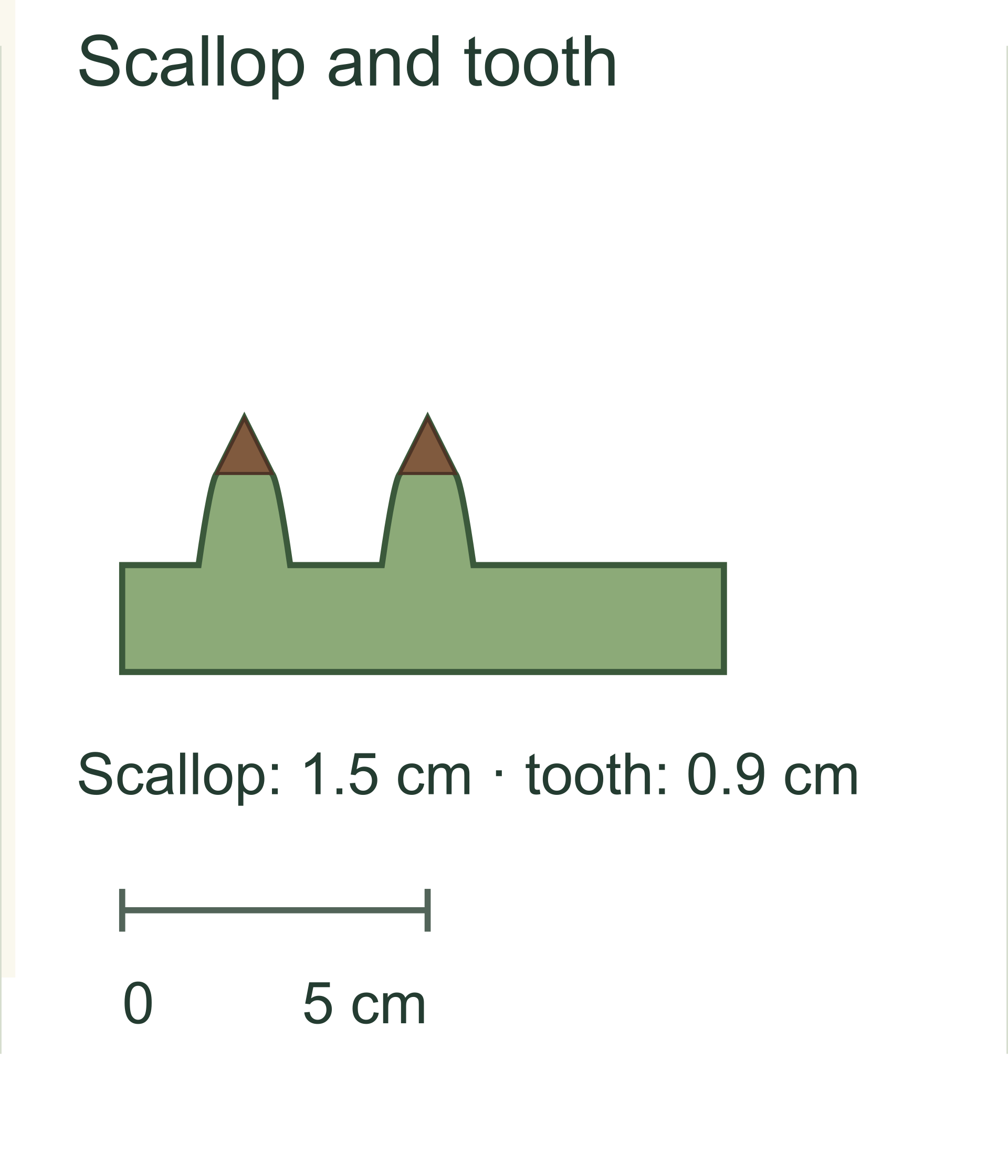
Scallop and tooth
Fleshy scallop: 1.5 cm high and wide. Tooth: 0.9 cm long and wide. Bar: 5 cm.
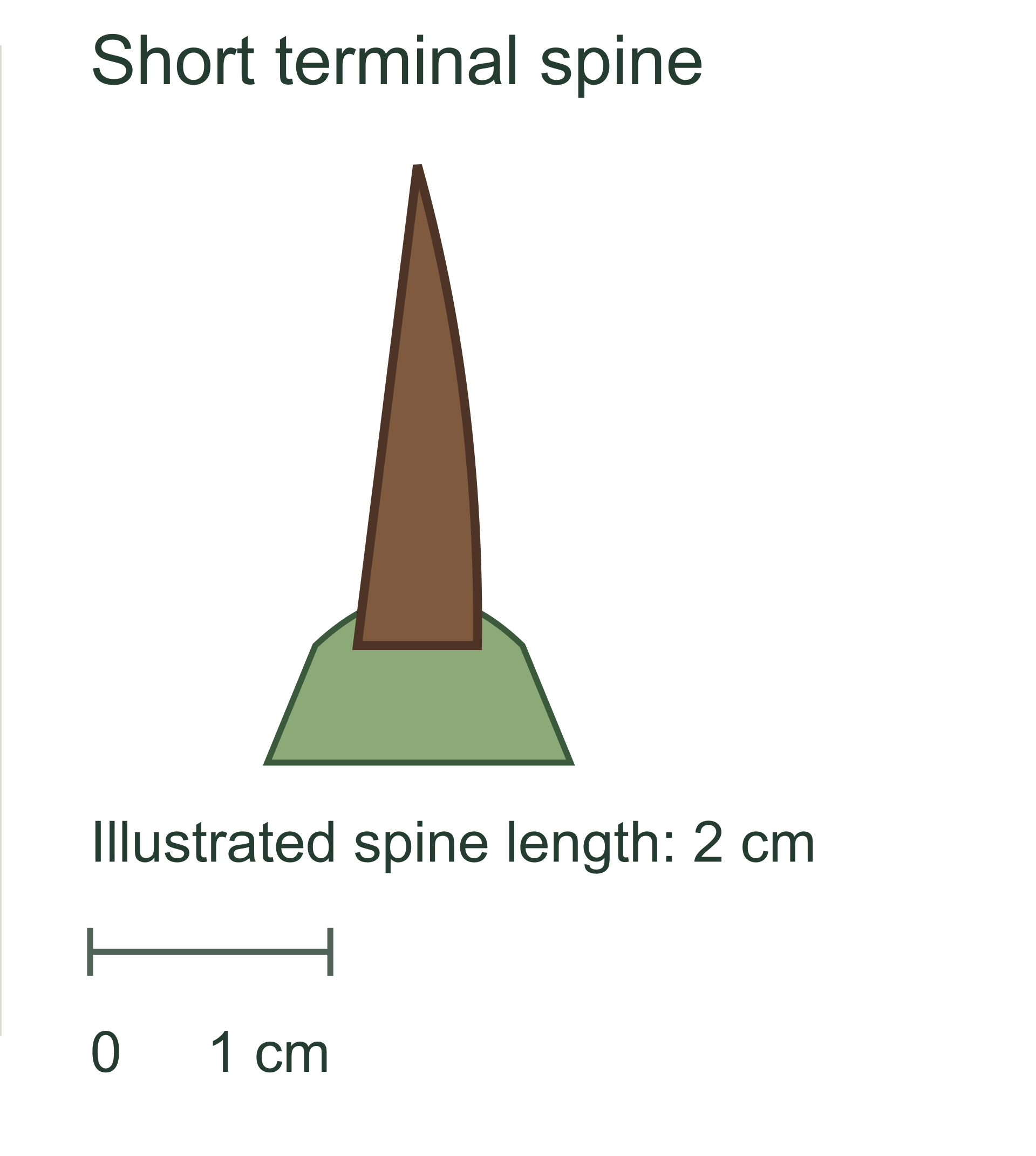
Short terminal spine
Illustrated spine: 2 cm. Bar: 1 cm.
Tepeztate and espadín have very different leaves
| Feature | Tepeztate — A. marmorata | Espadín — A. angustifolia |
|---|---|---|
| Leaf width in Oaxaca | 20–30 cm | 4–5 cm |
| Leaf shape | Broad, often twisting or undulating | Narrow, rigid |
| Edge | Fleshy scallops beneath stout teeth | Generally straighter, smaller teeth |
| Rosette | Open, irregular | More numerous leaves, often ascending |
A whole-rosette photograph plus close views of the margin and tip gives a better view of these features than one leaf alone.
Tepextate in Oaxaca, pichomel in Puebla
| Local names | Place and use |
|---|---|
| Tepeztate, tepextate | Oaxaca; familiar maguey and mezcal names |
| Pichomel, pichometl, pitzomel, pitzometl | Puebla; aguamiel, pulque, food and other uses. |
| Maguey curandero | Puebla |
Tepeztate and pichomel are regional names for A. marmorata. Around Miahuatlán, plants vary from broad, shorter-leaved forms to narrower-leaved forms. In the Mixteca of Oaxaca and Puebla, the species is also tapped for aguamiel. 3, 4
Tepeztate grows among rocks in dry forest, scrub and transitions into oak woodland. In Oaxaca it grows in Coixtlahuaca, Huajuapan, Miahuatlán, Tlacolula and Yautepec, on limestone and igneous ground. Harvesting on steep, rocky land means carrying heavy plants out of difficult terrain. 2 4
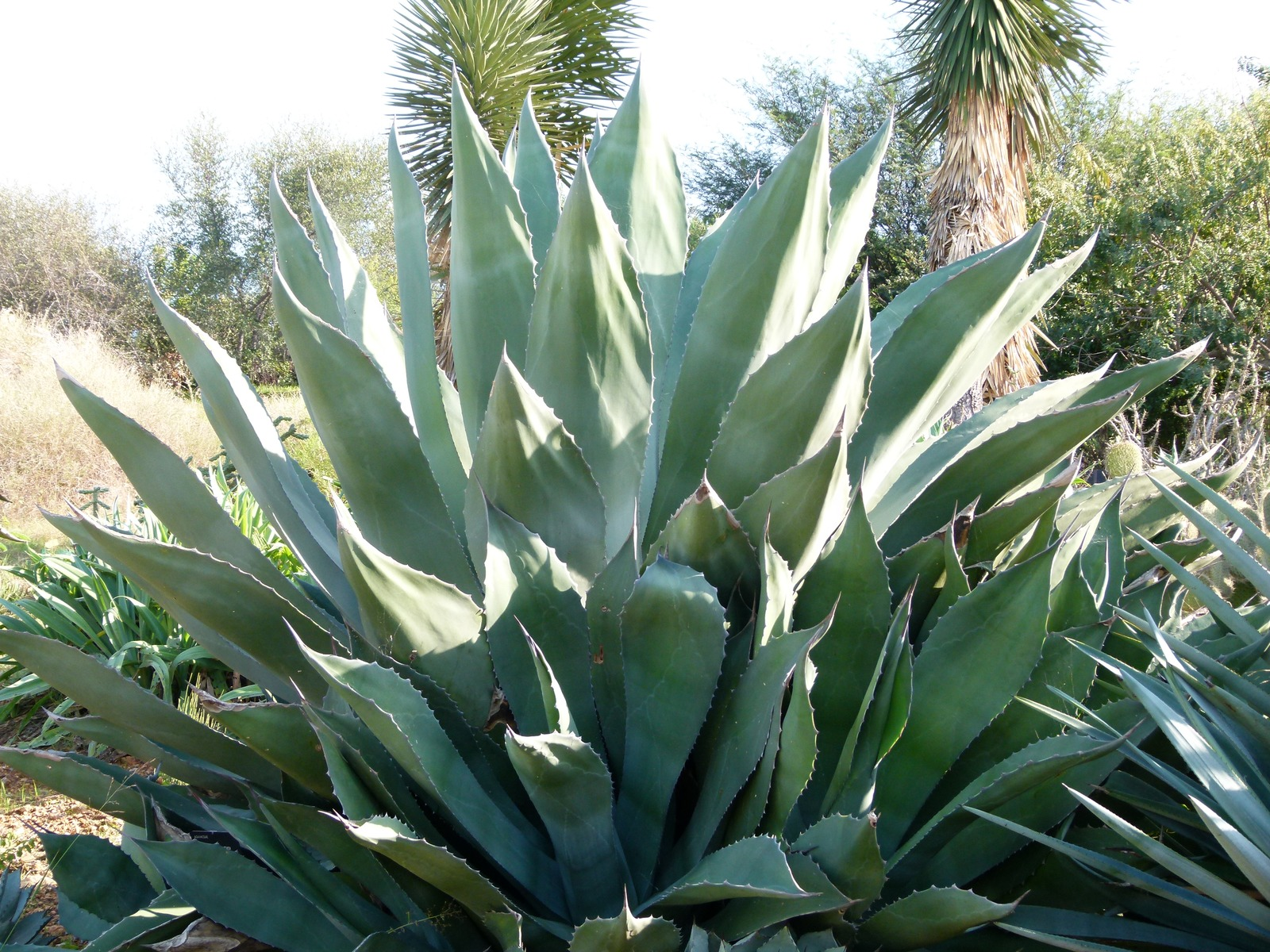
A. marmorata is also grown in Barcelona’s botanical garden, an overseas planting of this Mexican species. 5
Tepeztate can grow for decades before harvest
Mezcal harvest removes the piña before the agave completes its flowering cycle. Some makers leave plants capón: they cut the emerging flower stalk and let the agave stand longer before harvest. Tomás García Cruz used capón Tepextate for his May 2024 batch. 10, 17
Tepeztate can spend decades in the field before mezcal harvest. Around Miahuatlán, wild plants are commonly harvested at about 12–15 years; Del Maguey estimates 18–25 years for its Tepextate. These are approximate growing ages rather than a fixed harvest schedule. 4, 6
Growing conditions help explain the variation. Tepeztate grows across different soils, vegetation and management systems, and plants in Puebla’s managed and unmanaged populations showed different growth and survival. 4, 9
Flowering maturity can take longer than the wait for a mezcal harvest. Estimates reaching 35 years concern reproduction; they are not a requirement for harvesting every Tepeztate. 7, 8
A flower stalk rises far above the rosette
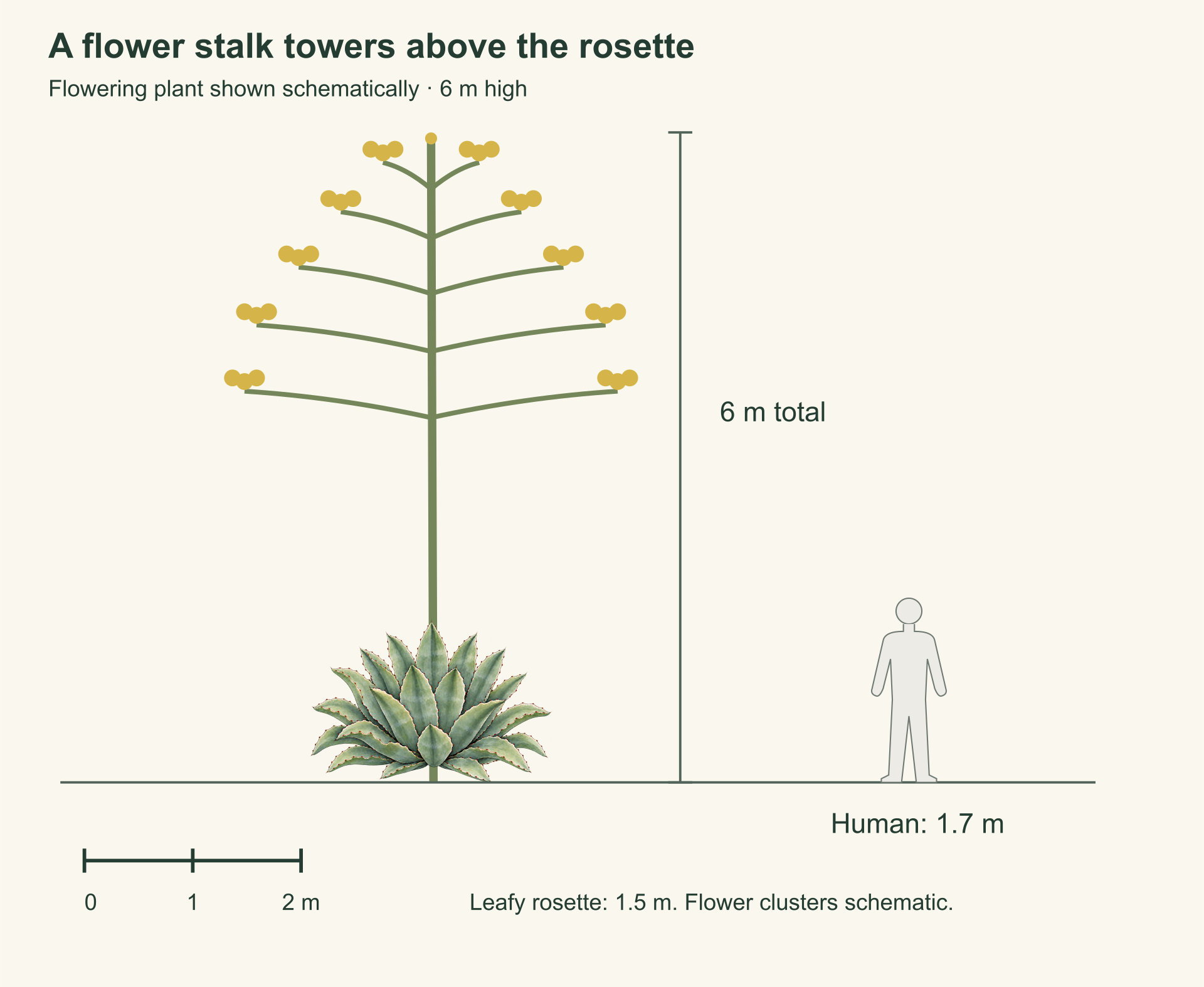
Each Tepeztate rosette flowers once and then dies. Its tall, branching stalk carries clusters of yellow flowers far above the leaves. Flowering dates vary by place and year. 2, 9
A. marmorata · flowering plant
The illustration is 6 m from ground to highest flower. The leafy rosette is 1.5 m high and about 2.22 m across.
Person: 1.7 m. Bar: 2 m.
View the flowering drawing larger
Scroll sideways in the enlarged panel, or open the full-size drawing.
Tomás García Cruz’s last wild Tepextate batch
In May 2024, Tomás García Cruz made batch TPXTGC2405 in Logoche, Miahuatlán, using 25 plants from the rocky, pale-soiled La Jamaica parcel near Santa Cruz. He chose it as his last wild Tepextate batch so that the remaining population could rest. 10
Tomás cooked the piñas for nine days in a conical earthen pit fired with mesquite and oak, then broke it up with a tractor-powered stone mill. Three 1,200-liter wooden vats each received 600 kg of cooked agave and 600 liters of well water. Fermentation began with 72 hours before water was added, followed by six further days. Double distillation in copper produced 100 liters at 45.5% ABV. 10
Wilfrido García Sánchez used a machete and shredder
Wilfrido García Sánchez’s April 2022 batch, TPXWGS2204, began with 84 wild plants from rocky Campo Grande land at Santa Cruz, Miahuatlán: 2,450 kg at harvest. After a week in an earthen pit, he used a machete and mechanical shredder to break up the cooked agave, fermented it for ten days and distilled twice in copper. The batch yielded 170 liters at 49.8% ABV. 11
Tomás’s 600 kg per vat is cooked agave; Wilfrido’s 2,450 kg is the harvest weight.
Tepeztate has no separate total in Mexico’s 2025 certified-mezcal production figures. 12
Floral, fruity and green notes in two Tepeztate mezcals
Del Maguey Tepextate
45% ABV · Santa María Albarradas, Oaxaca
Rogelio Martínez Cruz and Leopoldino Miranda crush the agave in a mill (molino) and distill in copper stills. Del Maguey’s tasting notes describe passion fruit, cinnamon and honeysuckle, a lighter body and a long dry finish. 6
Bozal Tepeztate
49% ABV · Santa Ana del Río, Oaxaca
Bozal’s tasting notes describe tropical fruit, berries and a flan-like sweetness, followed by papaya, green pepper and a mineral finish. The agave is pit-cooked, crushed with a horse-driven stone mill, fermented in open-air vessels and distilled twice in copper. 13
Pichomel for aguamiel, food and crafts in Puebla
In Puebla’s Tehuacán region, people tap A. marmorata for aguamiel, the sweet liquid fermented into pulque. They bake the stem and leaf bases for food and cook the flowers as seasonal cacayas. 3 14
In parts of Puebla, pulque was the main use until the middle of the twentieth century; mezcal gained prominence in its second half. In remote Oaxaca communities, rugged terrain and limited planting resources shaped which agaves people used for distillation. 14, 4
Dried flower stalks become rustic building materials and bird-nest crafts. Living plants mark boundaries and protect fields; flowering structures decorate churches during religious celebrations. Medicinal uses are also part of local knowledge in these communities. 14
Seedlings, offsets and the next generation
Tepeztate grows from seed and also produces offsets—shoots beside the parent. In Puebla, offsets have appeared on rosettes around 60 cm across. Around Miahuatlán, they are seen mainly on severely stressed plants. 9, 4
Leaving Tepeztate to flower provides nectar for wildlife and an opportunity to set seed. In Tehuacán, orioles can pick up pollen as they feed and are likely pollinators. Bats and moths also take nectar, with little or no contact with the flowers’ reproductive parts. 15
In Puebla, Sauane Katchu, formed in 2017, collects seed, raises young plants and grows agaves alongside other useful plants around Zapotitlán de las Salinas, San Juan Raya and San Luis Atolotitlán. 14
Cultivated Tepeztate plants had less genetic diversity than wild plants in samples collected across Puebla and Oaxaca in 2021–2022. 8
Tepeztate was classified as Least Concern globally in its 2019 IUCN assessment, although its population was decreasing and northern populations faced greater harvesting pressure. 16
Questions about Tepeztate
Are tepeztate and tepextate the same agave?
Yes. Tepeztate and tepextate are both Oaxaca mezcal names for Agave marmorata. 3 4
Does Tepeztate always take 35 years to mature?
No. Tepeztate harvest ages vary with the growing site and maker. Around Miahuatlán, wild harvests are commonly about 12–15 years; Del Maguey estimates 18–25 years. The estimates reaching 35 years concern flowering maturity, rather than a fixed age for making mezcal. 4, 6, 7, 8
Can Tepeztate make pulque?
Yes. People tap living Tepeztate (Agave marmorata) for aguamiel and ferment it into pulque in Puebla. Mezcal begins with the harvested, cooked piña, or agave heart. 14
Is Tepeztate only a wild agave?
No. Tepeztate (Agave marmorata) also grows in cultivation, living fences and nurseries in Puebla and Oaxaca. 8
More agave names and drinks
Browse the agave names guide for other maguey names and scientific identities. Navigating Mexico’s agave drinks explains aguamiel, pulque and distilled agave spirits.
Sources and illustration notes
Sources and illustration notes
The plant drawings show illustrative sizes, with each leaf-detail scale labeled separately. The flowering diagram measures from ground to highest flower. Photograph: cultivated A. marmorata in Barcelona’s botanical garden, Dinkum, 11 November 2011, CC0.
- Kew, Plants of the World Online: Agave marmorata Roezl. Accepted name and native range; Roezl’s name dates to 1883, with A. todaroi Baker (1888) listed as a synonym.
- García Mendoza and Franco Martínez, CONABIO project NE012, Fichas técnicas de los agaves de Oaxaca, 2018 project; A. marmorata pp. 26–27, A. angustifolia pp. 4–5. The 5.5–7 m inflorescence measurement leaves its lower endpoint unstated.
- Guía de magueyes mezcaleros y de buenas prácticas, GIZ/UNAM/Bioconciencia, November 2023, p. 41.
- Niki Nakazawa, NETA: Tepextate (Agave marmorata), 16 October 2020.
- Barcelona botanical-garden plant list, p. 3; Dinkum’s photograph and CC0 license, photograph 11 November 2011.
- Del Maguey Tepextate sell sheet, one-page sheet, hosted in the January 2024 directory.
- Martínez-Martínez and colleagues, Tropical and Subtropical Agroecosystems 24, article 84, 2021. The 20–35-year maturity statement appears in the background; the experiment follows young plants for months.
- Ruiz-Mondragón and colleagues, genomic diversity of Agave marmorata, Plants, People, Planet 6, 1381–1397, 2024. Population-history modeling uses an assumed 25-year generation time (15–35-year bounds); field samples were collected in 2021–2022.
- Jiménez-Valdés and colleagues, Population Dynamics of Agave marmorata under Two Contrasting Management Systems, Economic Botany 64, 149–160, 2010.
- NETA: Tomás García Cruz, TPXTGC2405, May 2024 batch, release page dated 4 September 2025.
- NETA: Wilfrido García Sánchez, TPXWGS2204, April 2022 batch, page dated 11 November 2024.
- COMERCAM, Informe estadístico 2026, calendar 2025 data, printed p. 7: 6,912,256 liters of certified Mexican mezcal at a 45% ABV reporting basis. Espadín: 84.53%; 31 other varieties together: 2.08%. Tepeztate has no separate line.
- Bozal Tepeztate tasting sheet, p. 2; expression page.
- Carlos Lucio, Ignacio Torres-García and Fernando Reyes Flores, People and Plants International: Mezcal (Agave marmorata), community account including 2021 work in Puebla.
- Ornelas and colleagues, Nectar oasis produced by Agave marmorata, Journal of Arid Environments 52, 37–51, 2002.
- García-Mendoza and colleagues, IUCN assessment of Agave marmorata, assessed 16 February 2018, published 2019.
- Niki Nakazawa, NETA: An Ode to Espadín, 21 November 2023, explanation of capón in Logoche.