
Tequila is the national drink of Mexico, and vodka is a huge part of the culture in Eastern Europe. Both spirits have strong ties to the regions where they originated.
Tequila and vodka are two of the most popular spirits, especially in the US. They come from different ingredients and regions and are made in different ways. Both are beloved regional drinks, usually have the same alcohol strength and calorie content, and work great in cocktails or drunk straight.
Tequila and Vodka Key Differences
- Tequila is always made from one type of agave, vodka can be made from almost anything, especially wheat, rye, potato, corn and sugar beet
- Tequila is only made in parts of Mexico, vodka can be made anywhere in the world
- Vodka is filtered and distilled more to remove most flavors, resulting in a neutral spirit. Tequila still carries agave flavors.
- Tequila must follow strict rules to be called tequila. There is no single set of rules for vodka production.
- Tequila is much more often aged in oak barrels compared to vodka which is hardly ever aged.
- Flavored tequila is very uncommon while flavored vodka is quite common.
- Vodka’s US volume remains larger than tequila and mezcal combined, although both categories’ volumes fell in 2025.
- The average tequila is twice the price of the average vodka.
Tequila and Vodka Key Similarities
- Both tequila and vodka are distilled from a base of fermented sugars.
- Tequila and vodka are most often bottled the same alcoholic strength: 40% ABV (80 proof).
- Neither tequila nor vodka contain any sugar or carbs (flavored varieties do).
- Both spirits are generally lighter in flavor and can be used as substitutes in a range of cocktails.
- Both drinks have strong cultural associations – Tequila in Mexico and Vodka in Eastern Europe.
- Tequila and vodka both have very cheap options and super premium options.
Table of Contents
Production Differences
Tequila primarily uses blue agave. The piñas are roasted to convert starches before fermentation and distillation, and oak aging often changes the flavor. Vodka usually starts with grains or potatoes. Repeated distillation increases its purity, and filtration gives it a clear appearance. Vodka is rarely aged.
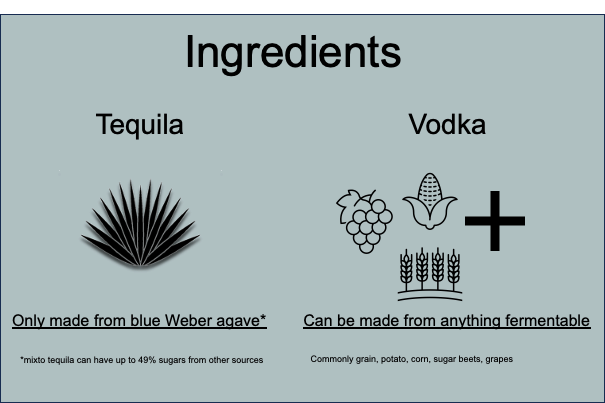
Tequila is made from only blue Weber agave, Vodka can be made from many things
The primary ingredient in tequila is one kind of agave while vodka can be made from any fermentable starch.
Tequila can only be made from a majority blue Weber agave (this species is Agave tequiliana). However up to 49% of the sugars used for fermentation can be from other sources, typically sugar cane. Most premium tequila comes from 100% agave.
Most vodka is made from grains, potatoes and sugar beet molasses but can also be made from fruit like grapes.
Examples of vodkas made from different ingredients:
- Wheat: Grey Goose, Ketel One
- Rye: Belvedere, Wyborowa Wodka
- Corn/maize: Tito’s, Crystal Head
- Barley: X Muse, Kirkwood
- Potato: Luksusowa, Monopolowa, Chopin Potato Vodka
- Grape: Cîroc
Tequila production follows tight rules, vodka does not
Tequila is a product regulated by the CRT, with production following a set of published rules known as the NORMA. These internationally recognized rules govern where and how tequila must be made to be called tequila. For example, tequila can only be made in the Mexican state of Jalisco as well as certain municipalities in the other states of Nayarit, Guanajuato, Tamaulipas and Michoacan. If it’s not made in one of these areas, it’s not tequila.
Other rules for tequila include:
- Alcohol percentage (must be between 35% and 55% alcohol by volume)
- Proportion and type of agave used (must be from at least 51% blue weber agave)
- Minimum aging requirements for labeling (for instance, it must be aged at least 2 months to be called reposado, and at least 12 months to be called añejo)
There is no recognized governing body for vodka however different regions apply general rules. For example, vodka (and any spirit, including tequila) must be at least 40% ABV in the US and 37.5% ABV in the European Union. Vodka not made from either grain or potatoes (considered the traditional ingredients) has to display what it is made from in the EU.
Vodka is usually filtered and distilled many times to remove flavor
Vodka relies on intense filtration, distillation or both to get to its desired “clean” flavor. Tequila is usually distilled just twice. Most vodka is distilled at least three times, but more commonly four or five times. Tito’s is distilled six times. There’s even the brand Purity Vodka that is distilled 34 times.
A higher number of distillations, or use of a column still which results in continuous distillations (like Absolut uses) results in a more neutral taste closer to industrial ethyl alcohol. The flavors of the ingredients will be less observable.
Vodka producers also use filtration to further remove “impurities”. Carbon filtration, otherwise known as charcoal filtration is typically used to filter vodka.
People are more likely to drink tequila because they actually like the taste of agave and don’t just want a neutral spirit. For this reason almost all tequila is distilled only twice. Enough to bring the alcohol up to a good level, but not enough to lose the desirable flavors.
There are certain brands that use three distillations and claim a “smoother” taste, such as Tres Generaciones and Pura Vida. Patron recently released its El Cielo line which is distilled four times but this is uncommon. Most tequila drinkers, myself included, feel that you lose too much agave flavor by distilling more than needed. However, if the tequila is rough to begin with, maybe this isn’t a bad thing.
Recently, charcoal filtered aged tequila has become more popular. This is known as cristalino tequila – aged tequila that looks clear and colorless.
Tequila and vodka are usually the same strength alcohol
Most tequilas and vodkas sold have the same strength alcohol (40% ABV) but the highest strength vodkas are stronger than the highest strength tequilas. Tequila and vodka must be at least 40% ABV (80 proof) to be sold in the USA as a spirit. All of the top 10 brands of tequila are 40% ABV. The top selling vodka brands are also all 40% ABV.
Some tequila brands offer higher proof bottlings at around 48%-50% and the highest strength by regulation is 55%. High strength vodkas at 50% are very common and there are vodkas that go much higher than this. Spirytus is the highest strength vodka available at 96% ABV.
Vodka is more often flavored
Flavored vodkas are very common while flavored tequilas are not. Tequila has its own agave flavor, while vodka’s neutral taste lends itself to added flavors.
Historical IWSR estimates put flavored vodka at about 15% of US vodka sales. Online retailer Drizly put flavored tequila at 1% of its sales.
About these flavored-spirit figures
These historical figures cover different sellers and definitions, rather than a matched 2025 comparison.
Popular flavored vodkas include Pink Whitney by New Amsterdam and Ketel One Botanical Grapefruit and Rose. Absolut has long been known for its flavored variations including Citron and Vanilla. Lower alcohol flavored vodkas with around 16%-22% ABV are gaining popularity, and have the benefit of being lower calorie.

Regional Differences
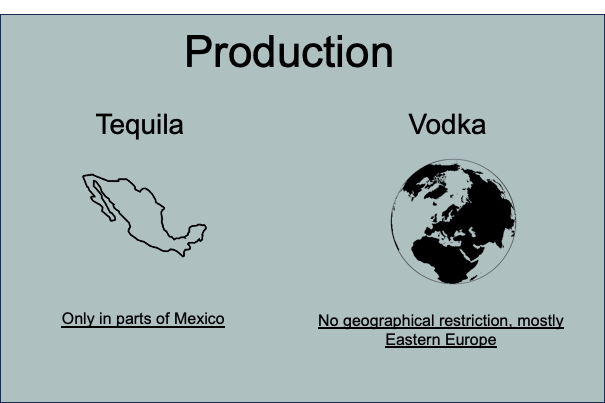
Tequila is only made in Mexico, Vodka can be made anywhere
Tequila can only be made in Mexico in a certain regions covered by its protected appellation, or denomination of origin. Similar to how Champagne can only be made in the Champagne region of France. Vodka has no protected regional status and can be made anywhere around the world. However, vodka is most connected with the “vodka belt” countries like Russia, Poland, Sweden and Finland.
All tequila is produced in Mexico, while vodka production is more dispersed. Historical IWSR estimates put Russia at around 30% of global vodka production.
Vodka is drunk more widely around the world, tequila is concentrated in North America
Historical IWSR estimates placed Russia first in global vodka demand at around 30%, and the US second at around 20%. The historical per-person ranking also put Russia first, followed by Poland and Ukraine.
About these vodka estimates
The underlying data year for these historical estimates was not recorded.
The US is the largest export destination for tequila. In 2025, it received 331.3 million liters, about 81.9% of the total in CRT’s country export table. Mexico is the home market and is outside that export comparison. Source: CRT’s country export table.
Differences in Drinking Tequila vs Vodka
Vodka has a neutral taste, tequila is more complex
There is some overlap in the flavor notes of tequila and vodka but tequila has a much stronger flavor driven by agave. Different vodkas have different tastes depending on what they are made from but overall the taste is subtle. To the average drinker, vodka just tastes like “alcohol” with different vodka having more or less of a burn. Vodka is mostly drunk chilled which further tones down any flavor.
Tequila has a wider range of possible flavors than vodka due to how it is made. Firstly, the taste of the baked agave is much more prevalent than the taste of whatever the underlying ingredient for the vodka is. This is both due to the distinctiveness of the agave in relation to say grain or corn, as well as the reduced filtration and distillation that tequila goes through.
Aged tequila also takes on the flavors from the oak barrels, similar to whiskey, cognac and aged rum. Vodka is almost never aged.
Primary flavors of tequila:
- Baked agave
- Black pepper
- Citrus
- Earthy
- Oak, vanilla, caramel (aged)
Primary flavors of vodka:
- Pepper
- Nutty
- Buttery
- Citrus
Both tequila and vodka are commonly drunk straight and in cocktails
In Eastern Europe vodka is most commonly drunk straight, in shots. In the US vodka is more likely to be drunk as part of a cocktail. Tequila is commonly drunk in shots, sipped and in cocktails.
Nutrition
Tequila and vodka usually have the same number of calories
As distilled beverages, the calories in tequila and vodka come from the alcohol percentage. Distilled beverages of the same strength have the same total calories.
Shot of tequila vs shot of vodka calories
- 1.5 oz shot of standard tequila has 96 calories (40% ABV / 80 proof)
- 1.5 oz shot of standard vodka has 96 calories (40% ABV / 80 proof)
- 1.5 oz shot of overproof tequila has 121 calories (50% ABV / 100 proof)
- 1.5 oz shot of overproof vodka has 121 calories (50% ABV / 100 proof)
Tequila and vodka are both carb free and contain no sugar
While you may assume alcoholic drinks contain sugar because they are made from sugary ingredients, the truth is that distilled spirits like vodka and tequila contain no sugar or carbs. The sugars and carbohydrates are fully converted into alcohol as part of the fermentation and distillation process. This doesn’t mean that they are low in calories. Alcohol is high in calories, and will be converted by your body back into sugars as part of your digestion.
Tequila and vodka are probably just as healthy/unhealthy for you
You may have read that tequila is healthy because of certain properties of the agave plant, like agavins, are nutritious. That’s only half true which pretty much makes it false. Yes agavins from agave are healthy but they are destroyed in the distillation process and so are not present in tequila.
Some also claim that vodka is healthy because it is somehow “pure”. Compared to drinking poison its healthy but compared to drinking water or nothing at all I don’t think this claim stands up.
Drinking either tequila or vodka straight is definitely better for you than drinking sugary cocktails. Tequila and vodka may be better for you than drinking lots of beer or wine which can be higher in calories per standard drink.
Tequila and vodka will get you drunk at the same pace
You physically get intoxicated at the same rate if drinking vodka and tequila with the same alcohol percentage. However you may experience a different feeling based on the social context and your expectations of how you should feel. Essentially there may be some placebo effect.
The effects of drinking alcohol come from both physiological (actual changes in your body chemistry) and psychological (following the expectation of change). Studies show that people who think they are drinking alcohol that is actually non-alcoholic start behaving as if they were drunk.
If you look at the contexts when tequila is drunk vs vodka this may explain why you may feel different. Compare drinking tequila shots in a celebratory context, together with a group, and after having already consumed a few drinks. Now compare this to how you might feel after sipping a vodka soda.
The expectation of how you should feel after a group shot of tequila may help explain you feeling differently. Plus comparing a shot vs sipping, more alcohol will be hitting your system at once which will be more noticeable.
Use in Cocktails
Both vodka and tequila are widely used in cocktails. Tequila is the main ingredient in America’s most popular cocktail, the margarita. Tequila also features in the Long Island Ice Tea, Tequila Sunrise and Paloma (all part of the IBA’s list of official cocktails).
Vodka is used for vodka martinis, Cosmopolitans, Moscow Mules and Espresso Martinis (and also Long Island Ice Teas alongside tequila as well as gin, rum and triple sec). As a neutral spirit vodka tends to add a kick to cocktails without imparting much flavor. Tequila based cocktails more often take on an agave taste.
Price
Both tequila and vodka offer inexpensive core bottles and more costly premium editions. Compare the same bottle size and include taxes and delivery charges when checking shop prices.
Price comparison notes
The price examples retain the article’s original amounts. Their country, currency and pricing date were not recorded; bottle sizes were not recorded except for the 750 ml Tito’s example. In the 2025 US supplier figures, tequila and mezcal earned about twice vodka’s revenue per equivalent case. That comparison concerns supplier revenue, including federal excise tax.
For a practical comparison, check the prices of the exact bottles you would buy, such as Patrón Silver and Grey Goose Original in the same bottle size.
The most expensive tequilas are more expensive than the most expensive vodkas. Crazy expensive tequilas are more often distinguished by their barrel aging and limited edition nature, similar to whiskey. It’s harder for vodka to distinguish itself as worth thousands of dollars given its method of production.
Sales and brand rankings
Historical global volume comparison: 2022
Global vodka sales in 2022 were 341.5 million 9 liter cases compared to 47.2 million cases for tequila. Global vodka sales are 7.2x that of tequila by volume. This is understandable given the fewer restrictions on the production of vodka including where it can be made (anywhere) and what it can be made from (almost anything).
US sales trends in 2025
In 2025, US tequila and mezcal volume fell 0.3%, compared with a 2.2% fall for vodka. Supplier gross revenue, including federal excise tax, fell 4.1% for tequila and mezcal and 3.0% for vodka. Source: DISCUS’s 2025 tables.
Tequila vs vodka sales in the USA
In the US in 2025, vodka sold 72.508 million nine-liter cases, compared with 32.106 million for tequila and mezcal combined. Vodka’s volume was 2.26 times as large. Supplier gross revenue including federal excise tax was US$7.009 billion for vodka and US$6.441 billion for tequila and mezcal. Revenue per equivalent case was about 2.1 times higher for tequila and mezcal. These are supplier figures rather than average shop prices. Source: DISCUS’s 2025 tables.
Top selling brands globally
The tequila volume lists are from 2025; the vodka shares and volumes are from 2022. Global tequila source: The Spirits Business, Brand Champions 2026.
Top five tequila brands by global volume in 2025
- Jose Cuervo (8.6 million nine-liter cases in 2025)
- Don Julio (4.5 million nine-liter cases in 2025)
- 1800 (2.8 million nine-liter cases in 2025)
- Patrón (2.7 million nine-liter cases in 2025)
- Lunazul (2.3 million nine-liter cases in 2025)
Historical global vodka brand shares in 2022
- Smirnoff (8.6% share)
- Absolut (4.0%)
- Żubrówka (3.2%)
- Khortytsa (2.9%)
- Hlibny Dar (2.6%)
Top selling brands in the US
US tequila source: Impact Databank’s table published in June 2026.
Top five US tequila brands by volume in 2025
- Jose Cuervo (4.800 million nine-liter cases)
- Don Julio (3.640 million nine-liter cases)
- Lunazul (2.258 million nine-liter cases)
- Patrón (2.068 million nine-liter cases)
- 1800 (1.925 million nine-liter cases)
Historical US vodka brand volumes in 2022
- Tito’s (11.6M cases)
- Smirnoff (8.8M cases)
- New Amsterdam (5.3M cases)
- Svedka (3.8M cases)
- Absolut (3.1M cases)
History of Vodka and Tequila
Vodka has been produced for longer than tequila, with evidence of production going back to the 8th or 9th century. Distilled spirits similar to Tequila have been produced since the 16th century following the Spanish colonization of Mexico. Prior to Spanish arrival indigenous Mexicans were drinking fermented beverages made from the agave plants for hundreds or thousands of years.
Vodka history
Vodka originated in Eastern Europe, with both Russia and Poland claiming to be its birthplace. Its name comes from the Slavic word “voda,” meaning “water,” in reference to its clear appearance. Historical accounts place the start of vodka production in Poland in the 8th or 9th century, and slightly later in Russia, around the 9th or 10th century. Early vodka was often used as medicine and tasted more like whiskey or brandy than today’s vodka.
Vodka grew rapidly in popularity in Russia by the 14th century. Prince Dmitry Donskoy of Moscow used it to raise revenue for the state. Improvements in distillation and filtration over the centuries made it a more refined, purer spirit.
Tequila history
Before Spanish colonizers arrived, indigenous Mexicans, including the Aztecs, made pulque, a fermented agave drink used for religious and social purposes. Spanish settlers introduced distillation in the 16th century and began making an agave spirit that preceded modern tequila.
By the 17th century, the town of Tequila in Jalisco, Mexico, had become the center of production. Its distinctive volcanic soil provided ideal conditions for blue agave and helped give the spirit its distinct flavor. Tequila spread beyond Mexico and its production became industrialized in the 19th century. It gained worldwide recognition in the 20th century. Regulations to protect its authenticity included the “Tequila” denomination of origin, restricting where in Mexico it can be made and which methods can be used.