
Zacatecas mezcal spans the Azul country around its southern valleys and the salmiana-growing plateau around Pinos. Family distilleries and former haciendas carry on these different traditions.
Azul in the southern valleys, salmiana around Pinos
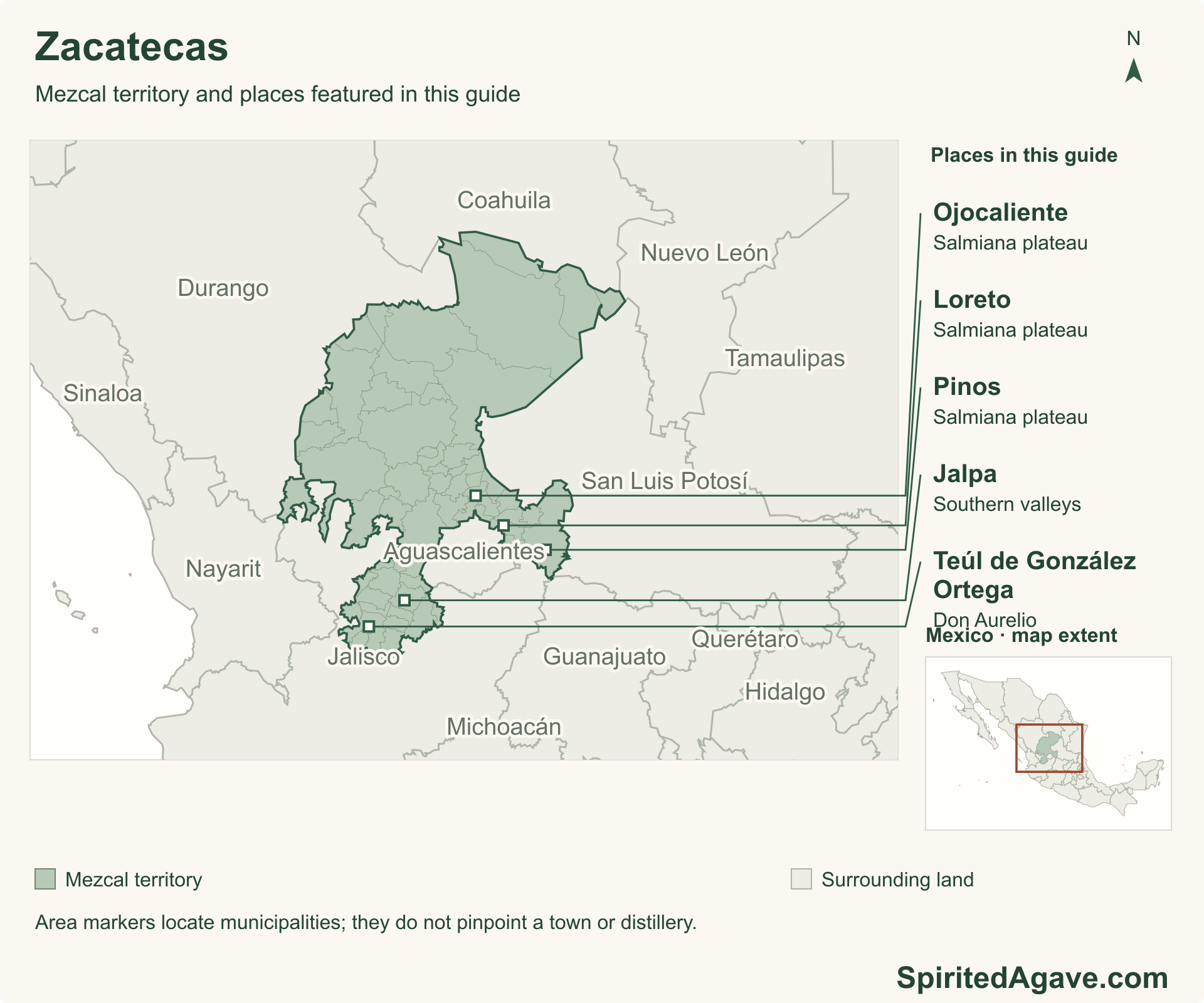
Azul, Agave tequilana Weber var. azul, grows in the Tlaltenango and Juchipila canyon region, including Teúl de González Ortega and Jalpa. Pinos and Villa Hidalgo are part of the salmiana country on the Potosí–Zacatecas plateau. A July 2025 state overview also identifies Loreto and Ojocaliente with salmiana production. 8 1
| Area | Agave | Towns |
|---|---|---|
| Southern valleys | Azul — Agave tequilana | Teúl de González Ortega, Jalpa and Juchipila |
| Southeastern plateau | Salmiana | Pinos, Loreto and Ojocaliente |
In July 2025, Zacatecas’s economy department reported 933 agave producers and 19 factories. Alongside Huitzila and Don Aurelio, it named Real de Jalpa, El Zacatecano and La Pendencia. 8
Salmiana is distilled in the plateau’s hacienda factories
The salmiana tradition extends across the border into San Luis Potosí. In Zacatecas, former hacienda factories have used stone ovens, tahonas and fermentation basins, while more extensively equipped facilities use roller mills and stainless steel vessels. 1
The protected territory covers all of Zacatecas
All 58 municipalities of Zacatecas fall within the protected Mezcal territory. 5
Zacatecas accounted for 0.84% of Mexico’s certified mezcal production reported by COMERCAM for 2025. 6
Three producer examples from Zacatecas
Huitzila makes mezcal from Azul
Casa Mezcal Huitzila makes its mezcal entirely from Azul. The family business began in Tezontla in the 1930s and moved to Huitzila under Cenobio Lamas. Its range includes blanco, reposado and añejo. 2
Huitzila uses oven cooking, milling, fermentation in vats and copper pot distillation. 3
La Pendencia: a Pinos hacienda factory
La Pendencia’s Pinos site has two tahonas around a central patio, five ovens, fermentation vats to the north and distilling and bottling areas near the entrance. Archaeologist Yarenni Monserrat Velasco de la Cruz recorded this layout in a 2026 study. She also examined the surviving mechanical shredder developed by Luis de la Rosa Berriozábal in the nineteenth century, which was out of operation when recorded. 4
Don Aurelio: autoclaves and a visitor museum in Teúl
In a December 2018 interview at Don Aurelio’s Teúl plant, Mario Alberto Robles described cooking Azul in autoclaves. Adriana Lamas explained the plant’s modernization. That documented process differs from the stone ovens recorded in the plateau’s former hacienda factories. 9
Mexico’s cultural registry lists the Museo y Fábrica de Mezcal Don Aurelio in Teúl de González Ortega. Its entry dates the museum’s opening to 2014 and describes guided visits through the production process. The entry was last updated in May 2023, so contact the venue for current arrangements before traveling. 7
Questions about Zacatecas mezcal
Is all Zacatecas mezcal made from Azul?
No. Azul is important in the southern valleys, while salmiana is associated with the plateau around Pinos.
Does every municipality in Zacatecas belong to the Mezcal denomination?
Yes. The protected territory includes the whole state. A producer still needs to meet the requirements that apply to the product and use of the name.
Follow salmiana into neighboring traditions
Continue with San Luis Potosí’s Altiplano mezcal and Guanajuato’s haciendas and salmiana producers. For another northern plant and distilling tradition, explore Durango’s cenizo vinatas.
Sources and notes
Maps adapted by Spirited Agave from INEGI’s Marco Geoestadístico, December 2025. Spirited Agave added the labels and geographic highlighting.
- Panorama del aprovechamiento de los agaves en México, page 184
- Casa Mezcal Huitzila’s agave and family account
- Huitzila’s production account
- Velasco de la Cruz, 2026, pages 145–149
- IMPI’s September 2025 account of the protected territory
- COMERCAM 2026 report, page 4 Production figures are for 2025, normalized to 45% ABV; the report does not estimate uncertified state output.
- Don Aurelio’s cultural-registry entry
- Zacatecas economy department, 8 July 2025: regional agaves and reported counts of growers and factories. These are dated state figures, separate from COMERCAM’s certified-volume table.
- Mayra Zepeda: first-hand Don Aurelio plant interviews, 21 December 2018 Equipment describes the interview period; the article’s old territory list is not used here. The CIATEJ 2017 regional account identifies stone ovens without enough detail to assign every oven a heat source.