
Durango’s vinatas turn cenizo from the southern hills and lamparillo from the northern desert into mezcal. The state also has a sotol tradition, sometimes carried on by the same distillers.
Durango’s mezcal trade survived repeated colonial prohibitions
In May 1725, an episcopal edict in Durango, then part of Nueva Vizcaya, condemned mezcal consumption. Mezcal had expanded toward the region’s mining markets, where it competed with Spanish aguardiente. The prohibition was repeated in 1756 and 1758. People producing or handling the prohibited drinks faced excommunication; civil punishment included imprisonment under the Tribunal de la Acordada. 1
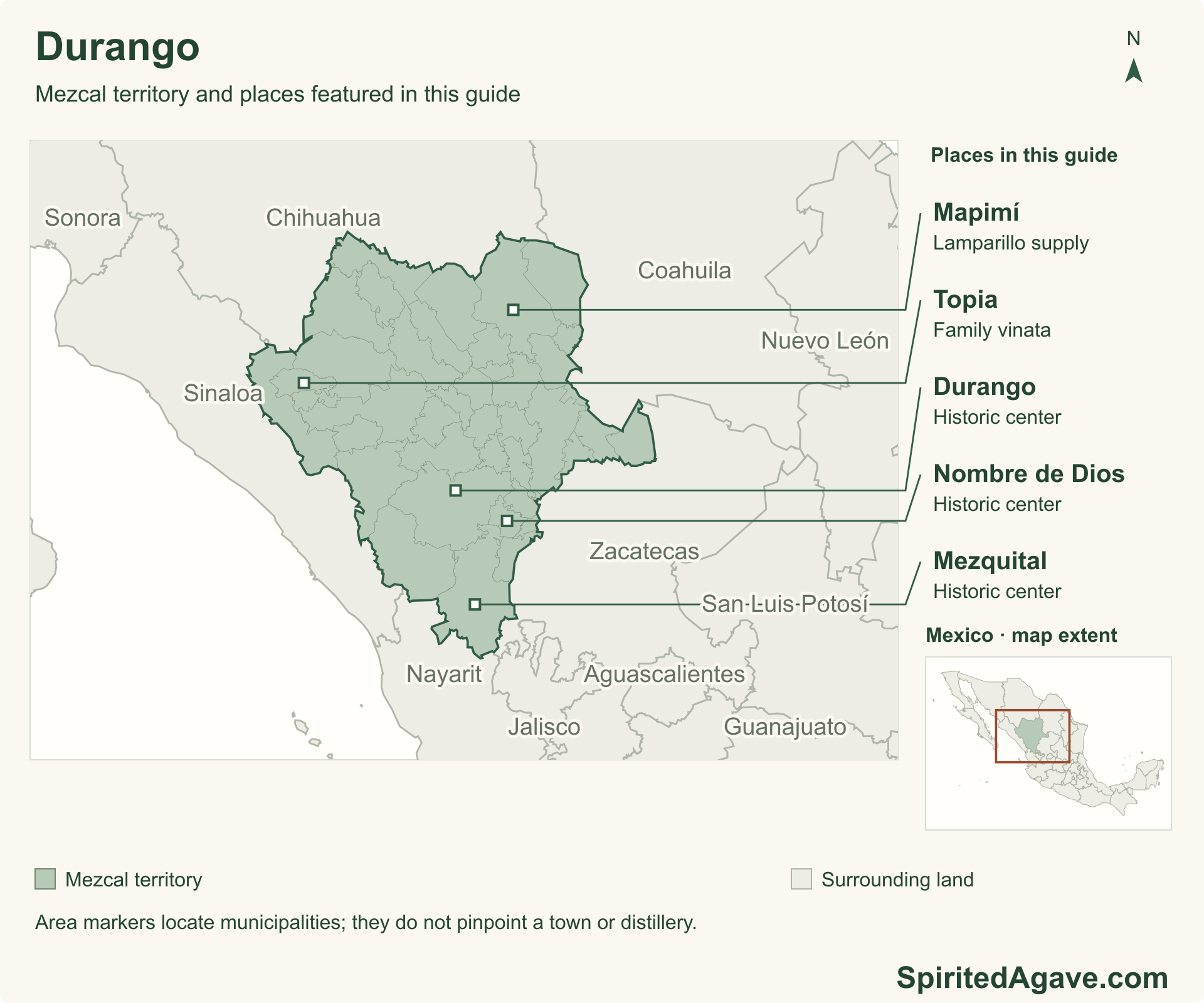
A vinata is a distillery; its maker may be called a vinatero. Nombre de Dios, Mezquital and Durango municipality became important production centers. By 2013, small vinatas supplied local buyers, shops and intermediaries, alongside bottlers reaching more distant markets. Some local brands were registered but sold without mezcal certification. Certified production figures omit that uncertified spirit.
Durango contributed 2.12% of reported certified mezcal in 2025
Durango contributed 2.12% of Mexico’s certified mezcal production reported by COMERCAM for 2025; Oaxaca contributed 89.47%. Across all reporting states, the A. durangensis agave category accounted for 2.00%. The state figure counts where the spirit was made; the agave figure counts the plant used. 22
Share of Mexico’s certified mezcal production reported for 2025
Durango
2.12%
- Agaves include
- Cenizo (A. durangensis)
- Lamparillo (A. asperrima)
- Manso / chacaleño
- Cooking
- Pit ovens
- Distilling
- Copper/wood, external coil; Steel then copper; Copper pots
Oaxaca
89.47%
- Agaves include
- Espadín (A. angustifolia)
- Tobalá (A. potatorum)
- Tepeztate (A. marmorata)
- Karwinskii forms (A. karwinskii)
- Cooking
- Pit ovens
- Distilling
- Copper pots; Clay pots; Copper refrescador
Both bars use a 0–100% scale. Production: COMERCAM 2026 report, page 4. Plants and methods are selections explained in the guides.SpiritedAgave.com
Cenizo’s broad, cupped leaves identify Durango’s principal mezcal agave
Durango’s cenizo is Agave durangensis, a gray-green rosette with broad, cupped leaves, conspicuous edge teeth and a strong terminal spine. The leaves narrow toward the base, and the stem is mostly hidden beneath the low rosette. CONABIO describes a plant reaching roughly 1.5 meters high and 2 meters across; individual plants vary. 5 6
Cenizo is also a common name for other agaves. For A. durangensis, growing conditions also affect harvest timing: a Sierra Registrillo study in 2018 recommended lower harvesting intensity on poorer sites. Leyendas describes mainly wild plants and ten to twelve years to maturity for its Cenizo expression, made by José Ventura Gallegos in Nombre de Dios. 7 8
Lamparillo is a rough-leaved agave from Mapimí’s desert
Lamparillo is Agave asperrima. Its gray-green leaves have a rough, sandpaper-like surface and faint striping or marbling. Kew places the species’ native range from southern Texas into northeastern Mexico. Sin Gusano’s lamparillo releases used plants from Rancho Pelayo, in Mapimí, distilled in Nombre de Dios. 9 10
The ranch account estimates fifteen to twenty years for its lamparillo to mature. That is longer than Leyendas’ ten-to-twelve-year cenizo estimate, though the plants grow at different sites and the producers use different harvest judgments. Lamparillo’s rough leaf surface and northern desert habitat distinguish it from the broad, cupped cenizo of the southern hills.
Two examples are Gilberto Roldán Quezada’s lamparillo and Juan Manuel Pérez’s later release. Both use pit roasting, axe crushing, wood-lined earth fermentation wells and double distillation through a copper-and-wood apparatus with an external coil. Sin Gusano describes Roldán Quezada’s spirit with green pepper, olive and leather; its notes for Ramiro Ávila’s cenizo emphasize ash, peppery cured meat and developing sweetness. 9 11
Nombre de Dios vinatas use axes, mallets and tahonas
Wooden mallets, mule-driven tahonas and axes were used to crush agave in Nombre de Dios in 2012. Vinatas fermented it in wooden vats or vats lined with boards, then distilled it in copper-and-wood stills with external cooling coils. 23
Ramiro Ávila’s copper-and-wood still uses an external coil
In Ramiro Ávila’s Nombre de Dios vinata, agave is pit-roasted, chopped with an axe and fermented in wood-lined wells set into the earth. The fermented material then goes through a copper boiler and wooden upper chamber. Vapor leaves that chamber for a coil immersed in a water bath, where it condenses into spirit. 11
Carmelo Vázquez uses steel, then copper
Carmelo Vázquez uses an axe and wood chipper, then open sabino-wood troughs. Sabino is a local name for Mexican cypress. His documented cenizo uses a steel alembic for the first distillation and copper for the second. He uses that arrangement for sotol too. 12 13 20
External coils differ from internal condensation
The location of condensation distinguishes these stills. Ramiro’s apparatus is a copper-and-wood alembic with an external cooling coil. The Filipino-type examples in Michoacán cool vapor beneath a bowl of water at the top of the wooden chamber and collect the condensed spirit inside it. A wooden upper chamber alone does not establish the still type. 14
Durango: an external cooling coil
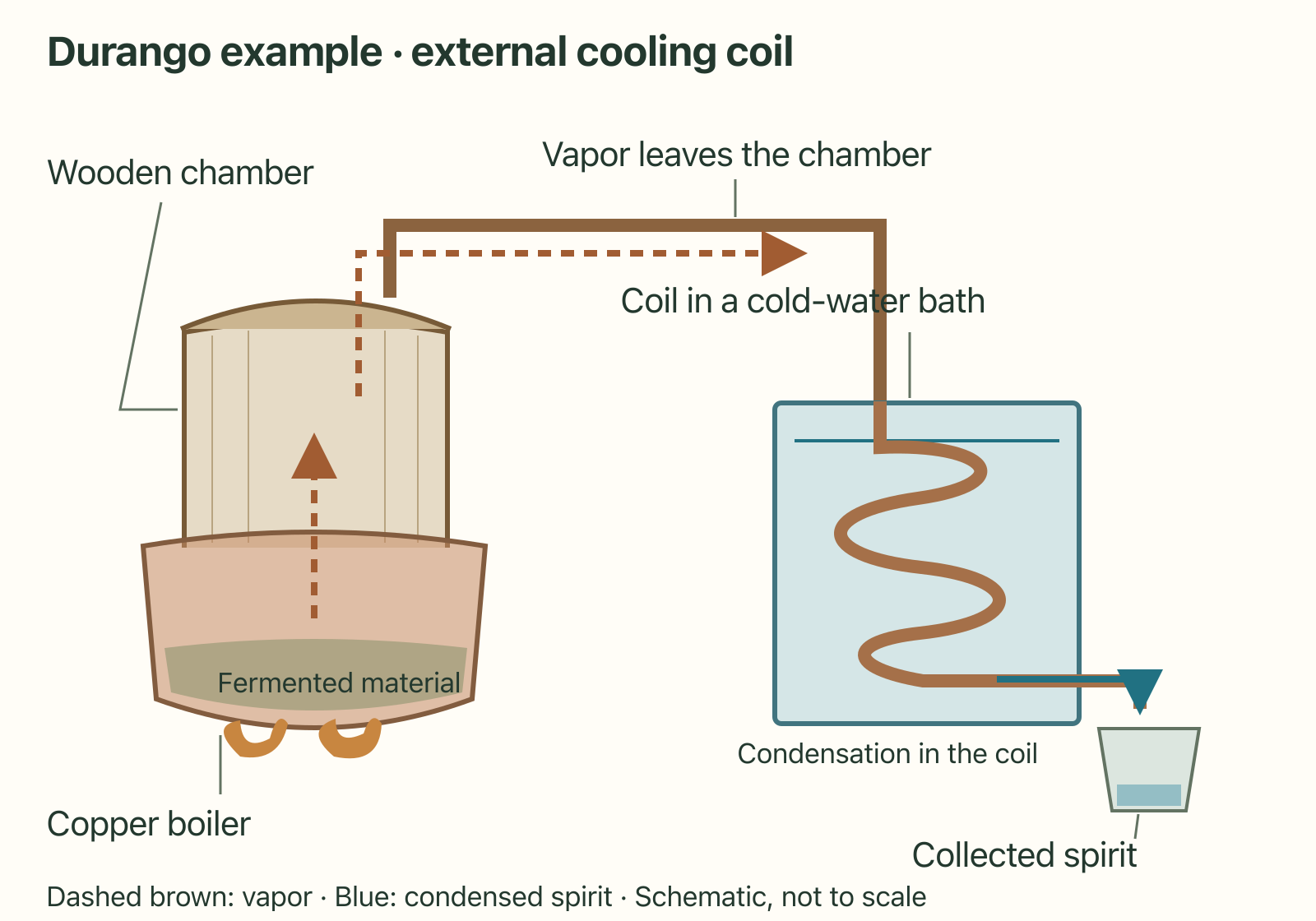
- Heat produces vapor in the copper boiler; it rises through the wooden chamber.
- The vapor travels through a pipe to a coil in a separate cold-water bath.
- The vapor condenses in the coil, and the spirit flows into the collection vessel.
Enlarge Durango diagram
Scroll sideways for the full detail. With a keyboard, focus the diagram and use the arrow keys.
Michoacán: condensation inside the chamber
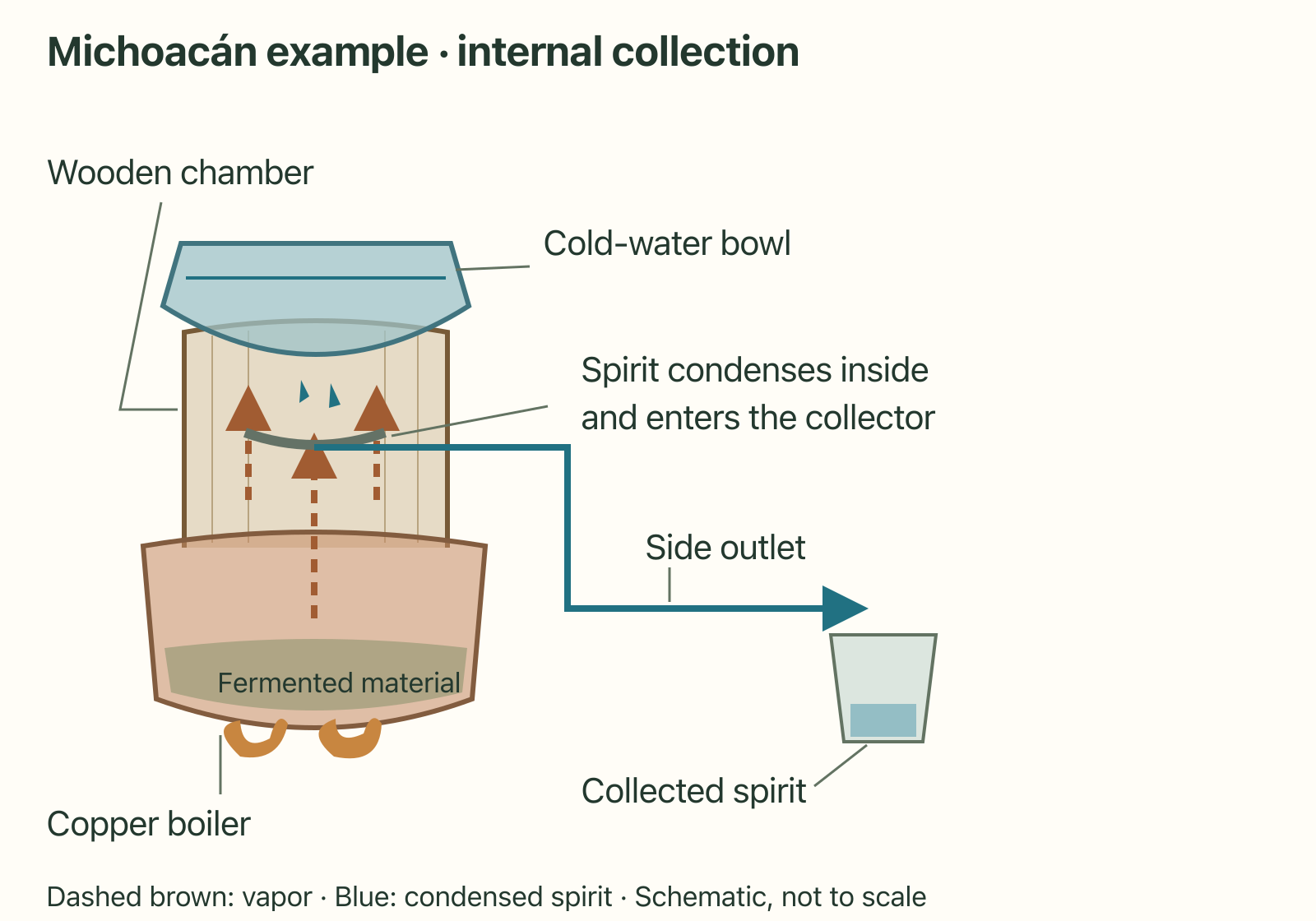
- Heat produces vapor in the copper boiler; it rises through the wooden chamber.
- A cold-water bowl on top cools the vapor, which condenses beneath the bowl.
- The spirit falls into an internal collector and flows through a side outlet.
Enlarge Michoacán diagram
Scroll sideways for the full detail. With a keyboard, focus the diagram and use the arrow keys.
In Oaxaca, Emigdio Jarquín’s refrescador cools part of the upper head so some condensed vapor falls back into the boiler; the remaining vapor goes to an external coil. That extra cooling and reflux distinguish it from Ramiro Ávila’s apparatus.
Copper-and-wood construction can fit Mezcal Artesanal
The Mezcal standard permits a copper boiler with a wooden head for Mezcal Artesanal. The complete category also governs cooking, crushing and fermentation; it permits a shredder among the crushing options. Mezcal Ancestral requires pit cooking, the specified hand or stone crushing, and a clay-pot still, with a clay or wooden head. A copper boiler does not meet that still requirement. 15
Steel boilers appear in the broader Mezcal category; the Artesanal list permits steel in the head, rather than as the boiler.
Two producer projects work with Durango’s vinatas
Origen Raíz and the Angulo family in Topia
Topia sits in Las Quebradas, the mountain country in the west. In El Platanar, Gilberto Angulo Torres began family production in 1975 with agaves locally called manso and chacaleño. His son Carlos Angulo Ríos revived it in 2016 after weak demand had interrupted production, and the family joined Origen Raíz in 2018. Origen Raíz brings together the Saravia family of Durango and the Cortés family of Santiago Matatlán, Oaxaca. 2
Vinatero works with makers in three municipalities
Vinatero’s project began in 2014, working with makers in Nombre de Dios, Mezquital and Topia; it describes building an independent vinata in 2021. 3
Sotol has its own plants, makers and denomination in Durango
Sotol begins with Dasylirion, rather than Agave. Its long, narrow leaves form a different kind of rosette, but distillers can cook, crush, ferment and distill its heart using familiar vinata equipment. The Sotol denomination, protected in August 2002, covers every municipality of Durango, Chihuahua and Coahuila. Sinaloa is outside that three-state territory. 16 17
Dasylirion cedrosanum has a documented local history: INIFAP researchers studied sotol production and trade in Torrecillas, Cuencamé, during 1998, publishing the work in 2004. Origen Raíz identifies the same species for its current Sotol from Durango’s Maika valley. 18 19
Carmelo Vázquez makes both cenizo and sotol in Nombre de Dios. For his sotol, the cooked hearts pass through axe and chipper, open sabino troughs, then the steel and copper stills described above. Vázquez finds metal alembics easier to work with and less demanding of firewood. 20
Juan Manuel Conde makes Señor Sotol in San Nicolás de Acevedo, near Nombre de Dios. The brand’s ensamble combines Dasylirion types named texano, cedrosano and wheeleri. Its process uses a volcanic-stone pit oven, electric milling, fermentation vats and two copper distillations. Here an ensamble combines sotol plants; it does not describe an agave–sotol mixture. 21
Sources and notes
Maps adapted by Spirited Agave from INEGI’s Marco Geoestadístico, December 2025. Spirited Agave added the labels and geographic highlighting.
- Rosas-Medina et al., El mezcal de Durango, México, Vidsupra 5(2), 2013, pp. 113–117. Historical account, citing Corona (2001) for the prohibitions; trade observations describe 2013, not current output.
- Origen Raíz: family and regional history. Producer account; the names manso and chacaleño are retained as local names.
- Vinatero: project and vinata history. Producer account read 8 October 2026.
- IMPI: original Mezcal territory and later resolutions. Durango was included as a whole state in the original 28 November 1994 protection.
- CONABIO: maguey descriptions. Durango cenizo description gives a rosette up to 1.5 m high and 2 m across.
- Agave durangensis chloroplast genome, 2024. Introduction discusses previously documented morphological and genetic variation.
- Site quality for Agave durangensis, 2018. Sierra Registrillo study: growing-site quality and harvesting intensity.
- Mezcal de Leyendas: Cenizo. Maker, mainly wild supply and expression-specific 10–12-year maturity estimate. Brand and shop differ in equipment descriptions, so no single apparatus is assigned here.
- Sin Gusano: Gilberto Roldán Quezada’s lamparillo. September 2021 production; Rancho Pelayo, Mapimí plant source, maturity estimate, surface description and house tasting notes. See also D-LAMP-02, released April 2024.
- Kew: Agave asperrima. Accepted species; native range southern Texas to northeastern Mexico.
- Sin Gusano: Ramiro Ávila’s cenizo and external-coil still. D-RA-01, made January 2022. Source describes no cooled lid or internal spirit collector; house tasting notes apply to this release.
- Sin Gusano: Carmelo Vázquez’s cenizo. D-CV-02, made April 2023. Axe and chipper, open sabino troughs, steel first pass and copper second pass.
- Universidad Autónoma de Nuevo León: sabino. Sabino, ahuehuete and ciprés mexicano for Taxodium mucronatum. The batch accounts name sabino wood without identifying a botanical specimen.
- CIATEJ–AGARED, Panorama del aprovechamiento de los agaves en México, 2017. Durango pp. 169–170; Michoacán p. 173 explains the cold-water bowl and internal collection channel.
- NOM-070-SCFI-2016: Mezcal. Sections 4.4.1–4.4.3 specify complete production categories. An apparatus description alone establishes no product certification.
- Sotol protection declaration, 8 August 2002, WIPO Lex. Original text covers every municipality of Chihuahua, Coahuila and Durango.
- NOM-159-SCFI-2004: Sotol. Definition uses Dasylirion spp..
- Olhagaray Rivera et al.: sotol in Torrecillas, Cuencamé. Original journal issue 2004; fieldwork 1998. Website upload date 2020 is separate.
- Origen Raíz: Sotol. Product identifies Dasylirion cedrosanum in Durango’s Maika valley.
- Sin Gusano: Carmelo Vázquez’s sotol. March 2023 production, February 2025 release. Dasylirion species unspecified; maker also works with cenizo.
- Señor Sotol: Juan Manuel Conde’s ensamble. San Nicolás de Acevedo, Durango; named Dasylirion forms texano, cedrosano and wheeleri, pit roasting, electric milling, vats and two copper distillations.
- COMERCAM 2026 report, pp. 4 and 7. Calendar-2025 certified production, normalized to 45% ABV. State share 2.12%; national A. durangensis category 2.00%; uncertified output uncounted.
- Fournier García and Mondragón Barrios: El mezcal, Arqueología Mexicana 114, March–April 2012 Nombre de Dios methods: wooden mallets, tahona, wooden vats and external-coil apparatus. The account describes that period; equipment frequency was not measured.