
Tamaulipas has a northeastern mezcal tradition centered on family vinatas, with agaves known locally as jarcia and amole. San Carlos and Jiménez are two of its production centers.
A vinata is a place where mezcal is made.
San Carlos is a center of a wider tradition
San Carlos, San Nicolás and Burgos are traditional mezcal producing areas. Regional agaves include Agave angustifolia, A. americana, A. montium-sancticaroli (jarcia) and A. asperrima. 1
The regional research project Destino Sierra Chiquita brings together researchers from UAT, IPN and UANL. Its public material includes maps and virtual visits around San Carlos, San Nicolás, Burgos and Santander Jiménez, offering a way to explore the landscape and cultural setting before visiting. 2
Family knowledge and local sales keep San Carlos’s vinatas working
San Carlos’s mezcal economy includes agave growers, distillers and sellers who work through both brands and direct relationships with buyers. Interviews conducted from September to December 2023, published in a 2026 study, describe skills learned beside parents, long-standing distillery customers and bulk sales to bottlers. 11
Those producers also described difficulties securing enough suitable agave and passing distilling knowledge to younger family members. The future of the vinata depends on replenishing plants and keeping people involved in the work, as well as finding buyers for the finished drink.
Pit cooking and varied fermentation vessels
A 2017 regional account describes pit cooking, crushing to extract the juices, and fermentation in wood, plastic or stainless steel vessels. 1
Eleven municipalities are included in the Mezcal territory
The protected area covers San Carlos, San Nicolás, Burgos, Miquihuana, Bustamante, Palmillas, Jaumave, Tula, Cruillas, Jiménez and Méndez. These are the Tamaulipas municipalities listed in IMPI’s September 2025 account of the denomination. 7
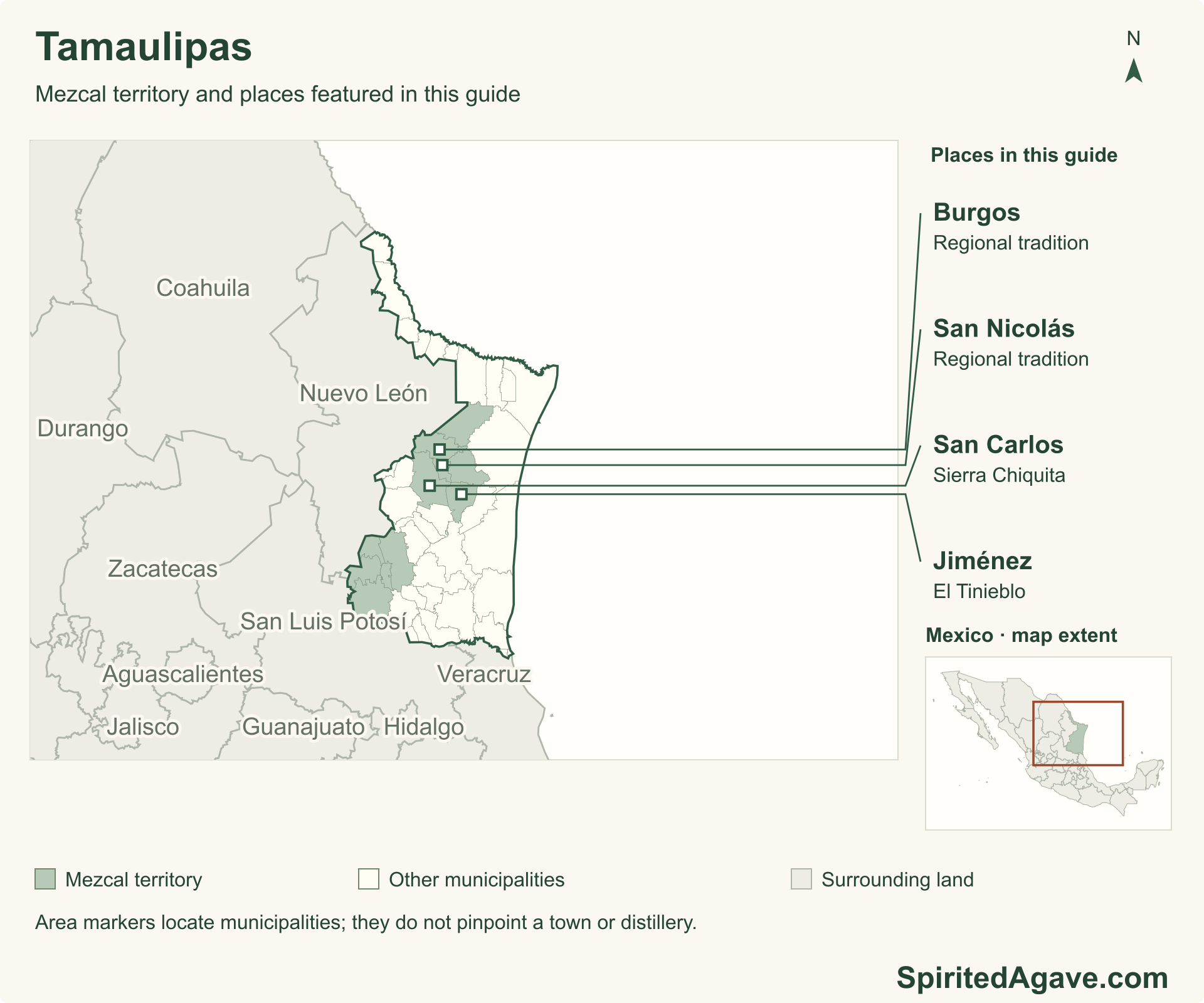
Tamaulipas also has municipalities in the Tequila denomination. Tula belongs to both the Tequila and Mezcal territories. 8
Tamaulipas accounted for 0.14% of Mexico’s certified mezcal production reported by COMERCAM for 2025. The San Carlos interviews describe additional local sales channels, but supply no statewide volume estimate. 9
Two producer examples from Tamaulipas
El Tinieblo in Jiménez
Alfredo “Ferruko” Pérez Salinas leads mezcal production at El Tinieblo’s ranch in Jiménez. The agaves cook beneath earth, are crushed by a mechanical tahona and ferment in outdoor wooden vats for up to two weeks. Distillation takes place twice in copper stills over a wood fire. 3
The tahona’s stone wheel is driven by an electric motor powered by solar energy.
El Tinieblo’s joven blends espadín, verde cenizo, jarcia and amole. It uses pine fermentation vats and copper distillation. 4
El Tinieblo’s joven, reposado and añejo
El Tinieblo’s Mexican joven and reposado are both 40% ABV and use the same four named agaves. The reposado spends nine months in American and French white oak barrels.
| Expression | Agaves | Strength and maturation |
|---|---|---|
| Joven | Espadín, verde cenizo, jarcia and amole | 40% ABV; unaged |
| Reposado | Espadín, verde cenizo, jarcia and amole | 40% ABV; nine months in oak |
| Añejo | Espadín, identified as A. angustifolia | 40% ABV; seven years in oak |
Mexican editions, in standard 750 mL bottles. 10
Sierra Chiquita: copper, then steel
Sierra Chiquita’s advertisement in a 2023 issue of Vatel Magazine, showing a 2020 special-edition bottle, describes an ensemble of americana, jarcia and funkiana agaves, mechanical milling and a conical pit oven fired with mesquite. It specifies a first distillation in copper and a second in steel. 5
Sierra Chiquita is made in San Carlos, with a first distillation in copper and a second in stainless steel. Its blanco joven is the base for the reposado and curado. 6
| Maker | Place | Fermentation and distillation |
|---|---|---|
| El Tinieblo | Jiménez | Wooden fermentation vats; two distillations in copper |
| Sierra Chiquita | San Carlos | First distillation in copper, second in stainless steel |
Questions about Tamaulipas mezcal
Is jarcia the same agave as espadín?
No. Tamaulipas jarcia is identified as Agave montium-sancticaroli; espadín is A. angustifolia.
Can mezcal be produced throughout Tamaulipas under the denomination?
No. The protected Mezcal territory includes the eleven named municipalities shown on the map. It does not cover the whole state.
Explore another northern mezcal tradition
Compare these vinatas with Durango’s cenizo vinatas, or follow different agaves through Zacatecas and San Luis Potosí.
Sources and notes
Maps adapted by Spirited Agave from INEGI’s Marco Geoestadístico, December 2025. Spirited Agave added the labels and geographic highlighting.
- Panorama del aprovechamiento de los agaves en México, pages 182–183
- Destino Sierra Chiquita
- El Tinieblo’s production account
- El Tinieblo’s Mexican product range
- Sierra Chiquita’s 2023 advertisement, PDF page 44
- Xibaria’s Sierra Chiquita profile
- IMPI’s protected-territory list
- Tamaulipas tourism department, May 2025
- COMERCAM 2026 report, page 4 Production figures are for 2025, normalized to 45% ABV; the report does not estimate uncertified state output.
- El Tinieblo’s Mexican product page
- Cortina-Calderón, Delgado-Rivas and García-Fernández, El mezcal de San Carlos (30 January 2026), pp. 75–92. Five participants interviewed in 2023; qualitative evidence about San Carlos, without a statewide estimate of direct or uncertified sales.