
Salmiana (Agave salmiana) is used for pulque, mezcal and agave syrup. Aguamiel is the sweet liquid collected from a living maguey; the piña is its heart, which is harvested and cooked for mezcal. Large cultivated forms grow in central Mexican pulque fields, while spiny wild forms supply mezcal makers in San Luis Potosí.
Salmiana at a glance
- Identity
- A. salmiana, a Mexican maguey used for pulque, mezcal, agave syrup, fiber and cooking leaves.
- Common local names
- Maguey verde in San Luis Potosí; Verde and Negro in parts of Michoacán; Corriente, Bronco and Verde de monte in Hidalgo.
- Recognition
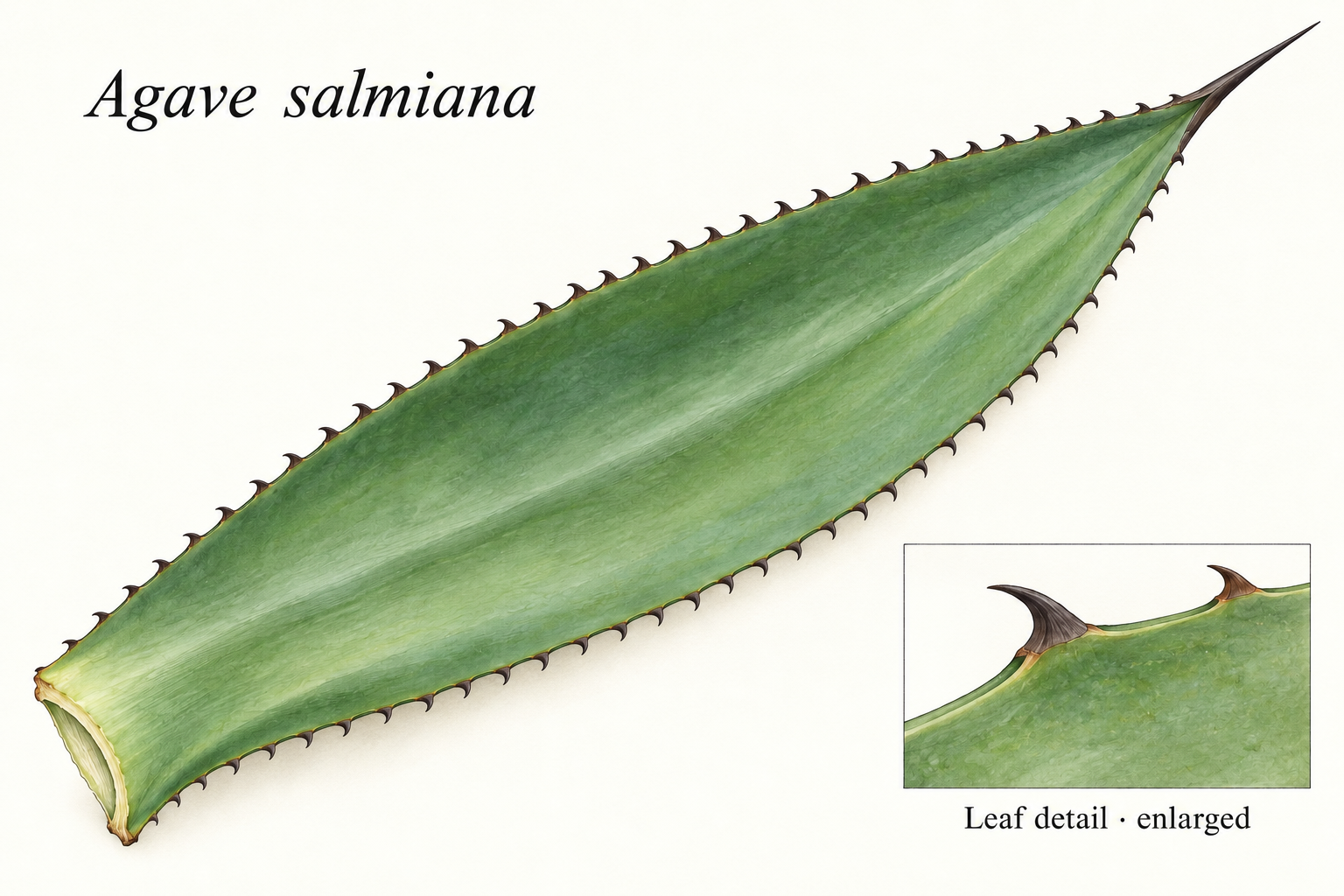
- Broad, concave leaves; an upright center; recurving outer leaves with strong teeth and dark tip spines.
- Leafy rosette
- Large mature forms: roughly 1.5–3 m tall and 2–5 m across; smaller forms also occur.
- Places and drinks
- Pulque communities in Hidalgo, Morelos and Michoacán; wild salmiana and mezcal in San Luis Potosí.
Two harvests lead to two drinks
Both drinks begin with a mature agave. For pulque, a collector prepares the living plant’s center and gathers aguamiel. For mezcal, the piña is harvested, cooked, fermented and distilled.
Pulque · usually about 4–7% ABV
Collect and ferment aguamiel
- Remove the central growing point before the quiote develops.
- Prepare and scrape the cavity, then collect aguamiel.
- Add an active pulque starter and let it ferment.
Aguamiel can also be drunk fresh.
Mezcal · Machetazo US salmiana: 45% ABV
Cook and distill the piña
- Harvest the mature piña and cook it.
- Crush or mill the cooked agave.
- Ferment, then distill.
Pulque production and alcohol content · Machetazo salmiana specifications
Recognize the broad leaves and deep rosette
Salmiana’s fleshy leaves rise from a short or concealed stem. Younger central leaves stand upright; older leaves curve outward. Look along the concave blade for prominent marginal teeth and a substantial dark terminal spine. Green shades vary, sometimes with a gray-green bloom.
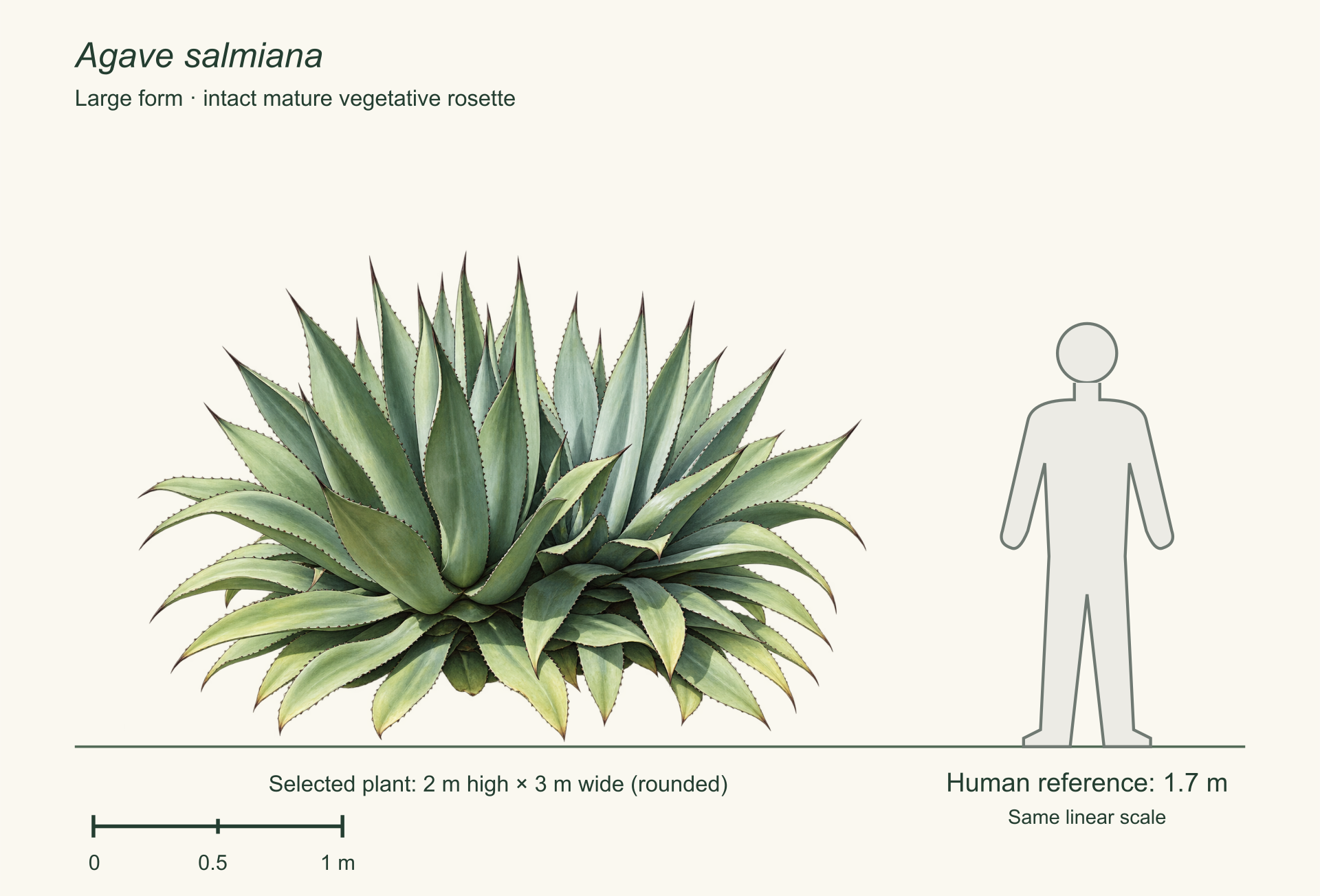
A. salmiana · large form · intact leafy rosette
- Selected illustration: 2 m high × about 3 m across.
- Reference: standing human 1.7 m; bar 1 m; plant and human share the same scale.
Large salmiana forms can grow taller than a person and several meters across. Their broad leaves commonly reach 1–2 m long and 20–35 cm wide. A fully grown quiote, the flowering stalk, can rise 6–8 m above the ground. Plant dimensions.
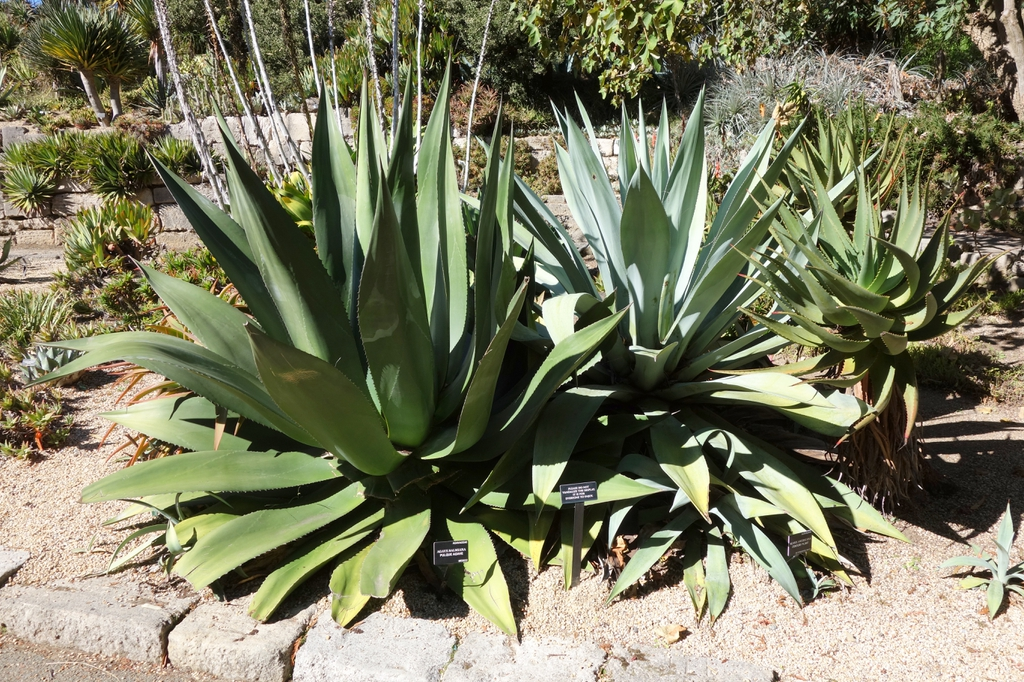
Two giant pulque plants with different leaves
A. mapisaga also grows into an enormous pulque plant. Its long, relatively narrow leaves and smaller teeth distinguish it from salmiana’s broad blades and stronger teeth. Cultivation changes the picture too: Hidalgo growers selected larger plants with reduced thorniness, abundant aguamiel and easier handling. Flora key, Hidalgo study (2021).
Pulquero describes a use; local names describe particular plants
“Maguey pulquero” can mean salmiana, mapisaga or another agave supplying pulque. Local growers distinguish plants more closely, and a name’s meaning can change between places.
Verde and Negro
Verde is used in Tarímbaro and Santiago Undameo, Michoacán; Negro in Santiago Undameo. Both are cultivated salmiana used for pulque. Listoncillo in Tarímbaro is A. mapisaga.
Corriente, Bronco, Verde de monte
Hidalgo study sites. A. salmiana subsp. crassispina: wild or tolerated plants, also transplanted by growers.
Penca larga and Corriente penca larga
Penca larga at El Cubo, Hidalgo, is A. mapisaga. Corriente penca larga at Rancho La Coyotera is A. salmiana.
Salmiana Crassispina
Derrumbes San Luis Potosí. The maker identifies its mezcal plant as A. salmiana subsp. crassispina.
Michoacán growers (2020), Hidalgo names, Table 2 (2019–2020 fieldwork), Derrumbes. The agave names guide covers other species and regional names.
Kew accepts A. salmiana Otto ex Salm-Dyck, first published in 1859, with subsp. salmiana, subsp. crassispina and var. ferox. Older studies use “var. salmiana” for the cultivated form; Kew now treats the flora’s subsp. tehuacanensis under var. ferox. Kew taxonomy, ferox synonyms.
Pulque fields and plateau mezcal country
Salmiana is native to Mexico. Pulque-growing communities in Hidalgo, Morelos and Michoacán cultivate it; wild mezcal plants occur in San Luis Potosí, including the studied populations of Aquiles Serdán, El Cuervo and Ipiña. Kew distribution, San Luis Potosí study (2016).
In Tehuacán–Cuicatlán, the large cultivated form grows around settlements and field boundaries, and in several vegetation types at 1,500–2,600 m. Beyond Mexico, Kew records introduced salmiana in the Canary Islands, the Cape Provinces of South Africa, Portugal and Spain.
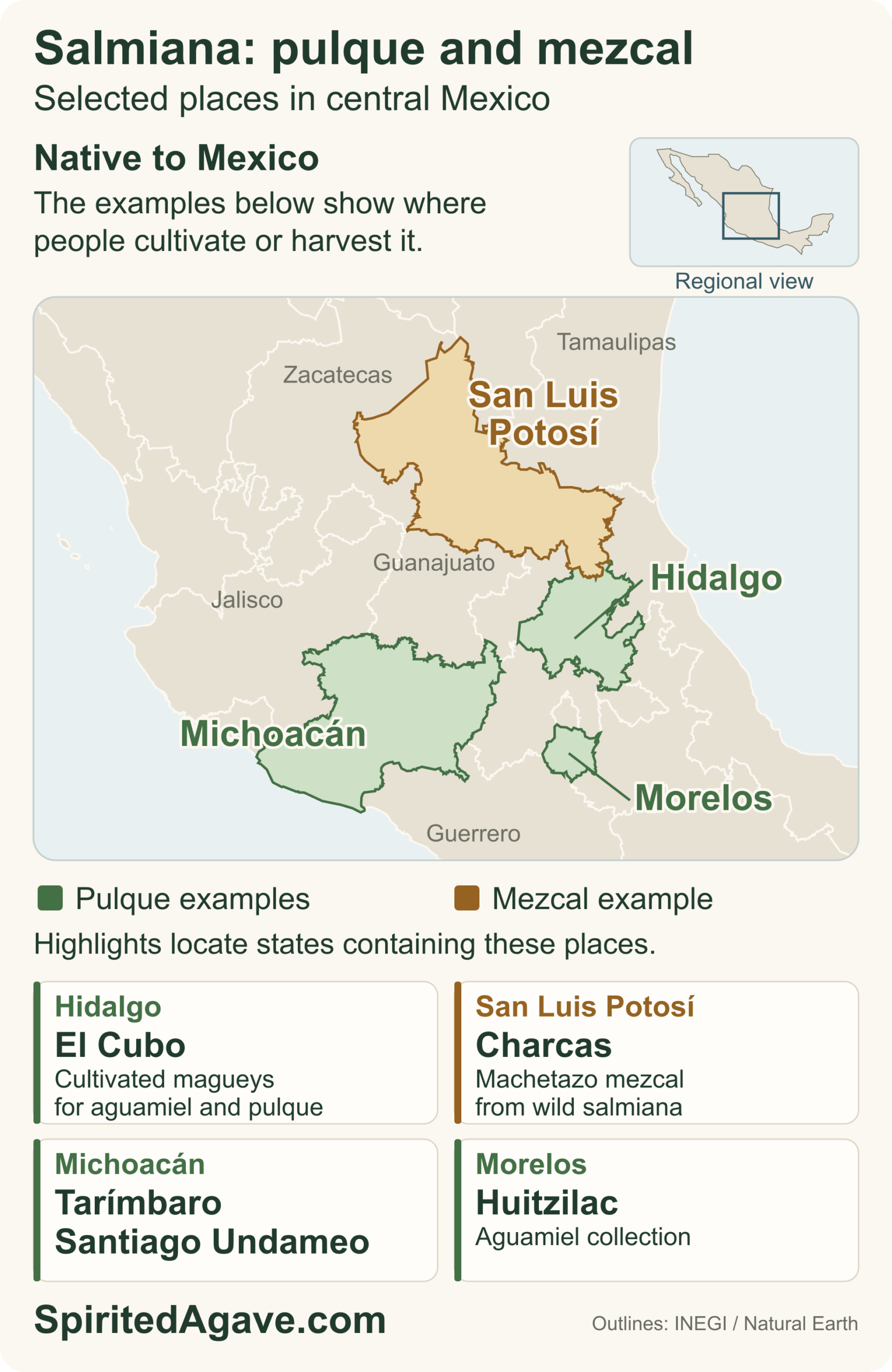
Mature agaves for both drinks
Pulque and mezcal both use mature salmiana. Over years, the plant builds carbohydrate reserves in its piña, which it draws on to grow the quiote and flower. A mezcal maker harvests the mature piña; a tlachiquero removes the central growing point before the flower stalk develops and prepares the plant for aguamiel collection. Maturity and harvest timing.
The wait varies with the plant and growing conditions. Hidalgo growers reported 9–10 years for Xaminí and 12–13 for Mutá; Machetazo gives 10–12 years for its wild salmiana from Charcas, San Luis Potosí. Local age examples.
Collecting aguamiel and fermenting pulque
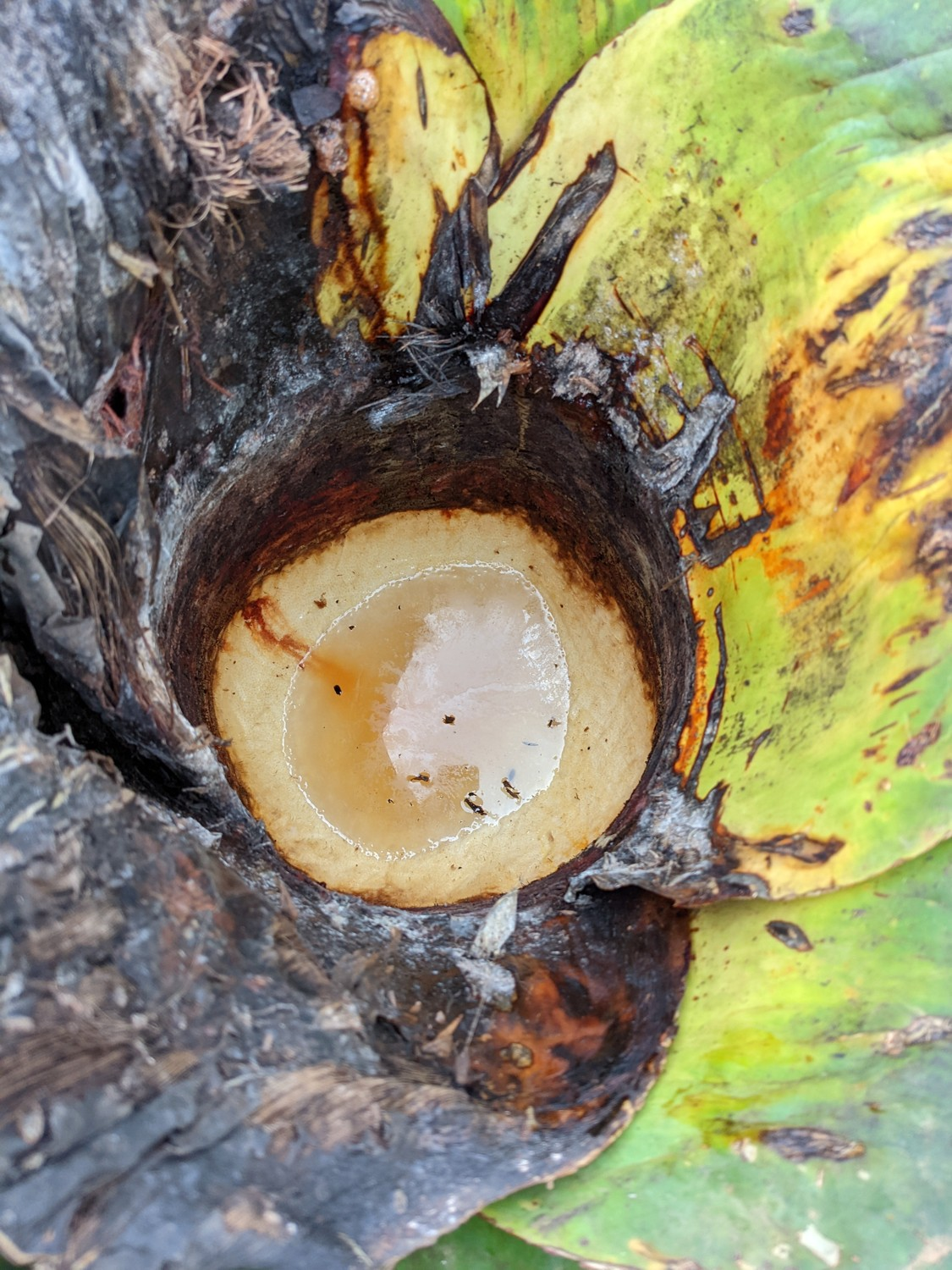
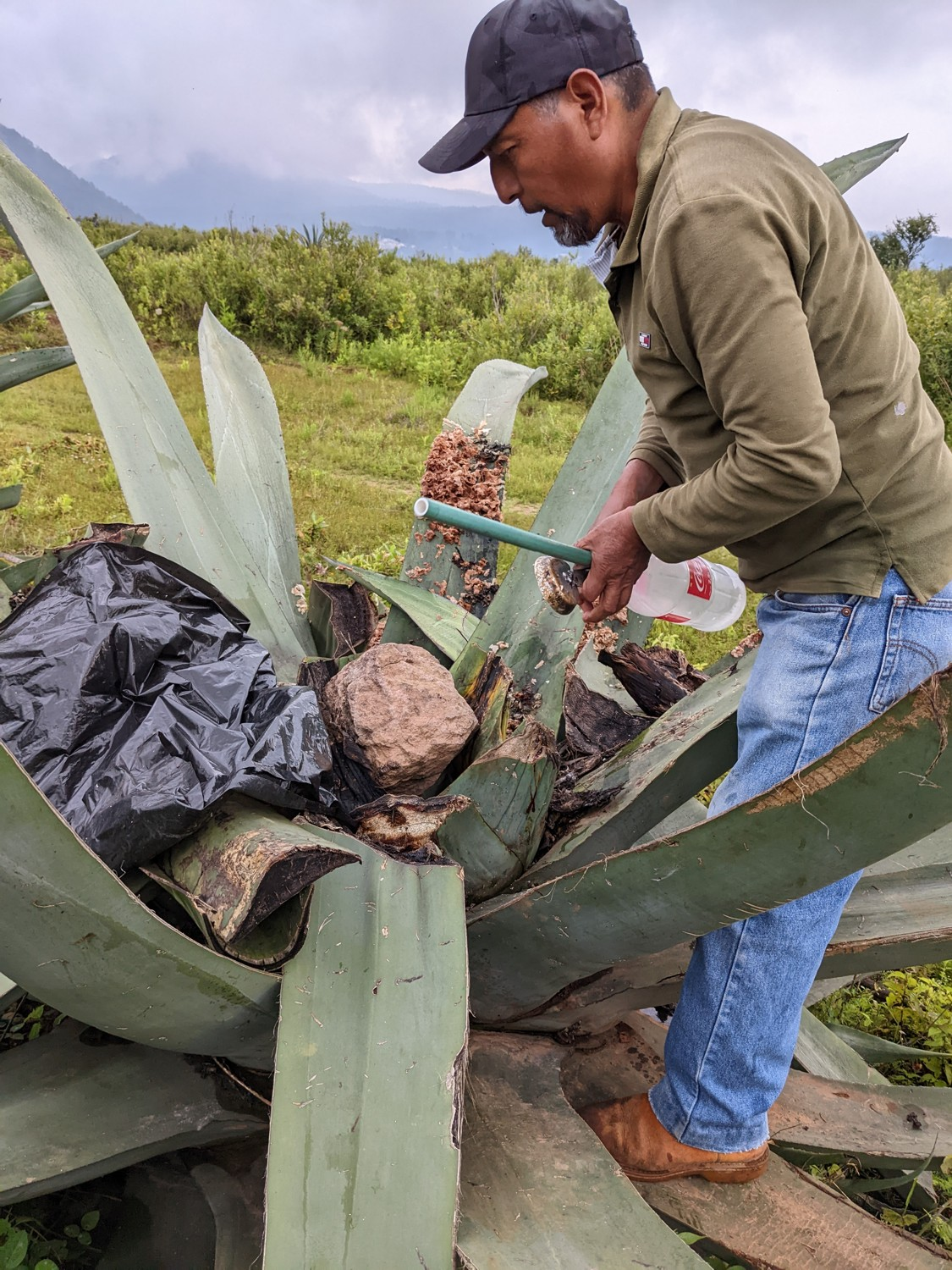
The tlachiquero, or aguamiel collector, removes the central growing point and prepares a cavity called a cajete. Scraping sustains the flow of aguamiel. Traditionally, a long gourd called an acocote draws out the liquid.
When we visited our friend Juan in Estado de México in October 2022, he collected aguamiel with a tube and a reused plastic bottle. The liquid had gathered in a cavity in the maguey’s center.
In Huitzilac, Morelos, Salvador Cueto, “Don Chava”, left prepared plants for five weeks before beginning twice-daily scraping and collection. One salmiana he managed had an estimated yield of about 335 liters of aguamiel over its full collection period. Huitzilac collection study.
Fresh aguamiel is sweet. Fermenting it with an active starter produces pulque: yeasts and bacteria turn its sugars into a milky, gently sour alcoholic drink with a viscous texture. In Tarímbaro, producers used sediment from the previous day’s pulque as a starter. Santiago Undameo producers briefly boiled the aguamiel, cooled it, then added their starter. Pulque fermentation, Michoacán practices.
Agave syrup from salmiana
Salmiana is also used to make agave syrup, alongside blue agave (A. tequilana). Fresh salmiana aguamiel can be heated to evaporate water and make a thick, sweet syrup. Our agave syrup guide explains this method, syrups made from harvested piñas, and their uses in drinks and cooking. Sources.
Cooking the piña for mezcal
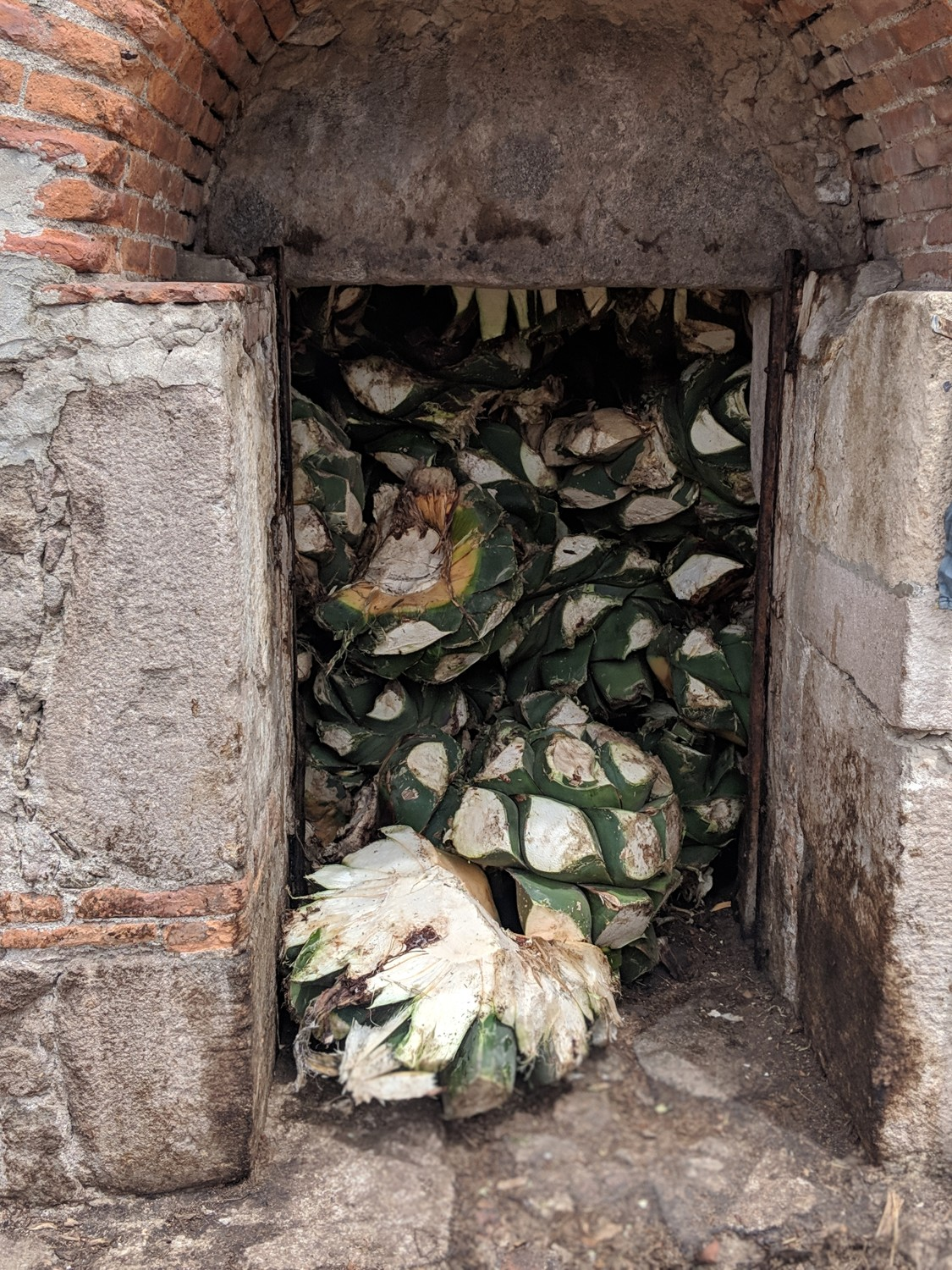
Above ground steam cooking is traditional in San Luis Potosí and often gives its salmiana mezcals a less smoky profile. Machetazo and Derrumbes are two examples of the state’s salmiana mezcal. San Luis Potosí production · Regional history.
Machetazo’s wild salmiana from Charcas
Machetazo steam-cooks its Charcas salmiana in an above ground masonry oven, crushes it with a tahona, ferments naturally in masonry vessels and distills twice in copper. Its US expression is 45% ABV in a 700 ml bottle. The maker describes floral and citrus aromas, a silky texture and fresh jalapeño on the finish. Machetazo’s US sheet.
Manuel Pérez’s Derrumbes San Luis Potosí
For Derrumbes San Luis Potosí, Manuel Pérez uses wild A. salmiana subsp. crassispina from the Altiplano. The maker describes dry agave leaves and quiotes as fuel, and calls the mezcal floral and herbaceous with a touch of sweetness. Derrumbes’ account.
Salmiana’s small share of certified mezcal
Verde (A. salmiana) accounted for about 1.3% of the mezcal production reported by COMERCAM for 2025, compared with about 85% for espadín. COMERCAM’s 2026 report, page 7, Table 2.
Production shares use the report’s volume basis of 45% ABV, with blends listed separately. These figures do not estimate uncertified output.
Pulque work, cooking leaves and Hñähñu fiber
Pulque haciendas supplied Mexico City during the colonial period; railways expanded the trade in the nineteenth century. Ignacio Torres Adalid, known as “El Rey del Pulque”, led efforts to preserve the drink for transport as beer became a growing competitor. Escalante and colleagues (2016).
Salmiana also grows in living fences and supplies fiber and cooking leaves. Hidalgo growers described Corriente in fences and fiber work, and Mutá leaves used in barbacoa. In Ixmiquilpan, Hidalgo, Alicia Reyes Samilpa’s 2016 research records Hñähñu use of both salmiana and mapisaga leaf fibers for woven articles such as ayates. Hidalgo uses, Table 2, Reyes Samilpa’s fiber research.
Renewing a magueyal
Michoacán growers selected vigorous offsets, the young plants beside a parent, and transplanted them into their agave fields, or magueyales. Pulque plants rarely flowered because preparing the center for aguamiel collection prevents the flower stalk from developing. Michoacán study.
Wild plants bring a different management concern. A 2016 study of three San Luis Potosí populations of A. salmiana subsp. crassispina found substantial genetic variation within them and identified poorly managed extraction as a pressure. Allowing some mature plants to flower and set seed helps sustain that diversity. Wild salmiana study.
Questions about salmiana
Does “maguey pulquero” always mean Agave salmiana?
No. “Maguey pulquero” describes an agave used for pulque; salmiana, mapisaga and other species can supply it. In Hidalgo, Penca larga at El Cubo is mapisaga; Corriente penca larga at Rancho La Coyotera is salmiana.
Is salmiana mezcal always smoky?
No. Steam cooking is traditional in San Luis Potosí’s salmiana mezcal industry and often produces less smoky spirits. Machetazo’s Charcas expression is one example. CIATEJ regional history, pp. 180–181.
Related reading
- Agave syrup: production methods and uses in drinks and cooking.
- Agave names used for mezcal: species, local names and bottle terminology.
- What a tlachiquero does: the collector’s work and aguamiel extraction.
Source notes
Pulque production and the approximate 4–7% ABV range: Escalante and colleagues (2016).
Machetazo’s US salmiana is 45% ABV; its technical sheet also describes Charcas production and plant age: Machetazo salmiana.
Large-form dimensions: UNAM Botanical Garden and García-Mendoza’s flora (2011), pages 53–55. The botanical ranges include smaller forms; the drawing uses a selected 2 m high plant.
Mature salmiana before and during quiote development: Godínez Hernández (2017), chapter 5. Aguamiel preparation before flowering: Escalante and colleagues.
Hidalgo ages and local names: Hidalgo grower study, Table 2; Charcas age: Machetazo. Age estimates follow each grower or maker’s account.
Salvador Cueto’s salmiana yield and collection practice: Huitzilac study (2020), methods and Table 5. Collection photographs and Juan’s visit: our tlachiquero article.
Selected cultivation areas: Michoacán grower study, the Hidalgo and Huitzilac studies above. Charcas mezcal: Machetazo. State outlines: INEGI; Mexico locator: Natural Earth. Kew records salmiana as native to Mexico.
Steam cooking in San Luis Potosí: CIATEJ regional history, pages 180–181.
Salmiana and blue agave for syrup: NMX-FF-110-SCFI-2008 declaration. Concentrated salmiana aguamiel: González-Montemayor and colleagues (2020), abstract and study description.