
Espadín’s narrow, spiny leaves are a familiar sight in Oaxaca’s fields. Growers raise new plants from offsets or seed and keep crops of different ages moving toward harvest. Makers then turn the cooked agave into mezcals shaped by their ovens, fermentation vessels, stills and family practices.
Espadín supplied about 85% of Mexico’s certified mezcal in 2025. Its botanical name is Agave angustifolia Haw., a species that includes many other locally named plants across Mexico and Central America. COMERCAM’s production figures
Explore Espadín
- Recognize Espadín by its narrow, spiny leaves
- Azul has broader leaves, but the plants can overlap in size
- Local names follow plants and communities
- Growers establish successive crops from offsets and seed
- Cutting the quiote changes the path to harvest
- Family practices shape the mezcal
- Taste the maker’s choices
- Espadín belongs to a longer history of cultivation and use
- Keeping plants for seed supports future crops
- Questions about Espadín
- Source notes
- Read further
Recognize Espadín by its narrow, spiny leaves
A mature Espadín spreads a fan of sword-like leaves around its center. García-Mendoza’s regional flora describes 40–70 leaves, commonly 60–100 cm long and 4–5 cm wide. Look for the combination of narrow blades, small teeth along their edges and a dark spine at each tip. Regional flora, pages 13–14
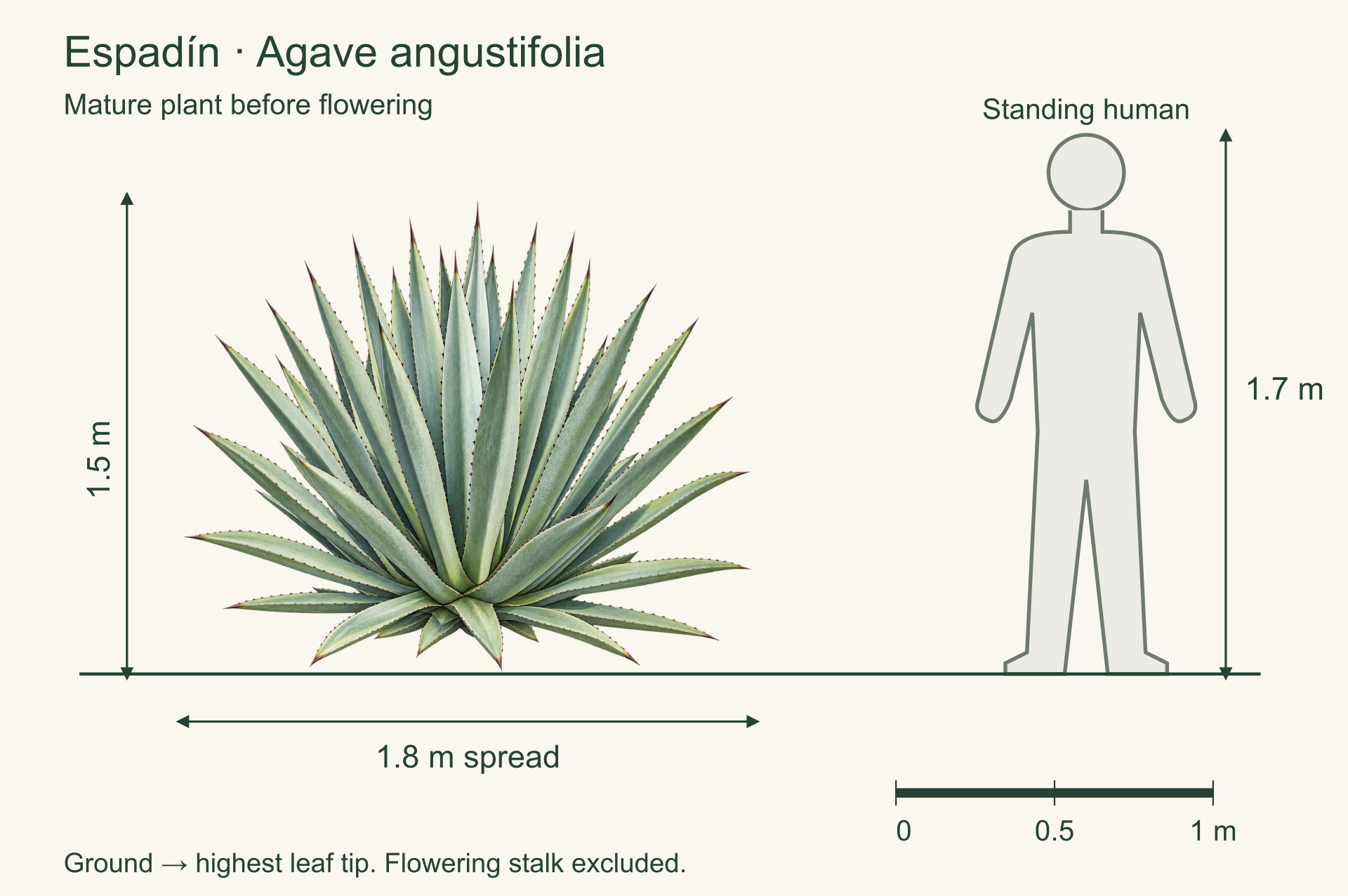
Espadín — A. angustifolia. Cultivated name familiar in Oaxaca.
Illustrated size: 1.5 m from ground to highest leaf tip × 1.8 m across. The standing person is 1.7 m tall; the scale bar is 1 m.
Enlarge Espadín at human scale
The teeth and tip spine are easier to see close up. The leaf drawing below uses separate enlargements for these small features, so each detail has its own scale.
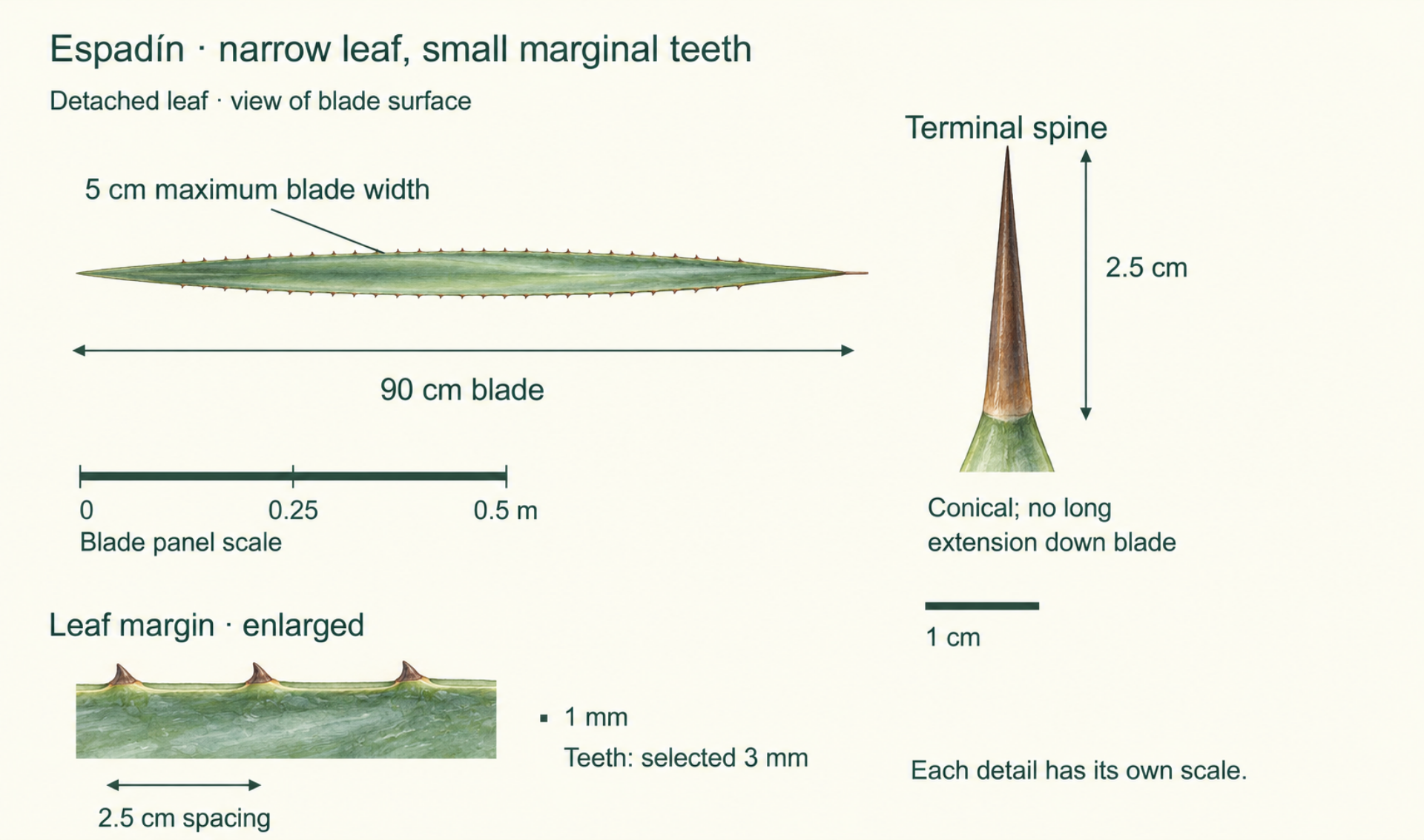
Espadín leaf — A. angustifolia. Based on the Tehuacán–Cuicatlán regional flora.
Chosen dimensions: blade 90 cm long × 5 cm wide; tip spine 2.5 cm long; edge teeth 3 mm long, spaced 2.5 cm apart. Each enlarged detail has its own bar.
Enlarge Espadín leaf details
Azul has broader leaves, but the plants can overlap in size
Azul, often called blue agave or Blue Weber in English, is the tequila agave. It has broader blades: UNAM describes leaves 90–120 cm long and 8–12 cm wide. Both agaves can form a rosette roughly as tall as a standing person. Their green to blue-gray colors also overlap, so color alone is a poor way to identify them. UNAM’s blue-agave description
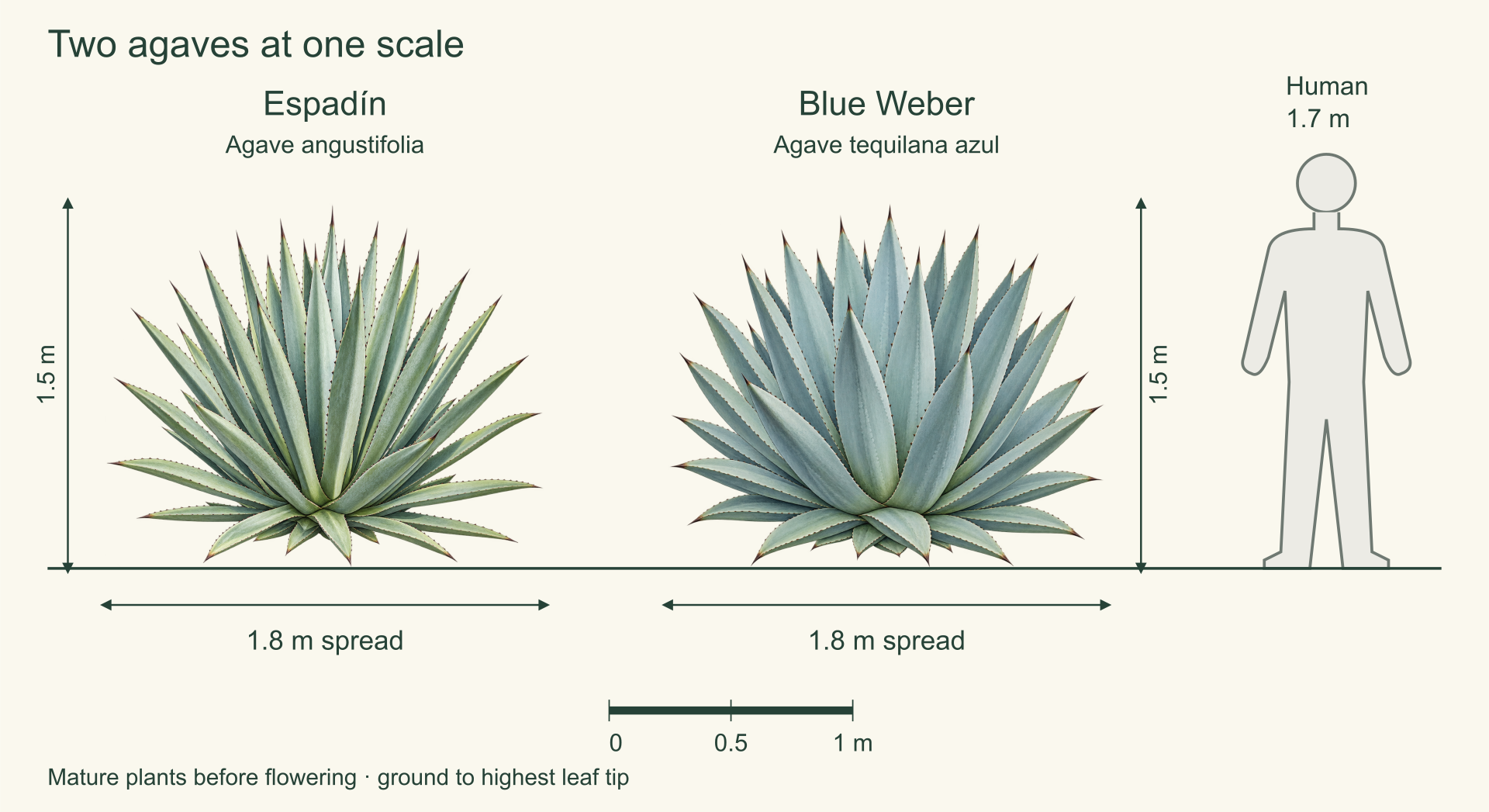
Espadín — A. angustifolia: the cultivated name familiar in Oaxaca. Azul — A. tequilana, blue selection: Mexico’s tequila agave. Both drawings show general mature forms before flowering.
Each illustrated plant: 1.5 m from ground to highest leaf tip × 1.8 m across. All figures share one scale and ground line, with a 1.7 m person and a 1 m bar.
Enlarge Espadín and Azul
Kew accepts A. angustifolia and A. tequilana as separate species. Espadín is a cultivated local name within the first; Azul is the form specified for tequila within the second. Growers’ knowledge of a plant’s origin matters alongside its appearance. A 2022 study in Jalisco found complex genetic and morphological relationships among traditionally named spirit-producing agaves. Kew: angustifolia · Kew: tequilana · Cabrera-Toledo and colleagues
Local names follow plants and communities
Espadín is the familiar cultivated name in Oaxaca. Espadilla appears for A. angustifolia var. angustifolia in García-Mendoza’s flora of Tehuacán–Cuicatlán. In coastal and southern Jalisco, the landrace study records Amarillo, Lineño and Ixtero Amarillo among distinct local plants in the broader A. angustifolia complex. Those names carry growers’ distinctions and traditions, including those of raicilla-producing regions.
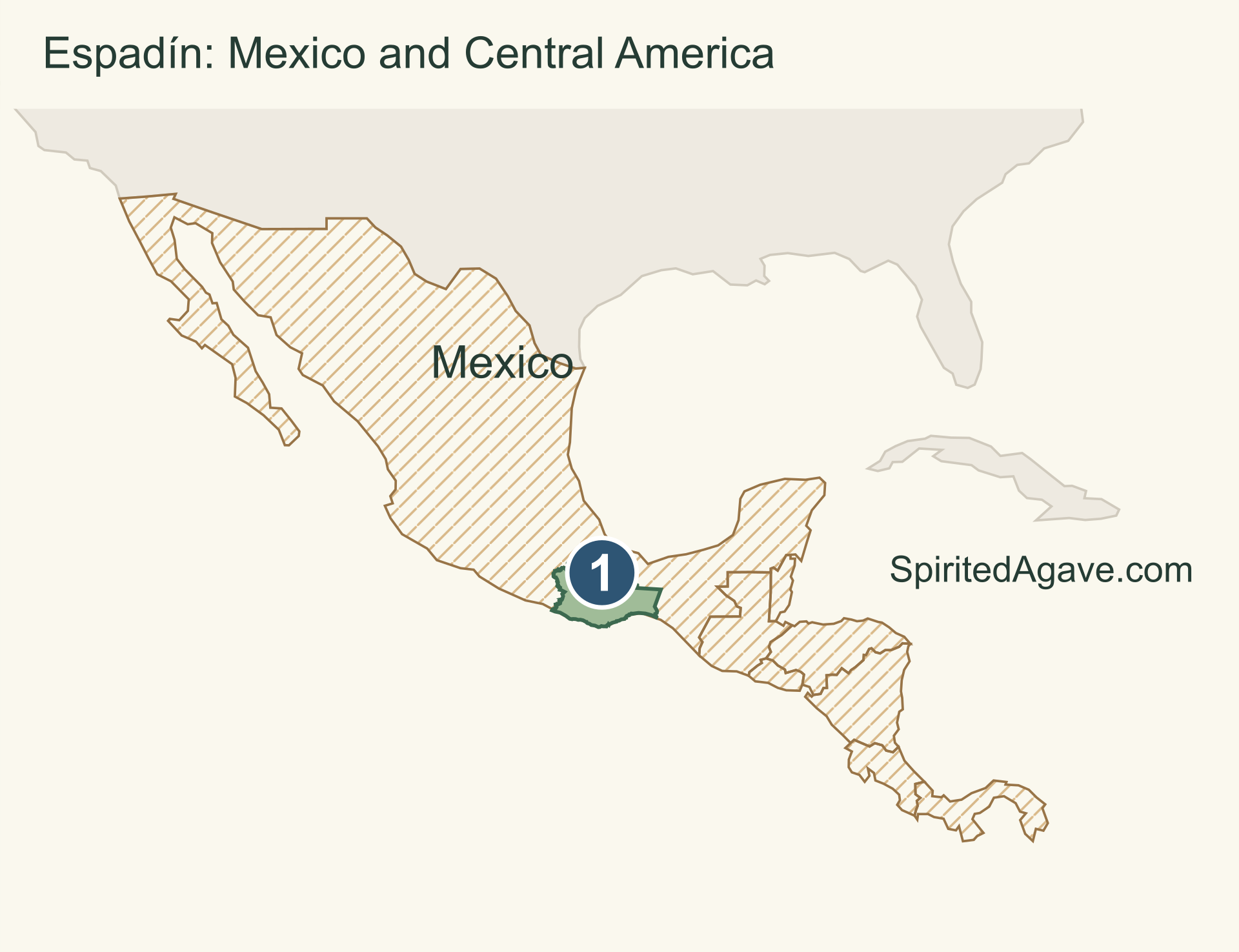
The wider species is native to Mexico and Central America. The regional flora describes it in tropical dry forest, dry scrub and transitions toward oak woodland. Its local forms have different leaf proportions, sizes and uses. The guide to agaves used for mezcal offers a route through more of these names.
Kew also records A. angustifolia introduced in Queensland, India and parts of South Africa. In California, the Agave Growers association advertised Mexican Espadín planting material for spring 2026. California planting notice
Growers establish successive crops from offsets and seed
Offsets, commonly called hijuelos, give growers new plants from an existing agave. Seed offers another route. The 2023 UNAM/GIZ guide recommends establishing young plants around the rains, when moisture helps them take root. CEMOSA describes planting in April and May and keeping crops of different ages for future harvests. Grower guide, page 32 · CEMOSA’s cultivation account
Espadín can mature in 6–9 years, depending on climate, soil and management. Some makers wait longer: Real Minero lists 10-year-old plants for its Espadín, while CEMOSA describes harvest at 8–12 years. A 2022 survey of producers in Oaxaca’s Central Valleys and Sierra Sur found an average harvest age of about seven years. Real Minero Espadín · Moreno-León and colleagues, Table 5
Cutting the quiote changes the path to harvest
As an agave approaches flowering, it sends up a quiote, the flowering stalk. Some growers cut the emerging stalk and leave the plant standing before harvest. NETA describes Cándido García Cruz’s Espadín in Logoche, Oaxaca, as quiotudo: plants managed this way before his March 2015 production. NETA’s production account
Family practices shape the mezcal
Harvesting removes the leaves and leaves the central head, or piña, for cooking. Makers break up the cooked material, ferment it and distill it. A bottle labeled Espadín can reflect many different choices along that route.
In March 2015, Cándido García Cruz and his family harvested Espadín grown alongside alternating food crops in Logoche. They roasted the piñas with mesquite in an earth oven, rested the cooked agave for a week, then chopped and mechanically milled it. Fermentation in Montezuma cypress tanks included 16 days after water was added. García Cruz and his daughters worked the copper pot stills.
Equipo Real Minero makes Espadín from agaves grown in Oaxaca’s Central Valleys. Production uses an earth oven, an electric shredder, spontaneous fermentation with native yeasts and two distillations in stacked clay pots. Alcohol strength varies by lot.
For Del Maguey Chichicapa, Faustino García Vásquez works in San Balthazar Chichicapam, Oaxaca. The agave is milled in a molino and distilled twice in wood-fired copper stills. Chichicapa is bottled at 48% ABV. Real Minero’s listing · Chichicapa page · Producer sheet
Taste the maker’s choices
Del Maguey describes Chichicapa with earthy sweetness, roasted agave, chipotle, baking chocolate and mint.
Explore more named makers and their methods in the Oaxaca mezcal guide.
Espadín belongs to a longer history of cultivation and use
Adrian Haworth published the name A. angustifolia in 1812. In 2003, Abisaí García-Mendoza and Fernando Chiang argued that it was distinct from A. vivipara and designated a new reference specimen collected near Tutla, Oaxaca, in 1992. Their paper also documents fiber-growing forms in Tamaulipas and Veracruz, and in El Salvador and Guatemala. García-Mendoza and Chiang
In the Tehuacán Valley, a 2014 study records young plants and developing flowering stalks of A. angustifolia var. angustifolia as livestock fodder. The cooked piña familiar to mezcal drinkers is one use among several for the broader species. Torres and colleagues
Modern trade has carried individual makers’ Espadíns much farther. Del Maguey identifies Chichicapa as one of its first two expressions introduced in the United States in 1995, taking that community’s mezcal to new drinkers.
Keeping plants for seed supports future crops
Offsets make it possible to multiply a desired plant. Repeatedly planting a small number of clones also narrows genetic variety. Torres and colleagues described this pressure in intensive A. angustifolia plantations in the Tehuacán Valley, alongside the replacement of forest vegetation.
Leaving some plants to flower allows seed reproduction. The 2023 grower guide includes seed production and flowering among its conservation practices.
Real Minero’s Lorenzo Ángeles Mendoza project, founded in 2018, describes a regional seed bank and propagation work with several agaves. Real Minero’s environmental and social projects
Questions about Espadín
Is Espadín the same as Agave angustifolia?
Espadín is a cultivated local name for plants within Agave angustifolia, especially familiar in Oaxaca. The botanical species also includes other locally named forms across its wider native range.
Can Espadín be used to make tequila?
No. Tequila’s standard specifies “Agave tequilana Weber variedad azul”. Espadín belongs to A. angustifolia and is widely used for mezcal. Tequila standard, sections 4.2 and 6.2
How long does Espadín take to grow for mezcal?
Espadín can reach maturity in 6–9 years. Some producers describe older plants: Real Minero lists ten years, and CEMOSA gives 8–12 years for harvest. Climate, soil, management and the grower’s harvest decisions affect the timing.
Does all Espadín mezcal taste smoky?
No. Bowler’s Q4 2020 notes for Viejo Indecente Espadín describe steam cooking and a tasting profile without smoke. NETA documents mesquite-fired earth-oven roasting for Cándido García Cruz’s March 2015 Espadín. Cooking and the maker’s other choices help shape the finished flavor. Bowler’s notes, page 5 · NETA’s production account
Where is Agave angustifolia native?
Agave angustifolia is native to Mexico and Central America, according to Kew. Cultivated Espadín is strongly associated with Oaxaca; the wider species also includes wild plants and other locally named forms.
Source notes
COMERCAM’s Informe Estadístico 2026, page 7, gives Espadín 84.53% of Mexico’s 6,912,256 liters of certified mezcal in 2025, expressed at 45% ABV.
The plant drawings use chosen sizes within published ranges. García-Mendoza’s flora gives the leafy rosette as 1–1.5 m high, occasionally 2 m, and 1.5–2 m across. Its usual leaf dimensions are 60–100 cm × 4–5 cm, with occasional leaves up to 130 cm long or 8 cm wide. The 2023 grower guide illustrates Espadín at 1.5–2 m high and wide. Azul’s 1.5 m × 1.8 m drawing falls within NParks’ 1.2–1.8 m height and spread; its partly hidden short stem is included. These sources do not supply precise height endpoints for a measured individual Azul plant. NParks plant record
The 2022 harvest survey covered 73 producers in 15 municipalities of Oaxaca’s Central Valleys and Sierra Sur. Its mean Espadín harvest age was 7.19 years. The cited age accounts do not consistently state whether counting begins with a seedling, an offset or a nursery stage. NETA’s account also leaves the extra standing time after cutting the quiote unspecified.
Read further
The guide to agaves used for mezcal connects Espadín with other local names. For plant identification, read García-Mendoza’s regional flora alongside the illustrated 2023 grower guide.