
Oaxaca produced 89.47% of Mexico’s reported certified mezcal in 2025. Its industry includes internationally distributed brands, grower cooperatives and family palenques making small batches. Espadín, pit ovens and copper stills are familiar features, alongside a much wider range of agaves and local techniques. 11
Mezcal from the valleys and southern highlands
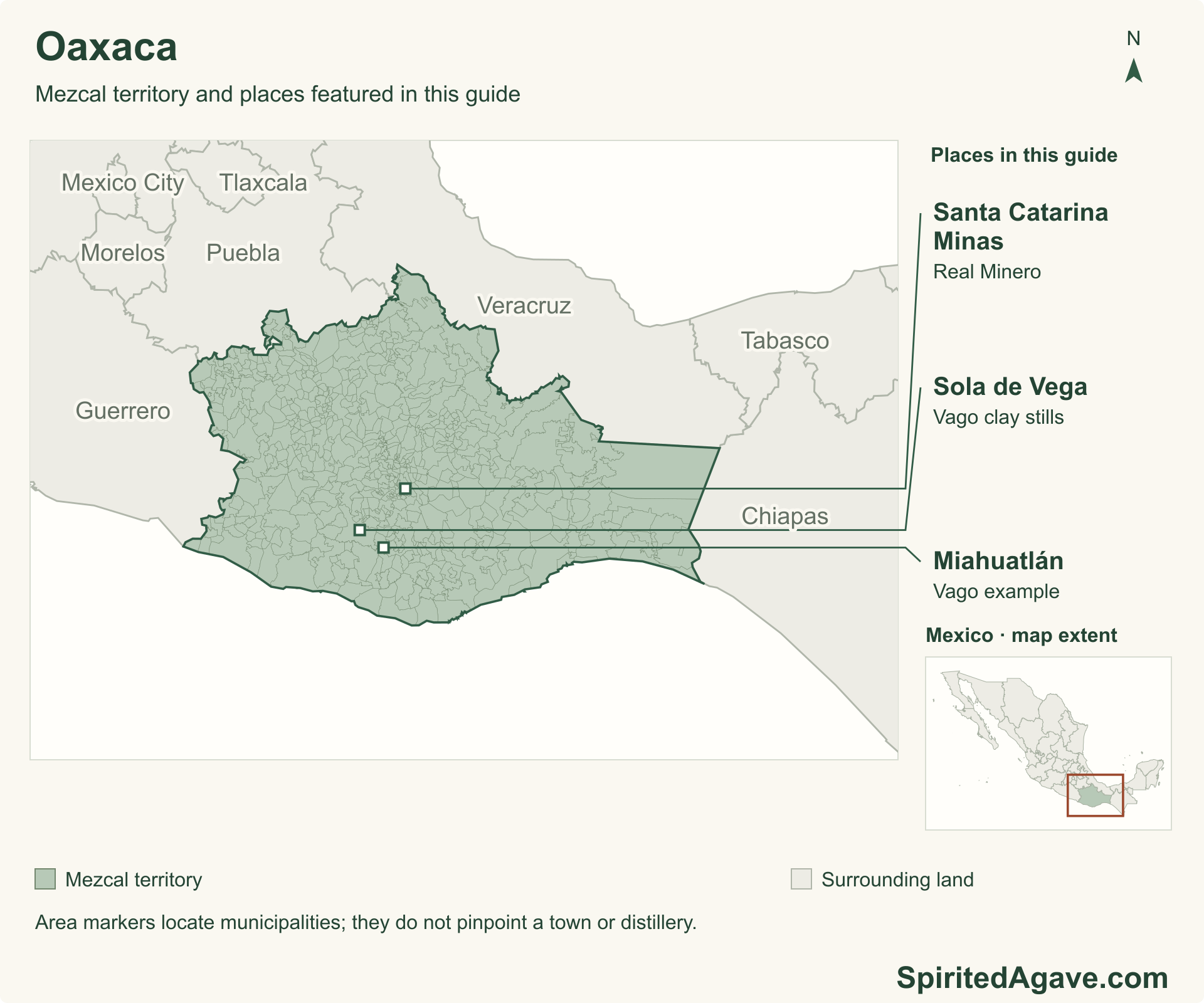
Important production areas include Santiago Matatlán and the valleys around Tlacolula and Ocotlán, along with Ejutla, Miahuatlán and Sola de Vega in the southern highlands. In Oaxaca, a distillery is called a palenque. 13
Estate producers used copper stills, while families also made agave spirits with stacked clay pots and reeds. 13
Artesanal, ancestral and the Mezcal category
Certified mezcal has three production categories: Mezcal, Mezcal Artesanal and Mezcal Ancestral. Each sets rules for cooking, crushing, fermentation and distillation. Artesanal permits a wider range of equipment than ancestral, including mechanical shredders and copper stills. 16
Artesanal accounted for 91.03% of Mexico’s reported certified production in 2025. Ancestral, with its pit ovens and clay pot distillation, accounted for 0.77%. 17
| Category | Main equipment distinctions | National share |
|---|---|---|
| Mezcal Artesanal | Pit or masonry ovens; hand tools, tahonas or permitted mills and shredders; copper or clay pots heated directly. | 91.03% |
| Mezcal | The broadest equipment options, including autoclaves, roller mills, diffusers and continuous distillation. | 8.20% |
| Mezcal Ancestral | Pit ovens; hand tools, tahonas or Chilean/Egyptian mills; clay pots heated directly, with clay or wooden heads. | 0.77% |
National certified production, 2025. The full equipment requirements are in NOM-070. 16 17
“Industrial” is an informal name sometimes used for the Mezcal category. Joven, reposado and añejo describe classes within those categories. Our guide to mezcal classifications explains the production rules and label terms. 16
400 Conejos, Montelobos and other major brands
400 Conejos is made in Santiago Matatlán and belongs to Becle, the company behind José Cuervo. It led Impact Databank’s estimated US mezcal sales for 2025, ahead of Del Maguey and Ilegal. 18 19
| Brand | Owner | Oaxaca expression or production area |
|---|---|---|
| 400 Conejos | Becle, which also owns José Cuervo | Espadín Joven; Santiago Matatlán. 19 |
| Del Maguey | Pernod Ricard, majority owner | Vida Clásico; San Luis del Río. 20 |
| Ilegal | Bacardi | Espadín mezcal from Santiago Matatlán; certified artesanal. 21 |
| Banhez | UPADEC grower and producer cooperative | Cooperative production in Ejutla. 22 |
| Casamigos | Diageo | Mezcal Joven made from espadín in Oaxaca. 23 |
| Montelobos | Campari | Espadín and Pechuga; Santiago Matatlán. 24 |
Montelobos Espadín is pit roasted, crushed with a mule powered tahona, fermented in open pine vats and distilled in copper pots. Its Tobalá and Ensamble come from Puebla. Campari acquired the remaining stake in Montelobos in 2024, becoming its sole owner. 24
Banhez offers a different ownership model: the families of the UPADEC cooperative own and operate the brand. Its Ejutla production uses pit ovens, tahonas, wooden fermentation vats and copper refrescador stills. 22
See the leading mezcal brands for sales figures and bar-survey results, and our guide to the spirits groups behind tequila and mezcal brands for more on Becle, Campari, Bacardi and Pernod Ricard.
Espadín, tobalá, tepeztate and many other agaves
Espadín (A. angustifolia) is widely used in Oaxaca, including the familiar expressions from 400 Conejos, Ilegal and Montelobos. Across Mexico, the espadín category accounted for 84.53% of reported certified production in 2025. 14 19 21 24
Other Oaxaca agaves include tobalá (A. potatorum), tepeztate (A. marmorata) and the stem forming karwinskii agaves. Local karwinskii names include largo, cuishe and madrecuishe. Mezcal made from a mixture of agaves is often called an ensamble. 3 13
Fieldwork in Oaxaca and Puebla during 2017–2018 documented eleven locally distinguished forms of A. karwinskii. Growers used some as living fences and propagated them from seed as well as vegetatively. 4
Pit roasting, fermentation and different stills
In many Oaxaca palenques, agave cooks over heated stones in an earth pit, covered to hold in the heat. A tahona, a heavy stone wheel, crushes the cooked agave; other distilleries use wooden mallets or mechanical shredders. Fermentation often includes the crushed agave fibers. Vessels include wooden vats, clay containers and, in some communities, cowhides. 13
Copper pot stills and clay pot stills both have long local histories. Some copper stills use a refrescador: a water cooled section around the upper chamber that condenses part of the vapor back into the boiler. The outgoing vapor then passes through an external cooling coil. In a stacked clay pot still, a cooled bowl at the top condenses vapor inside the apparatus, where a channel collects the spirit. 6 7 13
These differences are easier to see in specific palenques. The profiles below illustrate particular methods and family histories.
Producer examples: Vago’s copper and clay pot mezcals
In Miahuatlán, Emigdio Jarquín’s espadín for Vago is roasted for an average of five to seven days, crushed with an ox drawn tahona, fermented in wooden vats and distilled twice in copper. His madrecuishe and arroqueño use a copper refrescador. 6
In Sola de Vega, Tío Rey crushes agave by hand with wooden mallets and distills in stacked clay pots. His Vago ensambles combine different agaves and proportions between batches. 7 12
Producer profile: Real Minero in Santa Catarina Minas
The family behind Real Minero traces its distilling tradition to the late nineteenth century. It opened a shop in Ocotlán in 1994, selling mezcal in plastic containers and reused bottles, then began exporting to Germany in 2010 and the US in 2015. 9
Real Minero’s Espadín y Largo combines two agave species. It is cooked in an earth pit, crushed with an electric shredder, fermented with well water and distilled twice in clay pots. The brand changed its labels to destilado de agave in 2022. 3 8 10
Its Proyecto LAM, founded in 2018, maintains a seed bank, propagates plants and keeps a living collection of regional agaves. 5
Producer example: Ixcateco’s cowhide fermentation
In Santa María Ixcatlán, Ixcateco cuts and pounds cooked papalomé (A. potatorum) with wooden mallets, ferments it in cowhide vessels and distills twice in clay pots. It sells the spirit as an agave distillate. 15
Compare Oaxaca with Durango
Share of Mexico’s certified mezcal production reported for 2025
Durango
2.12%
- Agaves include
- Cenizo (A. durangensis)
- Lamparillo (A. asperrima)
- Manso / chacaleño
- Cooking
- Pit ovens
- Distilling
- Copper/wood, external coil; Steel then copper; Copper pots
Oaxaca
89.47%
- Agaves include
- Espadín (A. angustifolia)
- Tobalá (A. potatorum)
- Tepeztate (A. marmorata)
- Karwinskii forms (A. karwinskii)
- Cooking
- Pit ovens
- Distilling
- Copper pots; Clay pots; Copper refrescador
Both bars use a 0–100% scale. Production: COMERCAM 2026 report, page 4. Plants and methods are selections explained in the guides.SpiritedAgave.com
Questions about Oaxaca mezcal
Is clay distilled Oaxaca mezcal always made with hand crushed agave?
No. Some producers crush by hand, while others use mechanical shredders before clay pot distillation. Mezcal Ancestral certification requires the full ancestral process, including its specified crushing methods. 7 8 16
Why do some Oaxaca bottles say agave distillate?
Spirits sold outside Mezcal certification use another designation, such as destilado de agave. Real Minero changed its labels in 2022. 10
Explore another tradition
Continue with San Luis Potosí’s salmiana and steam ovens or Durango’s cenizo and vinatas. For broader background, see the mezcal guide and agaves used for mezcal.
Sources and notes
Maps adapted by Spirited Agave from INEGI’s Marco Geoestadístico, December 2025. Spirited Agave added the labels and geographic highlighting.
- Territory source
- Vago’s range; Emigdio Jarquín; Tío Rey; Real Minero’s 375 mL product sheet
- Real Minero
- Traditional knowledge and management of Agave karwinskii
- Proyecto LAM
- Vago’s maker profile
- Tío Rey’s process
- Espadín y Largo specifications
- Real Minero’s history
- Label and production changes
- COMERCAM 2026 report, page 4 Production figures are for 2025, normalized to 45% ABV; the report does not estimate uncertified state output.
- Vago’s range; Real Minero’s specifications
- CIATEJ–AGARED, Panorama del aprovechamiento de los agaves en México, 2017, pp. 176–179 Regional production places, plants and traditional equipment; historical volume figures superseded here by the 2025 COMERCAM report.
- COMERCAM 2026 report, page 7 2025 national production by agave category.
- Ixcateco: agave spirit and palenque Undated producer account, read 9 October 2026; CIATEJ’s Regionalismos, Cuero entry, p. 75 also documents the locality. The producer uses agave spirit as its designation.
- NOM-070-SCFI-2016, sections 4.2 and 4.4.1–4.4.3. Production-category definitions; full requirements apply across cooking, milling, fermentation and distillation.
- COMERCAM 2026 report, page 6, chart 2. National reported certified production in 2025: 6,912,256 liters at 45% ABV. Artesanal 91.03%, Mezcal 8.20%, Ancestral 0.77%. The report gives no Oaxaca-only category breakdown.
- Impact Databank’s leading US mezcal brands, 25 February 2026. Estimated 2025 US sales in nine-liter cases: 400 Conejos 87,000; Del Maguey 86,000; Ilegal 79,000; Banhez 62,000; Casamigos 26,000. These are brand sales estimates, not Oaxaca production totals.
- Becle annual report 2025, page 91. Ownership and Santiago Matatlán production; 400 Conejos Joven identifies espadín and Oaxaca.
- Pernod Ricard’s completed majority acquisition, 1 August 2017. Del Maguey Vida Clásico: espadín from San Luis del Río. Other expressions have other origins, including Puebla.
- Bacardi’s Ilegal acquisition, 11 September 2023. Sole ownership, Santiago Matatlán production and certified artesanal description.
- Banhez and the UPADEC cooperative. Ownership and Ejutla origin; Banhez production methods.
- Diageo’s Casamigos portfolio. Casamigos production: Oaxaca espadín mezcal.
- Campari annual report 2024, pages 29, 48 and 291. Acquisition of the remaining 49% of Casa Montelobos in September 2024. Brand pages place Espadín and Pechuga in Santiago Matatlán, Oaxaca; Tobalá and Ensamble in San Nicolás Huajuapan, Puebla.