
In Morelos, agave distilling is part of rural life in communities such as Palpan de Baranda and Tlajotla. Local criollo agaves grow among food crops and trees, while newer plantations and businesses around Tepoztlán are expanding production.
Southern and western Morelos have a long local distilling tradition
Morelos’s rural distilling tradition predates its recent territorial recognition. Researchers at the state’s university describe more than a century of production in the south and west, using agaves gathered in nearby woodland or grown among other crops. Small-scale local sales were part of those communities’ agricultural life. 3
By the late 1990s, outside commercial interest was encouraging Azul cultivation. Later investment in mezcal brought further planting. In their 2022 account, the researchers describe mixed farms and specialized agave plantations existing side by side, with expansion placing pressure on woodland, milpas and orchards.
Criollo agaves grow among crops and trees
In a December 2022 account, researchers from the Universidad Autónoma del Estado de Morelos described local criollo Agave angustifolia grown in mixed agricultural systems. They discussed agaves alongside crops and trees such as maize, sorghum, plums and copal, as well as earlier reliance on plants gathered from surrounding woodland. 3
A mixed farm can provide food, fruit, fuelwood and agave from the same holding. Replacing it with a single crop changes both the landscape and the range of things the family can produce.
Palpan and Tlajotla distill local criollo agaves
Palpan de Baranda and Tlajotla are in Miacatlán, Morelos, near the distilling communities of southern Estado de México. Fieldwork in 2018 documented their production together. 1
The distilleries included seasonal small producers and cooperatives working throughout the year. Across the communities studied in Morelos and Estado de México, the researchers recorded conical earth ovens, hand tools for crushing, and steel or plastic fermentation drums. Distilling apparatus combined wooden or copper vessels with clay or metal upper chambers and copper coils cooled in water tanks. The equipment varied between distilleries. 1
The June 2025 resolution names twenty-three municipalities
IMPI’s resolution published on 25 June 2025 names Amacuzac, Axochiapan, Ayala, Coatlán del Río, Emiliano Zapata, Jantetelco, Jiutepec, Jojutla, Jonacatepec, Mazatepec, Miacatlán, Puente de Ixtla, Temixco, Temoac, Tepalcingo, Tepoztlán, Tetecala, Tlaltizapán de Zapata, Tlaquiltenango, Xochitepec, Yautepec, Zacatepec and Zacualpan de Amilpas. 5
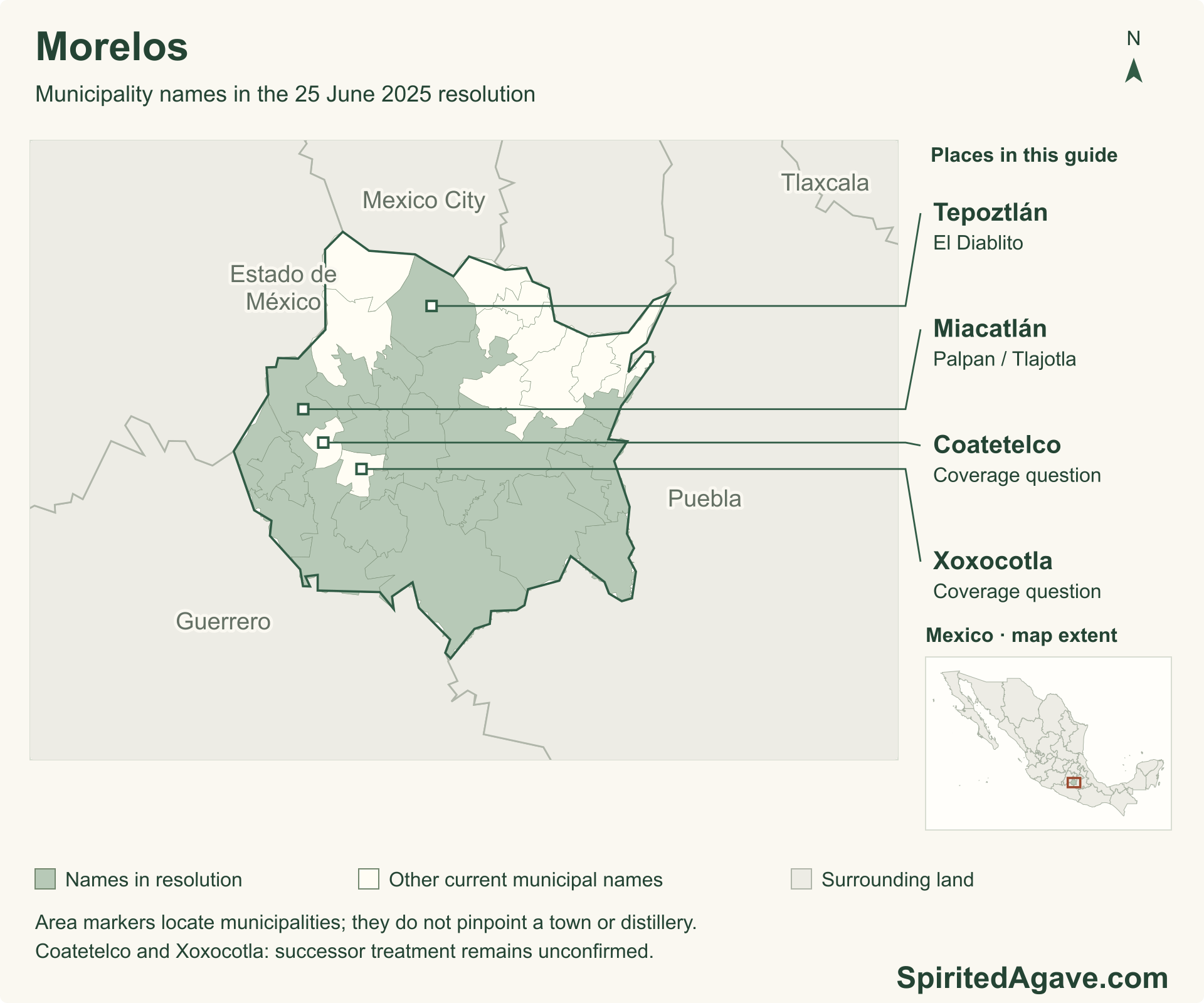
The municipal boundaries changed during the application process. Morelos submitted its request in 2016–2017. Coatetelco and Xoxocotla were created from parts of Miacatlán and Puente de Ixtla under decrees published in December 2017, followed by boundary agreements in 2019: Miacatlán–Coatetelco and Puente de Ixtla–Xoxocotla. The June 2025 resolution names the parent municipalities but does not address the two successors. IMPI confirmation is still needed for their territory. Pale shading on this map means that a current municipality name is absent from the resolution’s list.
The resolution also recounts the litigation following Morelos’s original August 2018 inclusion. That history explains why older descriptions of the denomination differ.
Morelos in the production figures
COMERCAM’s 2025 certified-production table does not list Morelos separately. It supplies no estimate for the state’s wider local agave-spirit production. 6
Two Morelos producer examples
Palpeño: criollo spirits from Tlajotla
Palpeño is based in Palpan de Baranda and distills in nearby Tlajotla. Its producer Alfonso described working with local criollo magueys in a July 2023 interview. 2
Alfonso described an expression rested in glass with an agave leaf and a pechuga made with chicken, beef, almonds, chocolate and raisins. He called the first expression reposado, although it rested in glass rather than a barrel.
El Diablito grows and distills espadín in Tepoztlán
El Diablito in Tepoztlán raises espadín (Agave angustifolia) from bulbils, grows the young plants in a nursery, and cultivates, distills and bottles its own mezcal. Morelos’s economic development department described it as the state’s first certified mezcal brand during an August 2026 visit. 4
| Producer | Distilling location | Agave |
|---|---|---|
| Palpeño | Tlajotla, Miacatlán | Local criollo magueys |
| El Diablito | Tepoztlán | Espadín, A. angustifolia |
Questions about Morelos mezcal
Where is Palpan de Baranda?
Palpan de Baranda is in the municipality of Miacatlán, in western Morelos, near the border with Estado de México.
Which agave is called criollo in Morelos?
Researchers studying Morelos in 2022 identified its local criollo agave as Agave angustifolia. Criollo is a regional name whose meaning can change elsewhere.
Explore the neighboring distilleries
Follow the family distilleries of Estado de México, compare Guerrero’s papalote traditions, or explore the local agave names of Puebla.
Sources and notes
Maps adapted by Spirited Agave from INEGI’s Marco Geoestadístico, December 2025. Spirited Agave added the labels and geographic highlighting.
- Castillo Nonato and Montes de Oca Hernández, 2019
- Palpeño’s directory profile; Diario de Morelos interview, 7 July 2023
- Blancas and colleagues on Morelos agave cultivation
- Morelos government’s El Diablito visit, 1 August 2026
- IMPI’s Morelos resolution
- COMERCAM 2026 report, page 4 Production figures are for 2025, normalized to 45% ABV; the report does not estimate uncertified state output.