
San Luis Potosí has more than two centuries of mezcal history. Its characteristic agave is salmiana, and steam cooking gives many of its mezcals an herbal, less smoky character than the pit roasted styles familiar from Oaxaca.1, 2
Salmiana grows abundantly on the dry high plateau in the north and west of San Luis Potosí, known as the Altiplano. Haciendas in this region combined mezcal production with farming and livestock. Today, both estate distilleries and small family distilleries make mezcal in the state.1, 2
Mezcal was a major hacienda business
By the nineteenth century, San Luis Potosí’s mezcal trade supplied markets in Zacatecas and Guanajuato as well as its home state. Larger factories made vino de chorrera; small producers with less capital made vino de campanilla, using clay distillation equipment.1
- Eighteenth century: Laguna Seca was among the haciendas producing mezcal. The distillery still makes salmiana mezcal today, in Charcas municipality.1, 12
- 1864: Physician Aniceto Ortega recorded how potosino mezcal was made, describing an already established industry.
- 1990s: Some hacienda distilleries restarted production after long interruptions.1, 2
In El Palmar, Mexquitic de Carmona, five local families make mezcal under separate labels. Visitors buying directly at the distilleries are an important source of sales, alongside distributors. One of those families, Daniel Navarro’s, makes Campanilla and grows replacement agaves in its own nursery; Navarro also described small exports to Germany and Italy.3
Where mezcal is made in San Luis Potosí
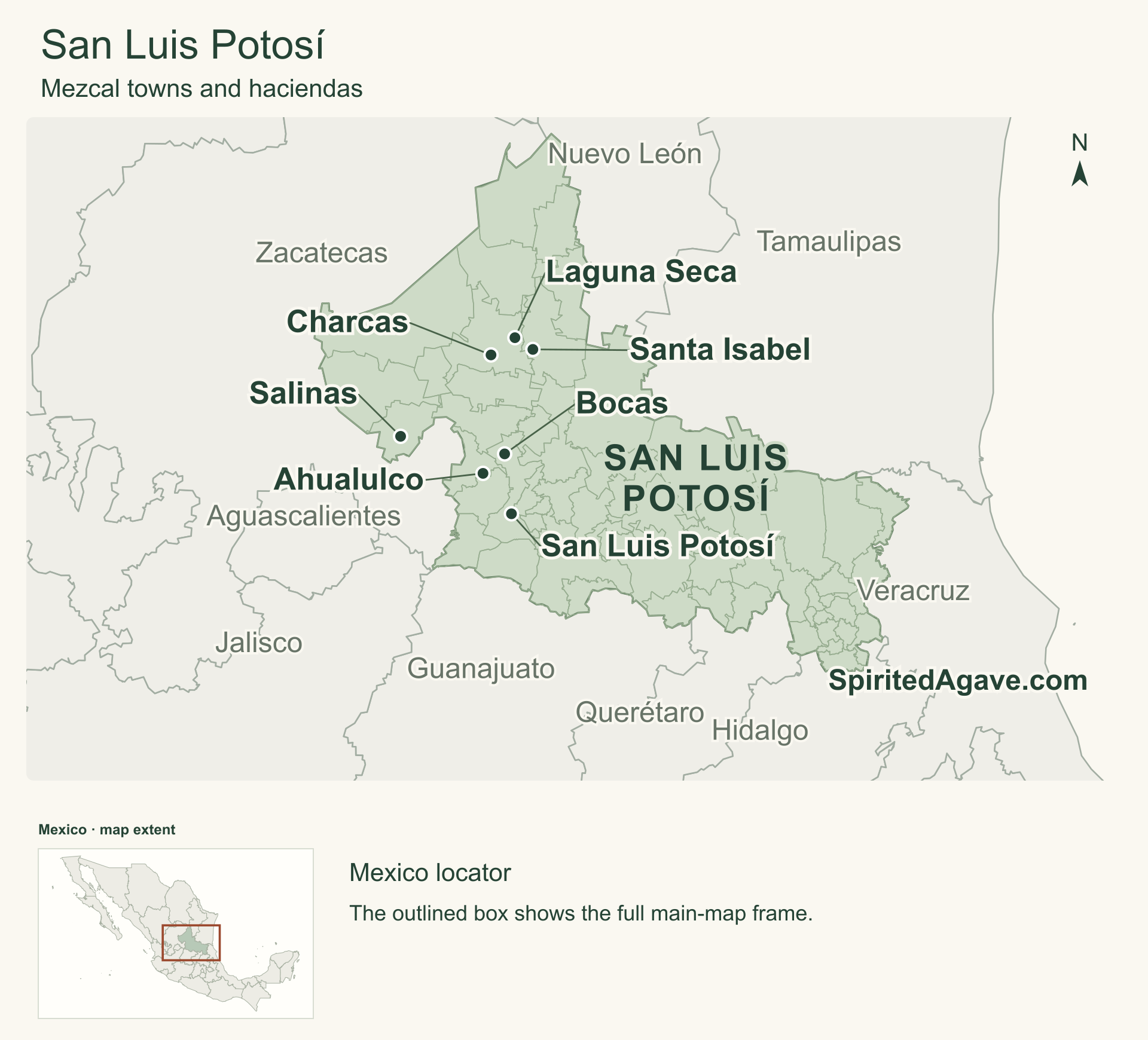
Charcas, Ahualulco and Salinas are part of the state’s historic mezcal country. Laguna Seca lies east of Charcas, and Hacienda Santa Isabel is farther east in Villa de Guadalupe municipality. Bocas, north of the state capital, is home to Derrumbes San Luis Potosí.2, 4, 11, 12 The entire state is included in the Mezcal denomination of origin.5
Steam cooking is part of the regional style
Steam heated masonry ovens are characteristic of San Luis Potosí’s hacienda tradition. The agaves cook above ground, without the direct exposure to smoke associated with an earth pit. This has more in common with traditional tequila cooking than with the pit roasting used for many Oaxacan mezcals.2
The result is often less smoky, leaving more room for salmiana’s green, herbal flavors. Machetazo’s salmiana, for example, has floral, citrus and fresh jalapeño notes in the maker’s tasting description.6
Wild and cultivated salmiana
Salmiana is both wild and cultivated in San Luis Potosí. The form traditionally used for the state’s mezcal is Agave salmiana subsp. crassispina, also called maguey verde. Machetazo and Derrumbes use wild plants; the Navarro family grows seedlings from seed and plants young agaves to replenish its future supply.2, 3, 6, 10, 11
Wild salmiana populations hold considerable genetic diversity. Leaving some mature plants to flower provides seed for the next generation, alongside the young plants that sprout from established agaves.7
Across Mexico, salmiana accounted for 1.33% of certified mezcal production in 2025; espadín accounted for 84.53%.9
Producer examples from San Luis Potosí
Machetazo in Charcas
Machetazo’s salmiana is steam cooked in masonry ovens, crushed with a stone tahona, fermented naturally in masonry vats and distilled twice in copper. Its US edition is 45% ABV; the Mexico edition is 42%.6
Cook and crush
Steam oven → stone tahona
Ferment and distill
Masonry vats → two copper distillations
Juan José “Che” Hernández at Hacienda Santa Isabel
Juan José “Che” Hernández makes Mezcal de Leyendas Verde from salmiana at Hacienda Santa Isabel. It is an unaged mezcal at 45.1% ABV. The brand calls it blanco; joven is another name for the same unaged class of mezcal.8
Derrumbes in Bocas
Manuel Pérez makes Derrumbes San Luis Potosí in Bocas from wild salmiana subsp. crassispina. Dry agave leaves and flower stalks, called quiotes, fuel the cooking. Derrumbes describes floral and herbal flavors with a little sweetness.11
Laguna Seca in Charcas
Laguna Seca still makes mezcal at its historic hacienda, using wild salmiana.12
San Luis Potosí versus Oaxaca
Oaxaca accounted for 89.47% of Mexico’s certified mezcal production in 2025, compared with 1.21% for San Luis Potosí. Oaxaca’s mezcals use a wider range of agaves, including espadín, tobalá, karwinskii and tepeztate; salmiana defines San Luis Potosí’s best-known regional style. Steam cooking often lets its herbal and peppery flavors stand out. Pit roasting is widespread in Oaxaca, where the agave, oven and distillation method produce a broad range of flavors and levels of smoke.2, 6, 9, 11, 13
Share of Mexico’s certified mezcal production · 2025
San Luis Potosí
1.21%
- Characteristic agave
- Salmiana
- Traditional cooking
- Above ground steam ovens
- Flavor example
- Herbs, citrus and fresh jalapeño
Machetazo Salmiana
Oaxaca
89.47%
- Agaves include
- Espadín, tobalá, karwinskii, tepeztate
- Common cooking
- Wood fired earth pits
- Flavor example
- Fruit, mineral notes and light smoke
Derrumbes Oaxaca
Bars share a 0–100% scale. Flavor examples use the makers’ tasting notes. SpiritedAgave.com
Questions about San Luis Potosí mezcal
Is San Luis Potosí mezcal smoky?
San Luis Potosí mezcal is often less smoky than pit roasted mezcal. Steam ovens are a regional tradition: they cook the agaves without exposing them directly to smoke. Salmiana’s green and herbal flavors are often more prominent.2, 6
What agave is used in San Luis Potosí mezcal?
Salmiana is the characteristic agave of San Luis Potosí’s mezcal tradition, particularly Agave salmiana subsp. crassispina. It grows wild and is also propagated and planted by local producers.2, 3, 10
Explore more mezcal regions
Zacatecas shares the Altiplano’s salmiana tradition. Northern Guanajuato also has salmiana hacienda factories, including steam cooked Jaral de Berrio. For different agaves and methods, explore Oaxaca’s palenques and Durango’s cenizo and vinatas, or start with our mezcal guide.
Sources and notes
Maps adapted by Spirited Agave from INEGI’s Marco Geoestadístico, December 2025. Spirited Agave added the labels and geographic highlighting.
- Moisés Gámez, “Límpido y potente como un estruendo,” in Somos lo que bebemos (2025), pp. 33–58.
- CIATEJ/AGARED, Panorama del aprovechamiento de los agaves en México (2017), section 3.10, pp. 180–181: regional salmiana production, steam ovens and hacienda history.
- Daniel Navarro interview, El Universal San Luis Potosí, 5 October 2025. Family production and sales channels in El Palmar.
- Villa de Guadalupe municipal plan, amended June 2025, p. 33.
- Mezcal denomination territory, official resolution.
- Machetazo technical sheets: US edition (45% ABV, 700 mL) and Mexico edition (42% ABV, 750 mL). Flavor notes are the maker’s.
- Lara Ávila and Alpuche Solís (2016), genetic diversity in wild salmiana populations.
- Leyendas Verde shop page; producer profile; importer technical sheet. All identify Hernández and Hacienda Santa Isabel. The brand’s pages differ on oven and fermentation vessel descriptions; the importer supports steam cooking and copper distillation. Copper construction and a plate configuration can describe the same still. Blanco and joven are both names for the unaged class under NOM-070, section 4.5(a).
- COMERCAM 2026 report, pp. 4 and 7: certified production by state and agave in 2025, with volumes standardized at 45% ABV. Uncertified output is outside these figures.
- UNAM Botanical Garden: Agave salmiana, wild and cultivated populations in San Luis Potosí.
- Derrumbes collection, San Luis Potosí and Oaxaca expressions. Flavor notes are the maker’s.
- Laguna Seca, current production at the hacienda in Charcas.
- Oaxaca’s maguey–mezcal production chain (2016), p. 2, regional agaves. See also our Oaxaca guide for local examples.