
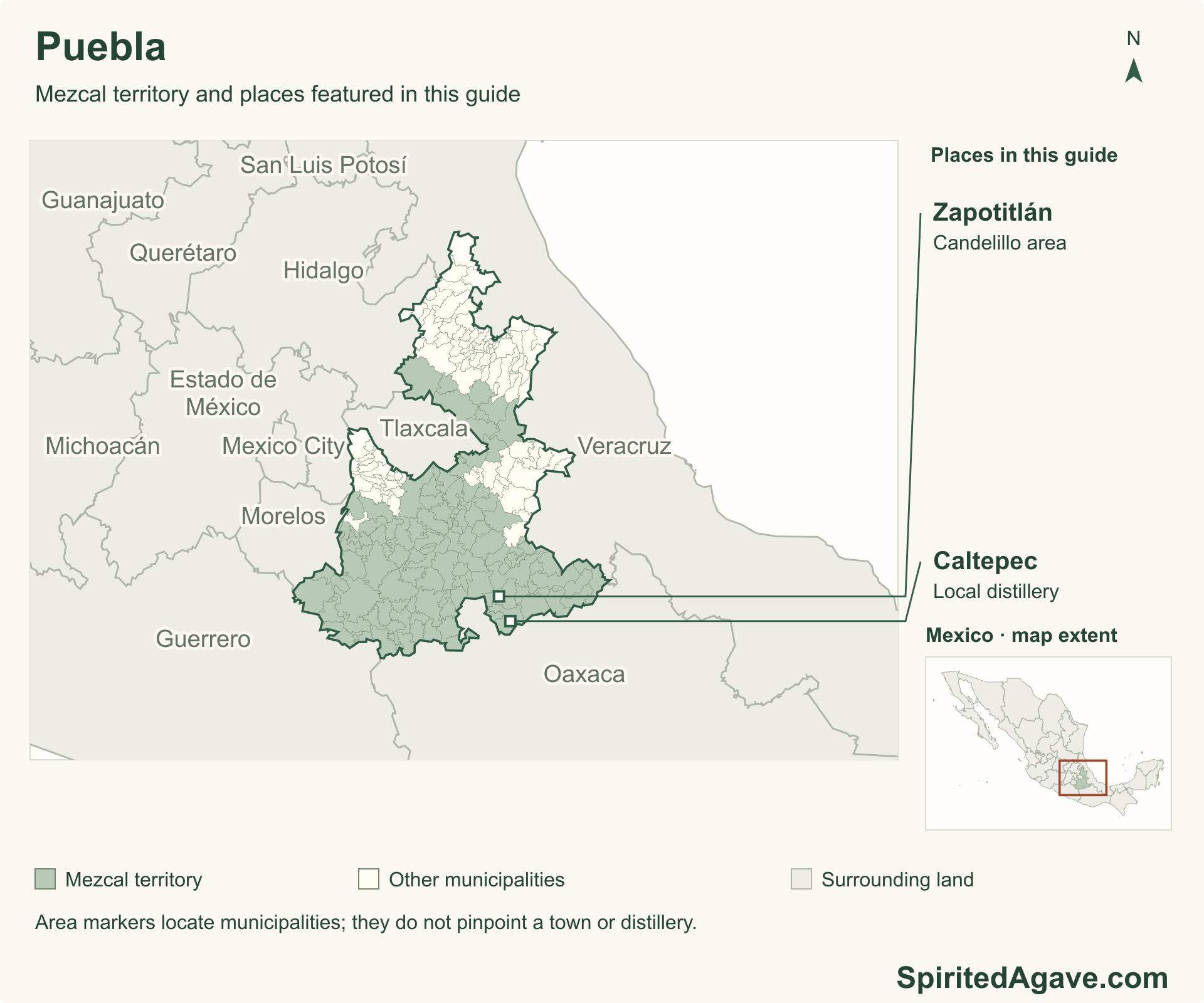
Southern Puebla has an agave distilling tradition in the Mixteca and Tehuacán valley. Local names include papalote, pichomel and candelillo, and makers use different agaves and stills. In San Luis Atolotitlán, residents have worked to restore agave populations. The protected Mezcal territory expanded again in May 2026.
Southern Puebla shares an agave landscape with Oaxaca
The Mixteca extends across the Puebla–Oaxaca border. Its small distilleries work with local agaves and equipment assembled from materials such as copper, clay and galvanized steel. The family distilleries of San Pablo Ameyaltepec, Reyes Metzontla and the Zapotitlán area form part of this shared distilling landscape, documented in Cinco Sentidos’ Colección Mixteca. 2
Agave names vary within Puebla and across state borders
| Place and maker | Local agave name | Species |
|---|---|---|
| San Pablo Ameyaltepec — Delfino Tobón | Pizorra; papalote | A. marmorata; A. potatorum |
| Reyes Metzontla — Atelo Ramírez and Laura Arriaga | Pichomel; papalome; Azul | A. marmorata; A. potatorum; A. tequilana |
| Southern Puebla — Félix Macedas Jinez | Candelillo | A locally described form of A. karwinskii |
Papalote can refer to different species: Delfino Tobón’s Puebla expression uses A. potatorum, while Aguerrido and Sanzekan use the name for A. cupreata in Guerrero.
In the Tehuacán valley, communities help renew the agaves
In San Luis Atolotitlán, Agave potatorum spirits were used for community celebrations before demand grew in regional markets. After agaves disappeared from some sites, residents worked with researchers and the Tehuacán–Cuicatlán reserve to restore populations in their natural habitat. A 2017 study describes that work. 7
Community rules included protected harvesting areas, limits on livestock access and replanting. Growers exchanged experience with Guerrero’s cupreata producers in 2006 and 2015. Keeping enough mature plants to flower, raising young agaves and protecting their growing sites supports the next generation of raw material.
Caltepec’s September 2026 fair brought together mezcal producers including Duxeen and 60 Fierros with local food and craft makers. 4
The protected territory now includes Puebla and Huaquechula
Puebla’s Mezcal territory includes 118 of its 217 municipalities after the additions published on 20 May 2026. The municipality of Puebla and Huaquechula joined an existing territory that already included places such as Caltepec, Zapotitlán and Santa Inés Ahuatempan. 5
| DOF publication | Change | Municipalities included |
|---|---|---|
| 24 December 2015 | First Puebla inclusion | 115 |
| 9 August 2018 | Xochiltepec added, correcting its omission from the earlier resolution. | 116 |
| 20 May 2026 | Puebla and Huaquechula added | 118 |
Some local producers sell their spirits as destilado de agave. Territorial inclusion is one requirement for using the protected name Mezcal; producers and products must also qualify.
Puebla accounted for 3.26% of Mexico’s certified mezcal production reported by COMERCAM for 2025, before the May 2026 territorial expansion. 6
Producer profiles from southern Puebla
Delfino and Nallely’s mole poblano pechuga
In San Pablo Ameyaltepec, Delfino Tobón Mejía makes a Pechuga de Mole Poblano documented by Cinco Sentidos. He roasts agave underground and uses a mechanical mill. For the pechuga, his wife Nallely prepares chicken and mole, which are added to the still with fermented papalote and some previously distilled spirit. 1
Delfino uses a homemade copper still with three plates and cooling water, followed by a copper coil in a water tank.
Cinco Sentidos calls this a single distillation. The recipe combines fermented agave with previously distilled spirit, chicken and mole.
Atelo Ramírez and Laura Arriaga’s pichomel blends
Atelo Ramírez and Laura Arriaga work together in Reyes Metzontla. Their two blends in Cinco Sentidos’ Colección Mixteca combine pichomel, identified as Agave marmorata, with either Azul or papalome. Their still combines galvanized steel, clay and copper. 2
Félix Macedas Jinez’s candelillo from Zapotitlán
Félix Macedas Jinez makes a candelillo for Cinco Sentidos using a local form of A. karwinskii from around Zapotitlán. His still has a galvanized steel boiling chamber, a domestic cooking pot (cazuela) above it and a copper condensing coil.
Abdias De La Luz Rodriguez ferments twice in bullhide
Abdias De La Luz Rodriguez uses bullhide vessels for Luneta’s Papalometl + Cupreata in Puebla. He first ferments whole cooked hearts, crushes them with wooden mallets, then returns the crushed agave to the hides for a second fermentation. The first distillation uses copper; the second uses a steel pot with a wooden neck. Elsewhere in Puebla, CIATEJ records cattle-hide fermentation in Tepenene, Tzicatlacoyan. 8
Rancho Aislados raises new agaves from seed in Caltepec
Rancho Aislados began in 2019 in Plan de San Miguel, Caltepec. Eleuterio Orea Aguilar, Félix Rubén Barragán Mendoza and Miguel Ángel Orea Aguilar founded the project using the family’s older pulque agave plantings. They collect seed, germinate it, raise seedlings and transplant the young agaves. 3
Growing from seed
Collect seed → germinate → grow seedlings → transplant
From planting to harvest
Young agaves are transplanted and tended until mature.
Questions about Puebla mezcal
Can Mezcal be made anywhere in Puebla?
No. The protected territory covers 118 of Puebla’s 217 municipalities following the May 2026 expansion.
Is Puebla’s papalote the same agave as Guerrero’s papalote?
No. Delfino Tobón’s papalote in Puebla is Agave potatorum; Aguerrido and Sanzekan use papalote for Agave cupreata in their Guerrero bottlings.
Continue through neighboring traditions
Compare the agaves with Guerrero’s cupreata, the equipment with Michoacán’s vinatas, or explore Oaxaca’s range of local makers and methods.
Sources and notes
Maps adapted by Spirited Agave from INEGI’s Marco Geoestadístico, December 2025. Spirited Agave added the labels and geographic highlighting.
- Cinco Sentidos’ account of Delfino and Nallely
- La Colección Mixteca
- Rancho Aislados’ history
- Puebla government’s report, 14 September 2026
- IMPI’s 2026 resolution
- COMERCAM 2026 report, page 4 Production figures are for 2025, normalized to 45% ABV; the report does not estimate uncertified state output.
- Casas and colleagues, Ciencia para la sustentabilidad (2017), San Luis Atolotitlán case study. The management account and exchanges describe that period; they are not a census of every Puebla producer.
- Luneta: Papalometl + Cupreata Undated expression account, read 9 October 2026. Separate locality evidence: CIATEJ, Regionalismos, Cuero and Piel de res entries, pp. 75 and 224. The Luneta page does not locate Abdias in Tepenene.