
Michoacán’s mezcal is made in family distilleries known as vinatas, in the hills around Morelia and Lake Pátzcuaro and farther east around Queréndaro. Local agaves include chino and alto, harvested from wild populations and cultivated plantings. One distinctive piece of equipment is the Filipino still: a hollow wooden chamber topped with a bowl of cold water that cools the vapor inside.
Chino and alto grow wild and in managed plantings
Chino (Agave cupreata) and alto (Agave inaequidens) are characteristic agaves of Michoacán’s mezcal tradition. In neighboring Guerrero, cupreata also goes by papalote or ancho. 1
Wild populations still supply agave, while growers also raise plants from seed. Cupreata cultivation in Madero, Charo, Tzitzio and Morelia includes nursery-grown plants, field plantings and agaves managed among trees. Alto growers around Indaparapeo and Queréndaro have also raised seedlings and replanted managed woodland populations. These practices developed as wild supply came under pressure. 2
In one Mezonte bottling, Jorge Pérez combines wild alto with cultivated pulquero (A. americana) and espadín (A. angustifolia). 4
Roasting, crushing and fermentation
The maker, or vinatero, roasts the agave in a pit oven, often lined with volcanic stone. After the roast, the softened hearts are chopped or crushed before fermentation. Wooden mallets and mechanical mills are both used. A wooden crushing trough may be called a batea or canoa; the mallet pounds the agave inside it. 5
Fermentation vessels include wooden vats, masonry tanks and pits lined with wood. Don Mateo uses mechanical milling and oak vats set into the ground. Jorge Pérez and Josefina work differently: they pound the agave with wooden mallets in eucalyptus troughs and ferment it in masonry tanks. Their process uses pulque, a drink made from fermented agave sap, to start fermentation. 3 6
How the Filipino still works
A Filipino-type still has a boiler below a hollow wooden upper chamber. A bowl of cold water closes the top. Rising vapor cools beneath the bowl, and the condensed spirit falls into a collector inside the chamber before flowing through a side outlet. An agave leaf shaped into a channel can form the collector, also called a canoa. The same word is used for the wooden trough in which agave is crushed. 5
Jorge Pérez’s still combines a copper boiler with an oyamel (fir) upper chamber. Its internal condensation differs from Ramiro Ávila’s Durango apparatus, where vapor leaves the wooden chamber and travels into a separate cooling coil. Don Mateo and Palomas Mensajeras also use Filipino stills. 6 7
Durango: an external cooling coil
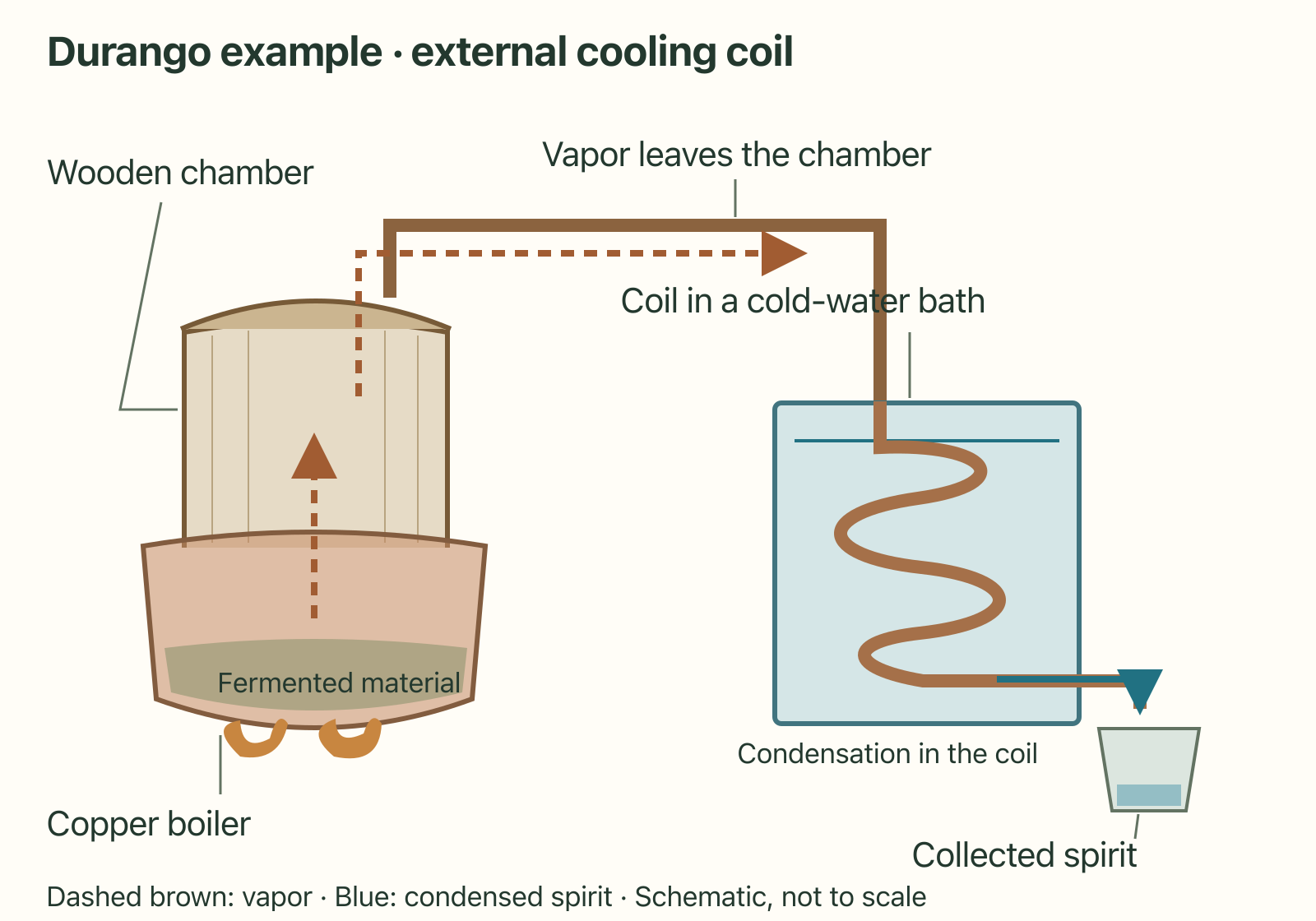
- Heat produces vapor in the copper boiler; it rises through the wooden chamber.
- The vapor travels through a pipe to a coil in a separate cold-water bath.
- The vapor condenses in the coil, and the spirit flows into the collection vessel.
Enlarge Durango diagram
Scroll sideways for the full detail. With a keyboard, focus the diagram and use the arrow keys.
Michoacán: condensation inside the chamber
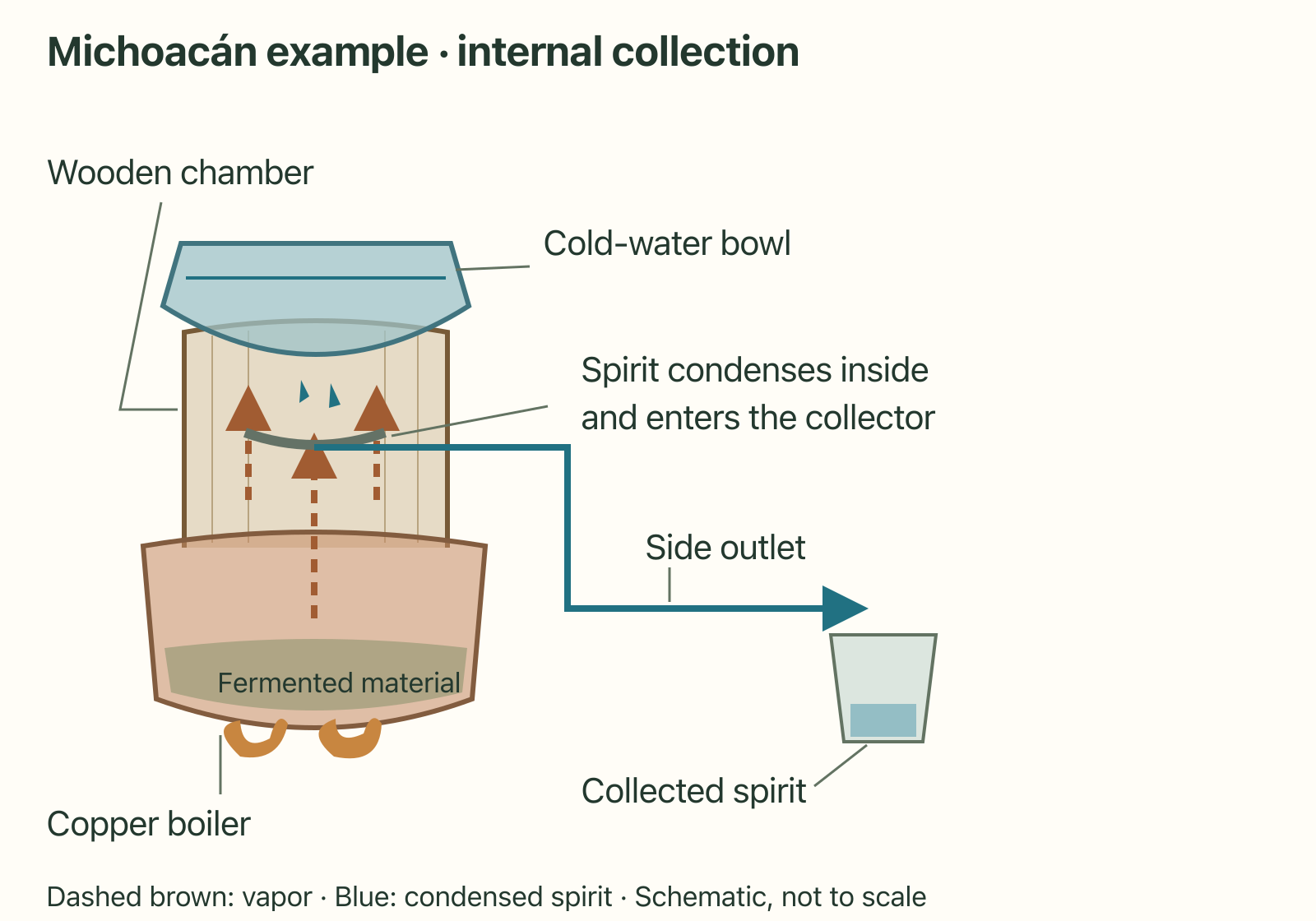
- Heat produces vapor in the copper boiler; it rises through the wooden chamber.
- A cold-water bowl on top cools the vapor, which condenses beneath the bowl.
- The spirit falls into an internal collector and flows through a side outlet.
Enlarge Michoacán diagram
Scroll sideways for the full detail. With a keyboard, focus the diagram and use the arrow keys.
Michoacán’s protected mezcal territory
Michoacán first entered the Mezcal denomination through a resolution published on 22 November 2012, naming 29 municipalities. Taretan joined on 24 September 2025, bringing the territory to 30 of the state’s 113 municipalities. 11
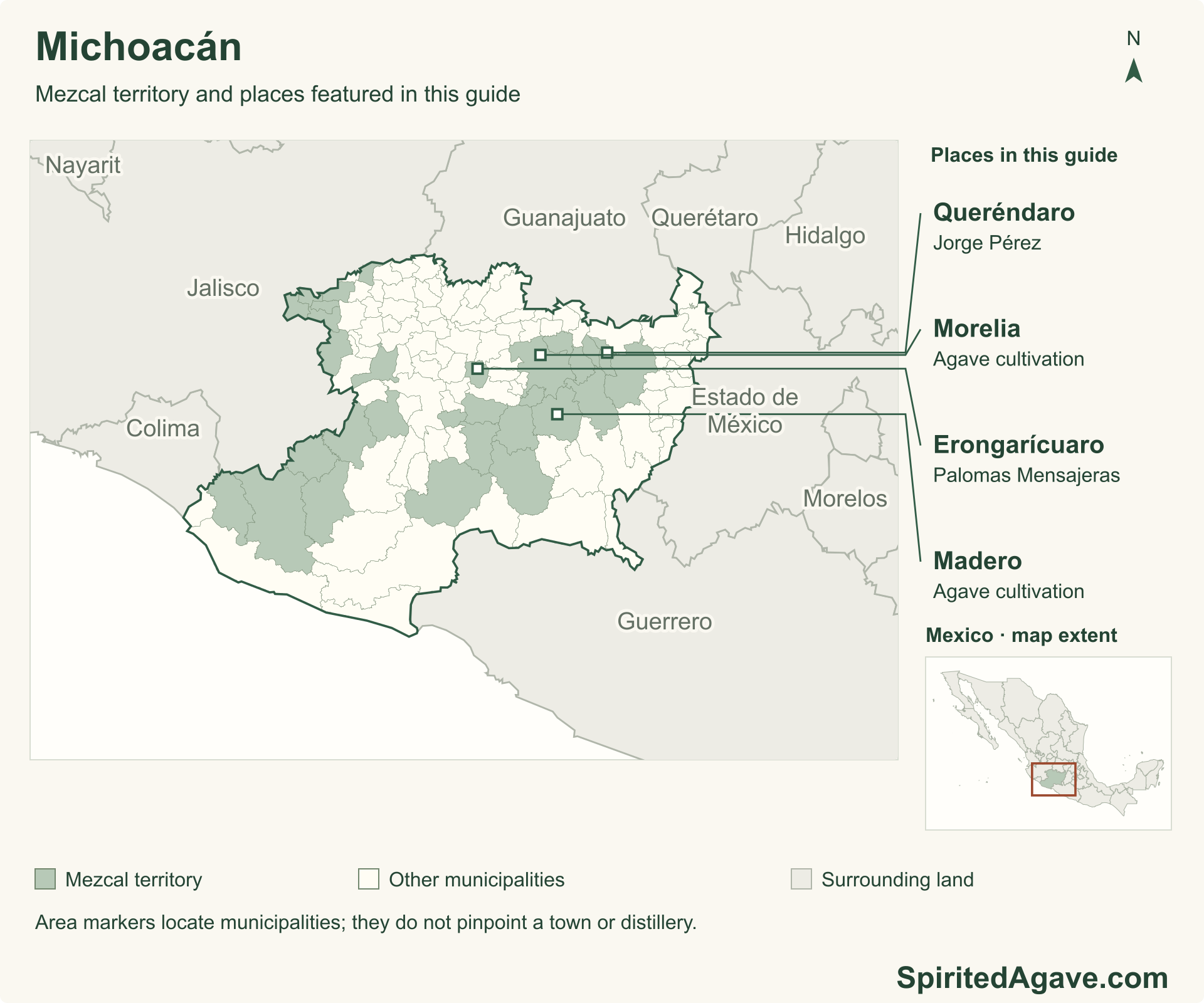
Michoacán accounted for 1.57% of Mexico’s certified mezcal production reported by COMERCAM for 2025. Spirits sold outside that certification, including agave distillates, are outside the reported total. 12
Tequila and mezcal share nine municipalities
Michoacán is also one of tequila’s five protected states. Nine municipalities appear in both its Tequila and Mezcal territories: Cotija, Cojumatlán de Régules, Jiquilpan, Los Reyes, Marcos Castellanos, Sahuayo, Tancítaro, Venustiano Carranza and Vista Hermosa. Producers in these places can qualify to make either spirit under its respective rules. 13
The protected name depends on the producer and product as well as the place. Tequila requires Azul, A. tequilana Weber var. azul, grown in its territory, an authorized factory and compliance with tequila’s production and certification rules. Mezcal requires 100% agave from its own territory, with its own process, authorization and certification requirements. Read more in the tequila guide and mezcal guide. 14
An authorized tequila factory cannot also make mezcal. The tequila standard prohibits producing or distilling an alcoholic product containing no tequila within that factory. 14
Two family distilleries: Don Mateo and Palomas Mensajeras
Questions about Michoacán mezcal
What is alto in Michoacán mezcal?
Alto is a local name for Agave inaequidens in Michoacán.
Can tequila and mezcal be made in the same Michoacán municipality?
Yes. Nine Michoacán municipalities lie in both protected territories. Each producer and product must meet the rules for its spirit; tequila requires Azul grown within its protected territory. An authorized tequila factory cannot also produce mezcal.
Compare Michoacán with other mezcal regions
Sources and notes
Maps adapted by Spirited Agave from INEGI’s Marco Geoestadístico, December 2025. Spirited Agave added the labels and geographic highlighting.
- Don Mateo Cupreata; Don Mateo Alto; Mezonte: Jorge Pérez. Local names vary by region. Statewide production shares by species are unavailable.
- The genus Agave in agroforestry systems of Mexico, 2019, cupreata and inaequidens management sections. The fieldwork describes that period, not current cultivation shares.
- Don Mateo: family, nurseries and process. Family history, two nurseries and the reported 80% cultivated share: producer’s account, read 8 October 2026.
- Mezcaleria Berlin: Jorge Pérez blend. March 2023, lot L010: alto, pulquero and espadín. Composition and sourcing describe that bottling.
- CIATEJ–AGARED, Panorama del aprovechamiento de los agaves en México, 2017, Michoacán pp. 171–175; trough, still and agave-leaf collector on p. 173.
- Mezonte: Jorge Pérez and Josefina. Eucalyptus crushing troughs, masonry fermentation with pulque, copper and oyamel apparatus. Oyamel commonly means fir; the process account does not identify a wood specimen. Pulque background: Tlachiquero.
- Sin Gusano: Ramiro Ávila, D-RA-01, January 2022. External coil; compare with CIATEJ’s Michoacán description in source 5. Schematics show these arrangements without construction dimensions.
- Skurnik: Palomas Mensajeras. Miguel Pérez Reséndiz and sons, Oponguio on Lake Pátzcuaro, visits from 1996 and move in 2001; supplier account read 8 October 2026.
- Skurnik’s Alto, Chino, Mexicano and Ensamble. The US range may differ from releases sold elsewhere. Mexicano was grown in Michoacán from seed supplied from Oaxaca.
- Joahna Hernández: A visit to Michoacán’s Palomas Mensajeras, 25 November 2025, describing a June 2025 visit. Chino from Etúcuaro, alto from Oponguio; steel/plastic fermentation vessels.
- IMPI: Taretan resolution, 24 September 2025, reciting the original 22 November 2012 publication and its 29 municipalities. The original 2012 resolution was also read in a DOF PDF copy.
- COMERCAM 2026 report, page 4. Calendar 2025 certified production, normalized to 45% ABV; uncertified state output is uncounted.
- CRT: Tequila territory; CRT sustainability report, Figure 3, p. 20, published 2023, municipality list attributed to CRT 2021; compared with the 2025 Mezcal resolution. The nine shared municipalities match by INEGI identifiers.
- NOM-006-SCFI-2012: Tequila, sections 4.36, 5.1, 6.5.1 and 6.5.2.2; NOM-070-SCFI-2016: Mezcal, sections 3.17, 3.19, 4.1, 4.4 and conformity provisions. Tequila’s 13 December 2012 amendment was checked; it does not amend section 6.5.2.2. These rules do not establish a named producer’s certification.