
Family distilleries in southern Estado de México work with local agaves around Malinalco and Zumpahuacán. A study published in 2024 found that bulk spirit was sold more often than labeled bottles in three Malinalco communities.
Estado de México surrounds much of Mexico City. Its mezcal production is concentrated in the south, including Malinalco and Zumpahuacán.
Growing and distilling in three Malinalco communities
A 2024 study covered three communities in Malinalco: Palmar de Guadalupe, San Pedro Chichicasco and Colonia Juárez. Nine in-depth interviews and field observation describe pit cooking, hand crushing with wooden mallets, fermentation in steel or plastic vessels, and double distillation in copper or stainless steel apparatus. Some distilleries were extending production beyond the warmer months. 4
Agave growing was part of production in all three communities. Growers raised plants from seed and from hijuelos, the young shoots produced beside established agaves. Their plots ranged from steep slopes and ravines to flatter, warmer ground.
Sales included sealed, labeled bottles and bulk spirit, with bulk sales more prevalent in the communities studied. The accounts describe Malinalco before the November 2025 territorial resolution.
The November 2025 resolution names fifteen municipalities
The resolution published on 21 November 2025 includes Almoloya de Alquisiras, Amatepec, Coatepec Harinas, Ixtapan de la Sal, Luvianos, Malinalco, Ocuilan, Sultepec, Tejupilco, Tenancingo, Tlatlaya, Tonatico, Villa Guerrero, Zacualpan and Zumpahuacán in the protected Mezcal territory. 5
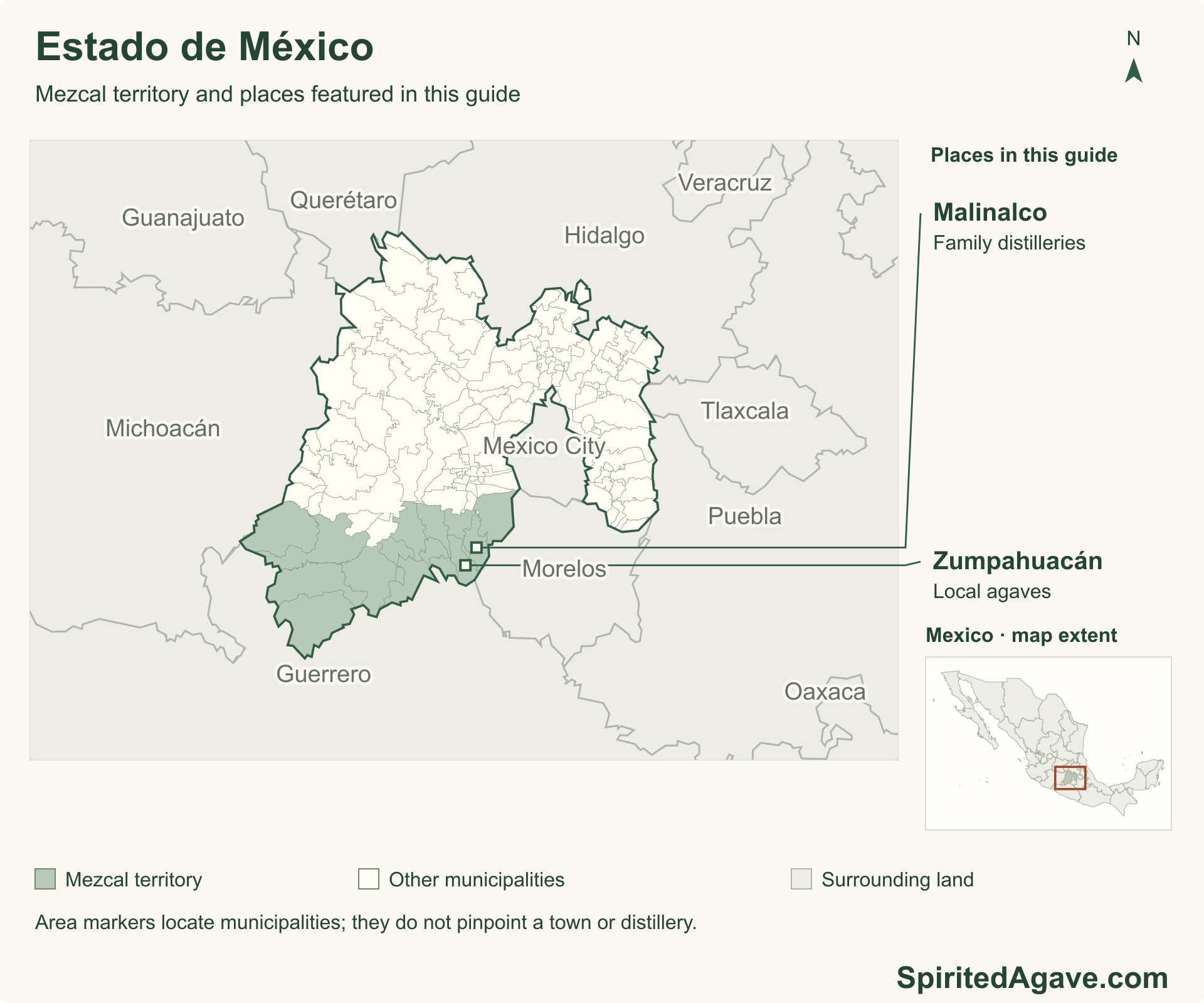
The legal history matters when reading older articles. The state was first included in August 2018, but that decision was challenged; the 2025 resolution sets out the proceedings and a fresh determination. An article written during the earlier dispute may therefore describe a different legal position.
For buyers, the municipality is one part of identifying a mezcal. The producer and product must also meet the applicable requirements. A town’s appearance on this map does not certify every bottle made there. The mezcal standard, NOM-070, sets out production categories and labeling requirements.
COMERCAM’s 2025 certified-production table does not list Estado de México separately. The Malinalco study describes local trade, but provides no current statewide production total. 6
Two producer profiles from southern Estado de México
José Luis Medina: a criollo ensemble in Zumpahuacán
Writing in December 2022, producer José Luis Medina of Zumpahuacán described making an ensemble from the local agaves his community calls criollos. He identified angustifolia and rhodacantha among them. In his account, criollo means the plants growing locally, rather than one uniform botanical identity. 1
Medina also described changes within his own family. Fermentation had moved from cattle hides to metal and then food-grade plastic tanks; the distillery had moved from a ravine to a roadside site with water. He recalled learning through jobs alongside his father and grandfather, and described his wife and son sharing production work.
El Caporal: a new distillery with a family history of copper work
In a December 2024 interview, El Caporal’s founder described establishing the distillery in Puente Caporal, Malinalco. He began the project in 2018 and made his first production in 2020, drawing on advice from other local mezcal makers. He said he bought agave directly from growers. 2
The founder described using mature agaves whose flower stalks had been cut roughly a year before harvest. He preferred producing in warmer weather, when fermentation worked better at his distillery.
At El Caporal, the stages are called rapada for trimming the agave, tapada for cooking, amajada for crushing, then fermentation, caldeada for the first distillation and refinada for the second.
El Caporal’s founder, Sergio Reynoso, is the first mezcal maker in his family. His grandfather was a blacksmith who repaired and made copper distilling equipment for other producers. 3
| Maker and place | Work and tradition | Account date |
|---|---|---|
| José Luis Medina, Zumpahuacán | Local criollo ensemble and family knowledge | December 2022 |
| El Caporal, Malinalco | Agave maturity, fermentation timing and a family history of copper work | December 2024; October 2026 |
Questions about Estado de México mezcal
Is Estado de México the same place as Mexico City?
No. Estado de México and Mexico City are separate federal entities. The fifteen municipalities in this guide belong to Estado de México.
Is all criollo mezcal made from the same agave species?
No. Criollo is a local description whose meaning depends on the maker and place. Medina’s Zumpahuacán account describes an ensemble and names more than one agave species.
Does the Mezcal denomination cover all of Estado de México?
No. The November 2025 resolution names fifteen municipalities, concentrated in the south of the state, rather than all 125.
Follow the tradition across the state border
Continue with Morelos’s agaves and makers, then compare the local plants and distilleries in Guerrero and Michoacán.
Sources and notes
Maps adapted by Spirited Agave from INEGI’s Marco Geoestadístico, December 2025. Spirited Agave added the labels and geographic highlighting.
- José Luis Medina’s account in La Jornada del Campo
- Milenio’s interview with the founder
- Mundo Ejecutivo Edomex, October 2026, page 66
- Florentino-Campos, Thomé-Ortiz and González-Domínguez, 2024, pages 9–10 and 15–19
- IMPI’s Estado de México resolution
- COMERCAM 2026 report, page 4 2025 reported state-production table; no separate Estado de México row.