
A glass-rested mezcal spends months or years in glass vessels before it is bottled for sale. Makers use that time to develop a rounder texture and bring the flavors together, while keeping the agave character free of oak. Tequila makers use glass resting too, including for high-proof blancos and spirits that have already spent years in barrels.
How is glass resting different from keeping mezcal in a retail bottle?
Glass resting and storage in a closed retail bottle allow the same kinds of chemical reaction to continue in the spirit. A producer's glass rest holds a batch before sale and can include deliberate air exposure and periodic tasting before bottling. A retail bottle kept closed can also change under its own closure and with the oxygen already inside it.
Large glass jugs, called damajuanas, demijohns or garrafones, are bulk storage vessels. They let a maker set aside part of a batch, draw samples and bottle portions later while the remainder keeps resting. A larger vessel does not automatically give the spirit more oxygen per liter: that also depends on its closure, the air space above the liquid and how often it is opened.
Glass is useful when a maker wants the agave's existing flavors to develop without adding the vanilla, tannin and color associated with barrel aging. The spirit can remain clear through a long glass rest.
How do producers rest agave spirits in glass?
At Macurichos in Santiago Matatlán, Oaxaca, Gonzalo Martínez Sernas keeps demijohns in the family's cuarto de descanso, or resting room. He gives the mezcal at least nine months in glass, with most resting for two years or more.
In 2021, Los Danzantes, also in Santiago Matatlán, was using old blown-glass vessels holding 15–18 liters, opening the garrafones every three months to release volatile compounds. Luis Loya of Lamata and Nación de las Verdes Matas preferred tight wax or synthetic seals to limit oxidation. Makers choose both the seal and the opening routine according to how they want the spirit to develop.
Why are some glass vessels buried?
The aim is a rounder spirit with more integrated flavors. Burial gives the mezcal a dark storage place with a fairly steady temperature during the rest, much as a well-controlled cellar would.
At Tlamati, maestros Sergio and Balbino Salas used 19-liter glass vessels closed with pieces of olote, the core of a corncob. Co-founder Orlando Estrada says the buried mezcal gains smoothness and sweetness. It is later unearthed for celebrations such as weddings and baptisms.
How does oxygen enter a closed glass jug?
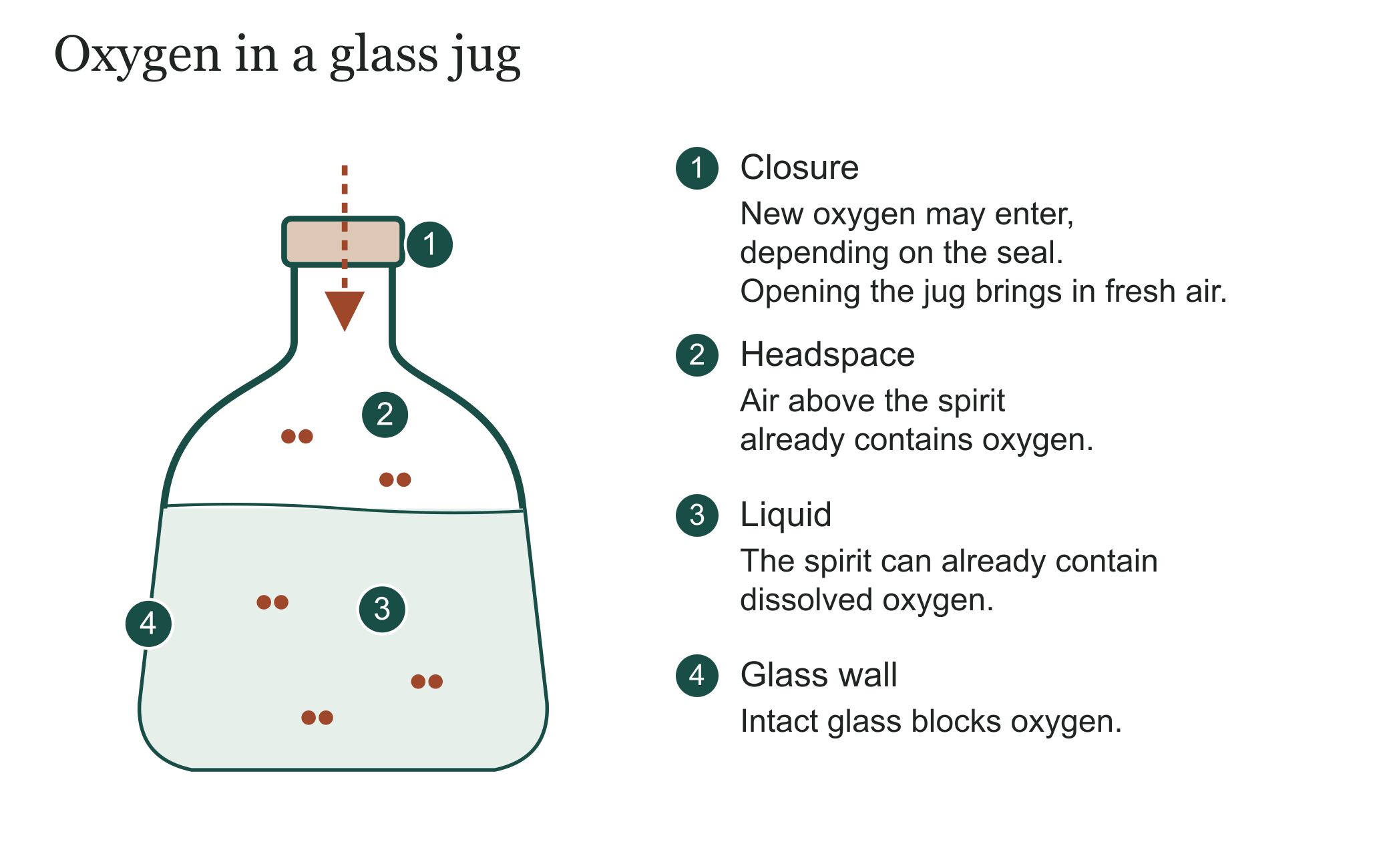
Oxygen can enter a closed glass jug through or around its closure. The walls of an intact glass vessel are effectively impermeable to oxygen. A cork can keep the neck closed while still allowing slow oxygen transfer; other closures can restrict that transfer much more tightly.
Opening a jug brings in fresh air. A closed jug can still contain oxygen dissolved in the spirit or present in the headspace, the air above it. Its closure affects how much fresh oxygen can enter over time.
What happens to the spirit during a glass rest?
Several processes can change the mixture of aroma and flavor compounds. Oxygen can react with compounds in the spirit; for example, some aldehydes can be converted to acids. Acids and alcohols can form esters, which contribute many fruity aromas. Esters can also break down through a reaction with water called hydrolysis, which can continue without fresh air entering the vessel.
When a vessel is opened or its closure permits vapor to escape, some volatile compounds can leave the spirit. The resulting balance of aromas can change along with the reactions taking place within the liquid.
How glass resting can change flavor and texture
I have tried mezcals from the same producer that were bottled straight away alongside ones rested in glass. In those comparisons, I found greater harmony of flavors and a thicker mouthfeel in the rested spirits. That is the change I look for: how comfortably the flavors sit together and how the spirit feels as I sip it.
Measured strength can also change during storage. Mal Bien bottled part of Refugio and Alejandro Calzada's May 2020 Papalote Capón that autumn at 47.1% ABV. The portion left in glass until autumn 2021 was bottled at 46.7%.
If you have the chance to compare a rested and an earlier-bottled portion of the same distillate, pay attention to aroma, the sharpness of the first sip, texture and the finish. Check both ABVs: a difference in strength can also change the comparison.
What Madurado en Vidrio means on a mezcal label
Madurado en Vidrio is a formal mezcal class. Mexico's NOM-070-SCFI-2016 requires stabilization in glass for more than 12 months, underground or in a place with minimal variation in light, temperature and humidity.
Certified bottles carry the class name and a numbered mezcal certification seal.
Descansado means rested. Creador uses the word on its Tobalá Descansado, distilled in Oaxaca in January 2019 and rested for four years.
For the broader distinction between production categories and aging classes, see mezcal classifications explained.
Examples of glass-rested mezcal, tequila and other agave spirits
| Release | Glass rest and bottled strength |
|---|---|
| Los Danzantes Still Proof Espadín Mezcal Artesanal; 700 mL release | One year in glass 53.5% ABV Resting period and ABV vary by batch |
| Viejo Barbón Espadín Madurado en Vidrio Mezcal Ancestral; 750 mL release | One year underground in glass 47–50% ABV |
| Siembra Valles High Proof Tahona Blanco Canadian 750 mL release | 11 months in glass damajuanas 46% ABV |
| Aguerrido Erika Meneses Cupreata Capón April 2022 batch; destilado de agave | 14 months in glass 46.9% ABV |
| Tapatío Excelencia Gran Reserva US extra añejo release, distilled in 2000 and bottled in 2015 | Ten years in five-liter glass jugs, following five years in used barrels 40% ABV |
Siembra Valles is made in El Arenal, Jalisco. Erika Meneses makes the Aguerrido spirit from Cupreata agave in Tetitlán de la Lima, Guerrero.
Keeping tequila and mezcal at home
Keep tequila and mezcal upright, tightly capped and away from sunlight and large temperature swings. As the bottle empties, more air occupies the space above the liquid, and each pour introduces fresh air. Recapping it promptly limits evaporation and the loss of volatile aromas. These habits help preserve the flavors you enjoy while you work through the bottle.