
Agave syrup, also sold as agave nectar, sweetens cocktails, baking and everyday drinks. It is often promoted for its low glycemic index and “natural” image. Most varieties go through extraction, hydrolysis, filtration and concentration—a level of processing similar to high fructose corn syrup. Some producers instead collect sap from living agaves and concentrate it into syrup.
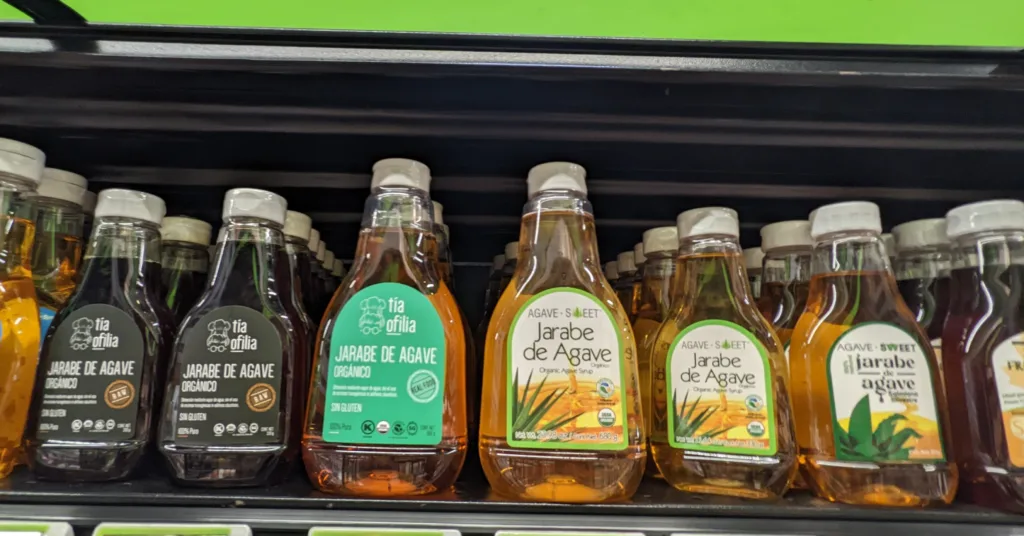
Table of Contents
What is agave syrup?
Agave syrup is a sweetener made either from the extracted juices of a harvested agave piña—the plant’s heart—or by concentrating aguamiel collected from a living agave. Agave syrup, also sold as agave nectar, is used in baking and drinks such as the Tommy’s Margarita, and as a sugar or honey substitute.
Several agave species supply syrup. The most common is blue Weber agave, Agave tequilana, the same variety used for making tequila.
Agave syrup is a vegan alternative to honey. Its low glycemic index is often marketed to people with diabetes, but it still contains carbohydrate.
Light, amber and dark agave syrup
| Light | Amber | Dark | |
|---|---|---|---|
| Taste | Mild, neutral flavor | Medium, caramel flavor | Stronger, caramel, molasses |
| Uses | Smoothies, tea, cocktails, baking, salad dressing | Desserts, sauces, savory food | Marinades, sauces, coffee, BBQ sauce, pancakes, French toast |
Agave syrups are sold in light, amber and dark varieties, as well as standard and “raw” versions. Their sweetness and sugar content are comparable, while their flavors suit different uses.
Dark agave syrup has a stronger caramel flavor, light agave syrup is almost neutral tasting and amber is somewhere in between the two. The different colors and flavor profiles are achieved by different levels of filtration. Heating also affects color: high temperatures can darken syrup through caramelization. Color alone does not tell you how hot a syrup was processed.
Raw agave syrup is generally more neutral tasting and is preferred by some in the “raw food” movement, or is considered less processed.
Types of agave used to make agave syrup.
Blue Weber agave, A. tequilana, is especially common in Jalisco. Agave salmiana and Agave americana also supply syrup.
Agaves store carbohydrates that can be extracted and converted into syrup. The time a plant takes to mature varies with the species and growing conditions. Producers can harvest the carbohydrate-rich heart or collect sweet sap from a plant that remains rooted.
Wild versus cultivated agave syrup
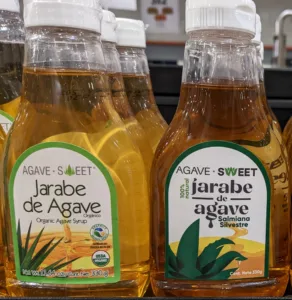
Most agave syrup sold is produced from cultivated agave. Blue Weber agave in particular is mostly farmed, especially in the Mexican state of Jalisco. Agave syrup from other species has more chance of being from wild agave, such as agave salmiana, although this species is also cultivated.
How syrup is made from harvested agave piñas
The key steps to create agave syrup are harvesting the agave, milling, extraction, hydrolysis (breakdown into sugars), filtration and reduction.
1. Harvesting the agave
Agave plants are ready for harvest when they reach maturity, which can be after six or seven years for blue agave. The agaves used for syrup flower only once, near the end of their lives, sending up a tall stalk from the center of the plant. This growth draws on carbohydrates stored in the heart, so harvesting mature piñas before flowering preserves those reserves for syrup-making. Sap collection for aguamiel also starts with a mature plant: the developing flower bud is removed before the stalk grows, and the plant remains rooted during collection.
The spiky leaves are chopped off to leave the carbohydrate-rich piña. Its name means “pineapple” in Spanish, reflecting its resemblance to the fruit. Inside are water, fiber and stored carbohydrates, including fructans.
The amount of syrup obtained from a piña depends on its weight and carbohydrate content, how much is recovered during processing, and how concentrated the finished syrup is.
2. Milling and extraction of the agave
At the factory, milling or shredding exposes the piña’s fibers. In a diffuser, hot water extracts soluble carbohydrates from this material. The liquid is separated from the remaining fiber and filtered.
3. Hydrolysis of the agave juices
The extracted juices contain fructans that must be broken down into simple sugars, chiefly fructose. This conversion is called hydrolysis. Producers can use heat, acid or enzymes, depending on their process. Another industrial route starts with dried, ground agave and uses enzymes for hydrolysis (2018).
Products marketed as “raw” commonly emphasize low-temperature processing, often below about 120 °F (49 °C). Other processes use much higher temperatures: one patented acid-and-heat process specifies 110–145 °C (230–293 °F) for hydrolysis.
Enzymes can help break down fructans at lower temperatures. Yoxitl describes thermal hydrolysis without added enzymes.
Fructans are carbohydrates built mainly from linked fructose units. Inulin is one type of fructan, defined by its structure. Blue agave contains mixed, branched fructans rather than inulin alone. Hydrolysis breaks these structures into individual sugars.
4. Filtration and polishing
The juices are passed through a number of filters of decreasing size. These steps remove any cloudiness to achieve a clear liquid. More filtration means a lighter colored and flavored syrup.
5. Reduction into syrup
The filtered juices are concentrated by evaporating excess water. Industrial processes commonly use vacuum evaporation, which lowers water’s boiling temperature. The equipment and vacuum level determine the operating temperature, and low-temperature processes can require longer evaporation.
6. Bottling
The finished syrup is kept moving in a large tank to maintain an even consistency. It is then bottled on site or packed in bulk for bottling elsewhere.
How aguamiel becomes syrup
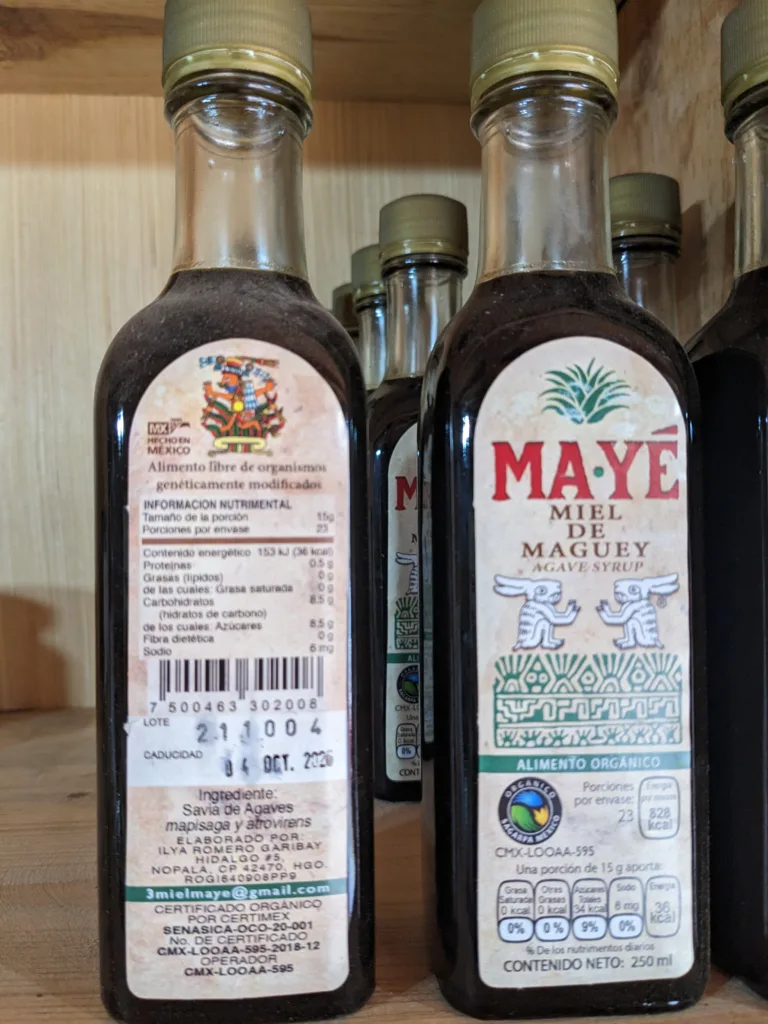
A second route starts with aguamiel, the sweet sap collected from a living maguey. Heating removes water and turns the sap into a thicker sweetener, often called miel de maguey or concentrated aguamiel. This collection-and-concentration process has much in common with making maple syrup.
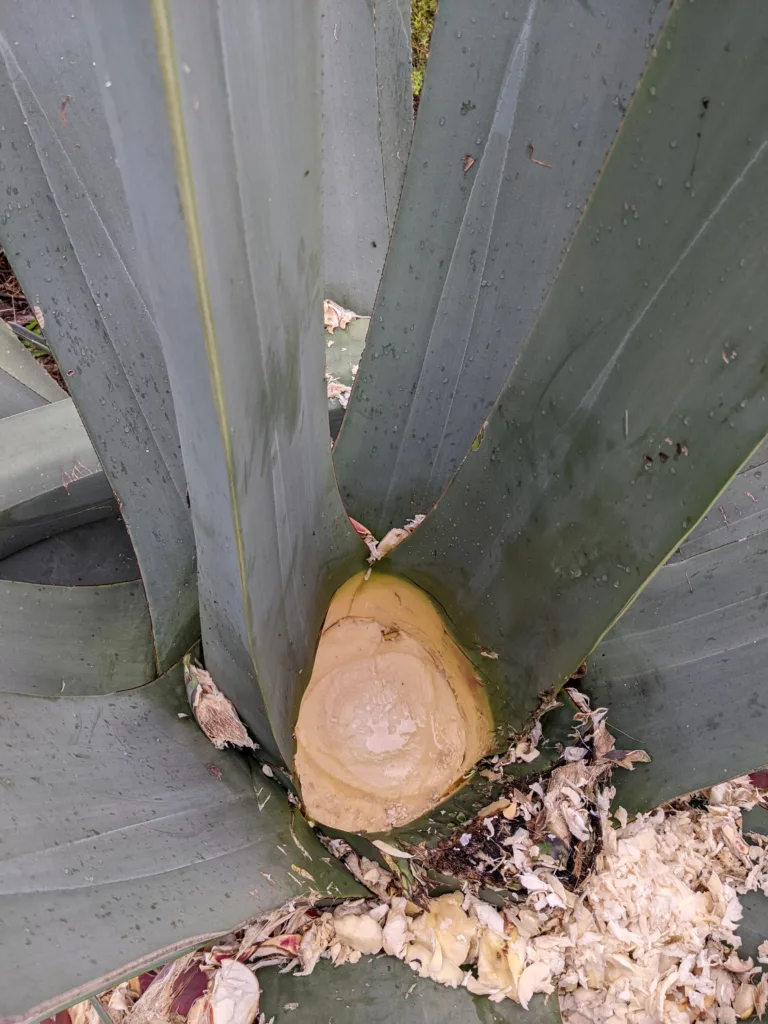
Before the maguey flowers, a tlachiquero removes the developing flower bud and prepares a cavity in the center of the plant. Sap gathers there. The tlachiquero usually collects it twice a day, then scrapes the cavity to encourage the flow to continue. Collection can last for several months. A traditional acocote is a hollow gourd used to draw out the sap; the same job can be done with a tube and bottle.
Aguamiel means “honey water.” It is the fresh, sweet sap. Pulque is the milky alcoholic drink made by fermenting that sap. Yeasts and bacteria take part in fermentation, and producers commonly add actively fermenting pulque to a new batch of aguamiel. Pulque has a long history in central Mexico and held an important place in pre-Hispanic ceremonies. More on traditional pulque production.
For a sweetener, the aguamiel is concentrated instead of being fermented into pulque. The plant stays rooted during sap collection, rather than being cut down for its piña. Salmiana is one of the magueys used for aguamiel and pulque. Syrup made from harvested agave hearts follows the milling, extraction and hydrolysis steps described above.
Agave syrup versus agave nectar
Agave nectar and agave syrup are commonly used as names for the same bottled sweetener. “Nectar” alone tells you little about how it was made. To distinguish the routes, look for a producer’s description of syrup made from harvested agave hearts or of aguamiel collected from living plants and then concentrated.
Nectar may sound more natural and desirable. In fact the word comes from the Greek nektar, which was the name for the drink of the gods which gave immortality. Today the term nectar refers to the sweet liquid produced by flowers which is collected by bees to make honey. Agave nectar does not come from the nectar of agave flowers so the name is somewhat misleading. For the sap-based version, “concentrated agave sap” would be more precise, but this doesn’t have quite the same ring to it.
Agave syrup vs sugar, honey and other sweeteners
Nutritional profile and calories
| Sweetener | Fructose | Glucose | Sucrose | Kcal per 100g |
|---|---|---|---|---|
| Agave syrup | 82% | 18% | – | 310 kcal |
| Table sugar | – | – | 100% | 387 kcal |
| Honey | 50% | 44% | 1% | 304 kcal |
| Maple syrup | 1% | 1% | 98% | 270 kcal |
| High fructose corn syrup | 55% | 45% | – | 281 kcal |
The agave syrup in the table is rich in fructose, the sugar also found in fruit. Concentrated aguamiel can have a different sugar balance: sucrose exceeded fructose in two of the three Hidalgo salmiana batches tested in a 2016 study.
About 82% of the sugars in the agave example are fructose and 18% are glucose. Table sugar is almost entirely sucrose; sucrose also accounts for about 98% of the sugars in the Canadian maple-syrup example. The honey example is about 50% fructose and 44% glucose. Common HFCS formulations contain 42% or 55% fructose on a dry basis; FDA describes the remainder as glucose and water. The agave example has a higher fructose proportion than either.
Fructose and glucose are simple sugars, or monosaccharides. Sucrose is a disaccharide made from equal parts fructose and glucose; digestion separates it into those two sugars.
Fructose, glucose and sucrose each provide about 4 calories per gram. Water lowers a syrup’s calories per gram, but a tablespoon can still contain more calories than a tablespoon of dry sugar. Yoxitl’s 2024 agave specification lists 60 calories per tablespoon (21 g). Domino’s granulated sugar label lists 30 calories per two teaspoons (8 g), equivalent to about 45 calories per tablespoon.
Sweetness level
Different sugar types have different levels of sweetness. Fructose is the sweetest, then sucrose then glucose. Due to its very high fructose content agave syrup is sweeter than other sweeteners, and you need to use less to get the desired level of sweetness.
Glycemic Index
| Sweetener | GI: selected tests |
|---|---|
| Agave syrup | 10–28 (selected tests) |
| Table sugar | 64–66 |
| Honey | 35–74 |
| Maple syrup | 54 |
| High fructose corn syrup | 56 |
| Glucose | 100 |
| Sucrose | 64–66 |
| Fructose | 23–25 |
Fructose produces a relatively small blood-glucose response and has a low GI. Agave syrup’s high fructose content helps explain its low GI.
The glycemic index compares the blood-glucose response over two hours after eating equal amounts of available carbohydrate. Glucose is the reference, with a GI of 100. A GI of 50 means roughly half the measured response area of glucose; it does not mean absorption takes twice as long.
Selected agave syrups have tested at GI values from 10 to 28. These are results for particular products, not a guaranteed range for every bottle. A GI of 55 or below is “low”, 56–69 is “medium”, and 70 or above is “high”. Selected table-sugar tests are 64–66, in the medium category. Honey examples span 35–74; the maple and HFCS examples are 54 and 56. Table sugar and sucrose refer to the same sugar. These agave examples have a lower GI than the other sweeteners compared here, apart from fructose itself.
Taste
Agave syrup has a generally neutral taste, especially lighter colored varieties. Amber and dark varieties have a more caramel flavor although it is still less distinctive than the taste of honey or maple syrup. Agave syrup does not have the same bitter after taste as artificial sweeteners.
Cost
| Example product | Package | Price (USD) |
|---|---|---|
| Wholesome Organic Blue Agave | 44 oz by weight | about $12 |
| H-E-B Pure Cane Granulated Sugar | 4 lb (64 oz by weight) | about $4 |
| Hill Country Fare Clover Honey | 12 oz by weight | about $4 |
| Coombs Pure Grade A Maple Syrup | 12 fl oz | about $8 |
| Stirrings Simple Syrup | 12 fl oz | about $6 |
Agave costs considerably more than granulated sugar in these examples: about 27 cents versus 6 cents per ounce by weight. The honey example is about 30 cents per ounce by weight. Maple and simple syrup here are sold by fluid volume, so their per-ounce prices cannot be compared directly with weight ounces. Compare the cost of the amount your recipe needs, allowing for different sweetness levels. Homemade simple syrup made with sugar and water is much cheaper than the bottled example.
Processing
Despite its positioning as a “natural product” most agave syrups are highly processed. Of the common sweeteners honey is typically the least processed, and in some cases it’s as it comes straight from the beehive. Granulated sugar is arguably the most processed.
Honey
Bees turn flower nectar into honey using enzymes in their stomachs. Almost all commercial honey comes from cultivated hives. Beekeepers may simply collect and package it, or heat and filter it to improve flow and shelf life. The flowers the bees visit and any human processing affect its flavor.
Maple syrup
Maple syrup starts with sap collected from sugar maples and boiled to concentrate it. It generally takes 40 gallons of sap to make one gallon of syrup, with the amount varying by tree and season. The process is much simpler than extracting and refining sugar.
Agave syrup
Most agave syrup uses extraction, hydrolysis, filtration and concentration, much like high fructose corn syrup. The smaller sap-based route needs collection and heating to remove water, more like maple syrup.
High fructose corn syrup
High fructose corn syrup starts with corn starch. The starch is converted into glucose syrup, then enzymes turn some of the glucose into fructose.
Granulated sugar
Granulated sugar comes from sugar cane or sugar beets. Sugar cane is crushed and sugar beets are sliced; hot water helps extract the sugar. The juice is clarified and concentrated in vacuum evaporators. Seed crystals grow in the concentrated syrup, then a centrifuge separates the crystals from molasses. The crystals are dried and sorted for packaging.
Uses
Agave syrup, sugar, honey and maple syrup can substitute for one another in baking and drinks. Honey, maple syrup and darker agave syrups also bring their own flavors; sugar and light agave syrup are more neutral.
Agave syrup along with other sugar syrups is sometimes used as an additive in tequila production.
When substituting agave syrup for sugar:
- Agave syrup is sweeter than sugar so less is needed to get the same sweetness.
- Agave can brown faster in baking. Volcanic’s recipe guidance suggests lowering the oven temperature by 25 °F (about 14 °C). Check for doneness using your recipe’s cues; there is no fixed percentage by which every baking time should increase.
- Agave adds moisture when it replaces dry sugar. Madhava recommends ⅔ cup of agave for 1 cup of sugar, with other recipe liquids reduced by ¼ cup. Adjust for your syrup and recipe; recipes with little adjustable liquid may need one developed for liquid sweeteners.
- Agave syrup dissolves easily in drinks, even cold ones. For a cocktail that calls for simple syrup made with equal parts sugar and water, start with half to ¾ as much agave syrup and adjust to taste. A rich simple syrup uses more sugar in proportion to water and needs a different comparison.
- Dark agave syrup is a better substitute for brown sugar than lighter syrup.
Does agave syrup need to be refrigerated?
No. Bottled agave syrup can generally be stored at room temperature, including after opening. Keep the bottle tightly closed in a cool, dry place, and follow any different instructions on its label. Fresh aguamiel is more perishable and can begin fermenting during collection and storage.
Agave syrup for specific diets
Is agave syrup paleo?
It depends on the version of paleo you follow. The Paleo Diet’s stricter TRUEPALEO approach excludes agave nectar, while its more flexible PaleoFLEX approach allows it. The Paleo Foundation accepts minimally processed aguamiel but excludes industrial agave nectar from its Certified Paleo standard.
Is agave syrup suitable for a ketogenic diet?
No. Agave syrup is high in sugar and is a poor fit for a ketogenic diet. Count the carbohydrate in the amount you use toward your daily limit.
How does agave syrup affect blood glucose?
Agave syrup still supplies carbohydrate, so the amount you use matters for blood-glucose management. Selected agave syrups have produced a smaller blood-glucose response than table sugar in GI tests. Very high fructose intakes that add excess calories can increase liver fat. In a ten-week feeding study of adults with overweight or obesity, fructose supplied 25% of daily calories and reduced insulin sensitivity.
Is agave syrup vegetarian?
Yes. Agave syrup is suitable for vegetarian diets. No meat or fish products are used in its production.
Is agave syrup vegan?
Yes. Agave syrup is plant based and suitable for vegan diets. It can replace honey, which comes from bees.
Is agave syrup suitable for a low-FODMAP diet?
Agave syrup is high in excess fructose—fructose in greater amounts than glucose—so it is generally a poor choice for a low-FODMAP diet. Serving size matters. FODMAP stands for fermentable oligosaccharides, disaccharides, monosaccharides and polyols. When poorly absorbed, these carbohydrates can trigger symptoms in people with IBS.
Is agave syrup gluten free?
Yes. Plain agave syrup is naturally gluten free. If you have celiac disease, choose a bottle labeled gluten free; added ingredients and cross-contact during production can affect suitability. For the spirit, see tequila and gluten.
Is agave syrup kosher?
Yes, agave syrup can be kosher. Choose a product with kosher certification, which covers its ingredients and production.
Is agave syrup halal?
Yes, agave syrup can be halal. Choose a product with halal certification if you need that assurance.