
Guerrero’s mezcal tradition reaches from the papalote-growing hills around Chilapa to northern distilleries that also distill espadín. Sanzekan and Aguerrido bring spirits from village distilleries to international markets.
Chilapa’s growers and village distilleries built a collective trade
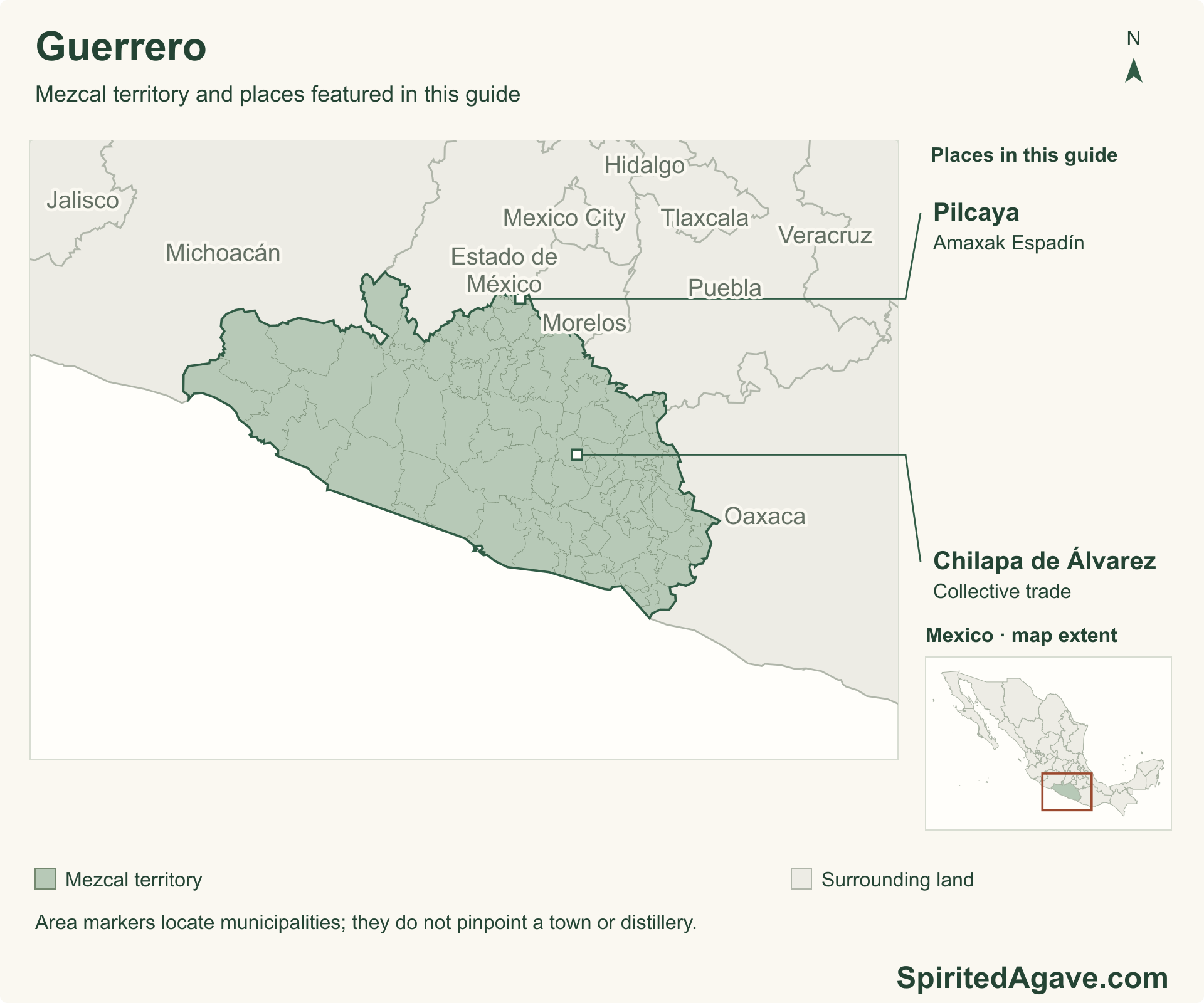
In central Guerrero, the communities around Chilapa de Álvarez, Zitlala, Ahuacuotzingo and Tixtla have a long tradition of growing, gathering and distilling maguey. Sanzekan Tinemi formed in 1990 from farmer organization in this region. Its collective bottlings identify the individual maker and village distillery, bringing those spirits to a wider market. 1
A field study carried out in eight central Guerrero communities during 2017–2018 found papalote to be the most-used mezcal agave there. The researchers also documented angustifolia forms called sacatoro, criollo, espada and espadín. That local variety extends beyond the cupreata bottles best known outside Guerrero. 2
Guerrero’s trade extends beyond certified mezcal
Guerrero accounted for 1.39% of Mexico’s certified mezcal production reported by COMERCAM for 2025. Aguerrido and Sanzekan also sell spirits as destilado de agave. The protected territory includes Guerrero, while the right to use Mezcal on a product depends on its producer and certification. The national table does not count the state’s uncertified output. 16
Papalote is cupreata; sacatoro and espadín are angustifolia
Agave cupreata is Guerrero’s papalote, also recorded as ancho around Atenango del Río. Its broad, toothed leaves distinguish it from the narrower-leaved A. angustifolia forms used for sacatoro and espadín. The regional names describe plants people distinguish locally; they do not establish separate botanical subspecies. 2
Other agaves reach the bottle. Bozal’s Sacatoro uses A. angustifolia from Escuchapa, Guerrero. Amaxak’s El Refugio factory in Pilcaya, in the north of the state, makes Espadín from the same species. The Sanzekan collection also includes Floriberta Barranca’s Espadín pechuga from Ahuacuotzintla. 4
Cupreata grows naturally in Guerrero and Michoacán
Cupreata grows naturally in Guerrero and Michoacán. The Balsas river basin is the area drained by the river and its tributaries; the Balsas Depression describes the inland valleys and lower country between surrounding mountain ranges. This landscape extends across state borders. Cupreata populations occur on its slopes and hills. 5
In Michoacán, cupreata is commonly called chino. Papalote comes from the Nahuatl papalotl, meaning butterfly; in Mexican Spanish it also means a paper kite. A 2017 botanical study associates the agave’s papalote name with its broad leaves, and chino with the scalloped leaf margins. 6
Common names cross species boundaries too. Delfino Tobón’s Puebla papalote uses A. potatorum, the species often called tobalá in Oaxaca. Cupreata and potatorum both have broad, toothed leaves, but they are different species with different native ranges. The agave names guide explains more regional names and their species. 7
Flowering papalote supplies seed for the next harvest
Cupreata regenerates naturally through seed and produces neither the basal shoots called hijuelos nor bulbils on its flowering stalk. Espadín, Azul and salmiana can supply growers with vegetative planting material as well as seed. For papalote growers, retaining flowering plants provides the seed from which young agaves can be raised. Harvesting the heart before flowering removes that plant’s opportunity to produce seed. 8
Seed collection, nursery raising and planting were already part of community management around Chilapa in a 2011 study. In a 2021 interview, Refugio Calzada Hernández described collecting seed and planting papalote with his sons; he had also begun growing zacatoro from seed. 9
Researchers have also multiplied cupreata tissue in laboratory culture, including a study published in 2026 using nursery plants from Zitlala. That is a separate propagation method from the plant’s natural reproduction in the field. 10
Crushing opens the cooked agave before fermentation
In Axaxacualco, Emilio Isidro makes Mucho Rico’s artesanal mezcal. The producer describes cutting the cooked hearts with an axe and then feeding them through a mechanical shredder. Crushing breaks up the softened agave so its sugars are available during fermentation. 17
Capón is time in the field; glass resting follows distillation
Capón means cutting an emerging flowering stalk and leaving the agave standing before harvest. Cutting the stalk prevents that plant from completing flowering and producing seed. Erika Meneses’s April 2022 batch used agaves left two years capón before harvest; the finished spirit then rested fourteen months in glass. 12
Some Guerrero makers rest their spirits in glass to let the flavor settle before bottling. In a 2021 interview, Aguerrido maker Don Tomás described greater smoothness after one or two years. Mal Bien likewise describes flavor changes between its two bottlings of Refugio’s May 2020 distillate. 9 13
Certified mezcal has an official class called Madurado en Vidrio. Under NOM-070, it must be stabilized in glass for more than twelve months, underground or in a space with minimal changes in light, temperature and humidity. An agave distillate’s stated time in glass describes its production; using the official Mezcal class also requires the applicable certification. See the mezcal classifications guide and the official rule, section 4.5(b). 15
Two maker profiles from Aguerrido
Erika Meneses: distilling her own batches and organizing Aguerrido
Erika Meneses grew up in Atempa and learned the work alongside her husband, Melquiades Tlacotempa. In her 2021 memoir, she describes moving from sales work with Sanzekan to coordinating Aguerrido and making her own batches in 2020 at Vicencio Miranda’s factory. She developed a papalote spirit with lemongrass in remembrance of her husband. 11
A later Aguerrido release records a 100-liter cupreata capón batch made in Tetitlán de la Lima in April 2022. The plants spent two years capón before harvest, followed by four days of pit cooking, six days fermenting in pine tanks and two copper-pot distillations. The spirit rested fourteen months in glass and was bottled at 46.9% ABV. 12
Refugio Calzada Hernández: seed raising and time before bottling
Refugio, known as Don Cuco, works in Tetitlán de la Lima. He grows papalote and has also worked with espadín. A Mal Bien release used cupreata harvested after a capón period and distilled in May 2020; portions of that same distillate were bottled in autumn 2020 and 2021. 13
A separate Aguerrido bottling records pine fermentation, two copper-pot distillations and two years resting in glass, at 46.9% ABV. 14
Questions about Guerrero’s agaves
What is papalote in Guerrero mezcal?
In Guerrero, papalote is Agave cupreata, the broad-leaved maguey prominent in the central communities studied in 2017–2018. In parts of Puebla, papalote can mean A. potatorum, the species commonly called tobalá in Oaxaca.
Does Guerrero make spirits from agaves besides cupreata?
Yes. Guerrero’s sacatoro and espadín bottlings also use Agave angustifolia, including Bozal’s Sacatoro from Escuchapa and Amaxak’s Espadín from Pilcaya.
Follow the agaves into neighboring states
Explore Michoacán’s chino, alto and vinatas, then compare the papalote names and family distilleries of Puebla.
Sources and notes
Maps adapted by Spirited Agave from INEGI’s Marco Geoestadístico, December 2025. Spirited Agave added the labels and geographic highlighting.
- Sanzekan’s history.
- Barrientos-Rivera and colleagues, 2020, pp. 12, 19–20. Fieldwork January 2017–March 2018 in eight communities, with thirteen informants; findings describe central Guerrero.
- IMPI’s protected-territory history, 24 September 2025, recalling the 28 November 1994 declaration.
- Bozal Sacatoro; Amaxak’s factory and range; Floriberta Barranca’s Espadín pechuga. Undated product accounts read 8 October 2026.
- Genetic diversity of Agave cupreata, 2011; CONABIO’s Michoacán state study, Balsas–Tepalcatepec geography.
- RAE, papalote; Figueredo and colleagues, 2017, introduction. The paper associates the names with leaf traits.
- Cinco Sentidos’ Delfino Tobón account; native-range and identification sources in the linked cupreata and tobalá profiles.
- CONABIO’s agave reproduction account; the 2020 field study above records espadín offsets; Abraham-Juárez and colleagues, 2010, blue-agave propagation.
- 2011 cupreata study; Joahna Hernández’s direct producer interviews, 19 January 2021. These describe community management and producer experience at those dates.
- Influence of mother plant age on in-vitro cupreata propagation, 2026, methods and discussion.
- Miradas femeninas desde el mezcal, CIATEJ, 2021, Erika Meneses’s account, pp. 95–99. Her sequence of 2020 project milestones differs from the importer’s founding timeline, so a single Aguerrido founding date is omitted.
- Erika Meneses’s April 2022 batch. Production location and batch facts are separate from the training workshop in her earlier memoir.
- Mal Bien’s Refugio interview and May 2020 release. Its later bottling strength is not specified; the account does not establish a direction or size of alcohol-strength change.
- Refugio’s Aguerrido bottling. Undated listing.
- NOM-070-SCFI-2016, sections 4.5(b), 6.1(c–d); Economy Ministry’s current registry, marked vigente when read 8 October 2026.
- COMERCAM 2026, p. 4. Calendar 2025, certified production reported at 45% ABV; no current statewide species breakdown or uncertified-volume estimate.
- Mucho Rico: Emilio Isidro and the artesanal milling process Undated producer account, read 9 October 2026. The maker is identified in Axaxacualco, Guerrero; the brand distinguishes mechanical shredding in its artesanal process from mallet crushing in its Oaxaca ancestral process.